The Supreme Court Case That Could Shield Unregulated Pregnancy Clinics From Oversight

On Dec. 2, the U.S. Supreme Court heard oral arguments in First Choice Women’s Resource Centers v. Platkin, an unregulated pregnancy clinic’s constitutional challenge to the New Jersey attorney general’s subpoena for information about its operations, including donor records. 

Despite being awash in revenue, and serial reports of fraud, waste and illegal use of taxpayer funds, these antiabortion clinics are positioning to realize a long-term goal: to “replace” Planned Parenthood and Title X programs and secure federal taxpayer funds to advance an agenda that promotes childbirth and undermines evidence-based healthcare. 

As right-wing politicians decimate the reproductive health delivery system for low-income and uninsured Americans, the UPC industry is ramping up the narrative that their unregulated pregnancy clinics are the answer to the maternal healthcare deserts their policies have created. 

Most media observers are predicting the Court will rule for the crisis pregnancy center, First Choice. If it does, unregulated pregnancy clinics nationwide will be further emboldened to resist any state oversight, including of their medical services. A bold, innovative, multi-front action by reproductive justice advocates, public health professionals and pro-choice officials is the only way we ensure they can’t succeed. 

Supreme Court Soon to Hear a Religious Freedom Case That’s United Both Sides of the Church-State Divide

A case headed to the U.S. Supreme Court on Nov. 10 stands apart from most of the high-profile cases we’ve seen lately. Landor v. Louisiana Department of Corrections asks whether an inmate who’s part of a minority religious group—the Rastafarians—can sue for monetary damages after a warden violated his religious rights by forcing him to cut his hair.

With nearly 2 million people currently held in prisons, jails and other detention facilities, the inability to seek damages under the Religious Land Use and Institutionalized Persons Act means there’s little accountability when those rights are violated.

Landor’s case also highlights something fundamental: Minority religions are entitled to the same First Amendment protections as major faiths. How the Supreme Court rules will speak volumes about the future of religious freedom—and how it applies to issues the Constitution’s authors could never have imagined.

Through Art and Storytelling, Artist Harmonia Rosales’ First Book Brings African-Centered Myths to Life

When Harmonia Rosales first unveiled The Creation of God in 2017—a reimagining of Michelangelo’s The Creation of Adam with a Black woman as the divine—she didn’t just challenge art history; she remade it in her image. With her brush, Rosales flipped the script on Western depictions of power, beauty and divinity, centering Black womanhood and African spiritual traditions long erased from the canon.

Her new book, Chronicles of Ori, continues that reclamation through story. A lushly illustrated volume rooted in Yoruba mythology, the work brings to life the Orishas, divine figures of West African cosmology, and weaves them together with familiar names like Eve—both biblical and mitochondrial—into a mythology that claims space for the African diaspora beyond enslavement.

“I felt that we needed a mythology,” Rosales told Ms. “We needed something to connect to besides enslavement, because that’s what seems to be in the Western canon.”

With Chronicles of Ori, she offers that connection: a world where African gods are unmasked, women embody creation itself, and the sacred is painted in brown skin. Through her art and her words, Rosales restores what history fragmented—melding spirituality, storytelling and imagination into what she calls a new kind of mythology, one that reclaims both memory and power.

A Call to the Muslim Community: Fighting for Reproductive Justice Is in Line With Our Faith

The Islamic ethical concepts of communal obligation (fard kifayah) and compassion for others (rahma) call on us to fight back against injustice wherever it arises—whether from within our community, or the cruel attacks on our bodily autonomy and accessibility to safe and affordable reproductive care, including abortion care. 

What Muslims need is nonjudgmental support grounded in compassion (rahma), the ability to consult (shura) experts with medically accurate information, and the agency to make decisions that align with their faith.

(This essay is part of a collection presented by Ms. and the Groundswell Fund highlighting the work of Groundswell partners advancing inclusive democracy.)

‘Freeing Black Girls’ and ‘Loving Black Boys’: Tamura Lomax on Revolutionary Mothering During Troubled Times

Tamura Lomax, a trailblazing Black feminist religious scholar, is on a mission to deliver a “Black feminist Bible on racism and revolutionary mother” with two companion books. The first, Freeing Black Girls, was published this year (2025); the second, Loving Black Boys, comes out next year.

Ms. contributing editor Janell Hobson spoke with Dr. Lomax about her latest works and the radical vision of “revolutionary mothering” that guides them.

“Black feminist mothering becomes this experiment. If people can teach sexism and hatred and racism, can we teach Black feminist politics? Is that possible? If we just do it from birth, and it’s just normal everyday talk it’s not this lesson that happens once at the dinner table but it’s just part of our everyday living. Can we do that the same way that we teach hatred?

“Revolutionary mothering is teaching those Black feminist politics everywhere—in the car, on the couch, during movie night, after the basketball game, in the football stands. It’s teaching a radical politics of our rights, our collective right to bodily autonomy first and foremost.”

Meet Dr. Lincoln, the Internet’s Favorite OB-GYN

You may know—and love—Dr. Jennifer Lincoln already. If you are unfamiliar, she’s a board-certified OB-GYN and a famous content creator with 2.8 million followers on TikTok and large platforms on Instagram and YouTube. Dr. Lincoln is also a practicing OB-hospitalist who works in labor and delivery, night and day.

She makes content to dispel medical misinformation, a frequent tool of the patriarchy. As ‘MAHA’ influencers decry everything from birth control to Tylenol, at the expense of women, she’s pushing back with evidence-based information.

Like most Americans, I felt uninformed about sexual reproductive health, even after my in-school health classes. In high school, I searched YouTube for information about reproductive health, where I found my way to Dr. Lincoln, who not only provided the health class I never had, but also ignited my interest in reproductive justice. Without her influence, I likely would not have become a feminist writer at Ms.

Over Zoom, I had the privilege of chatting with Dr. Lincoln about her journey from OB-GYN to viral educator, how the post-Dobbs landscape has reshaped her work, and why she believes accurate, inclusive sex education is one of the most powerful tools we have for liberation. Our conversation spanned everything from social media strategy to Christian nationalism—and what it really means to fight misinformation with empathy.

Sahaj Kohli Is Helping Immigrant Daughters Break the Silence They Inherited

Seventy-seven percent of Indian Americans ages 25 and older hold a bachelor’s or advanced degree—one of the highest education levels of any group in the country. However, there aren’t many that are civically active in their communities. Few post about controversial issues. Fewer donate. Almost none speak publicly. These are the women who are otherwise bold: executives, founders, fundraisers, moms who command rooms. But when it comes to controversial topics—especially anything that could “stir the pot”—there’s a quiet, familiar retreat.

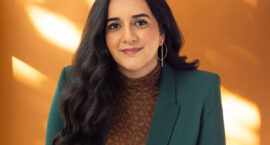
Therapist and founder of Brown Girl Therapy, Sahaj Kohli has spent years studying this phenomenon. Through a book, a podcast and a mental health community for bicultural and immigrant women, she’s helping these women understand “your voice doesn’t have to be angry or loud in order for it to be brave. It just has to be yours.”

As we celebrate Diwali—a festival that honors light’s triumph over darkness—it’s worth remembering that our voices are part of that light. Choosing to speak, even when it’s uncomfortable, is how we brighten the path for those who come after us.

Community Is as Important to the Fight for Democracy as Everything Else

It has been a hell of a week for gridlock in my hometown, New York City, as global leaders convene for the 80th United Nations General Assembly—where on Monday, President Donald Trump delivered an hour-long rant calling climate change a hoax and claiming to have personally ended seven wars in his first seven months in office.

It wasn’t all grievance and gloom. Monday also marked the 30th anniversary of the historic United Nations Fourth World Conference on Women in Beijing, where 189 nations adopted an ambitious “Platform for Action” to acknowledge and advance women’s rights. It was there that future Secretary of State Hillary Rodham Clinton famously pronounced “women’s rights are human rights.” For more about the anniversary, read this extraordinary report, released this week and co-authored by Contrarian contributor Jennifer Klein, “Beijing+30: A Roadmap for Women’s Rights for the Next Thirty Years.” It details the myriad ways regression on women’s freedom is also an early sign of weakened democracy and outlines critical priorities to advance women’s rights in the immediate future.

‘Dad Went to War’: The Radical Faith Behind the Minnesota Assassinations [Part 3 of 4]

When Minnesota police arrested 57-year-old Vance Boelter after a two-day manhunt, they uncovered notebooks filled with names and addresses of elected officials and abortion providers. The suspect, who authorities say stockpiled 48 firearms, had already gunned down two people and left others gravely wounded. His writings and sermons hint at extremist religious currents, including ties to the New Apostolic Reformation.

“Their vision is violent at the outset,” says Frederick Clarkson, a longtime researcher of Christian extremism.

Advocates warn that rhetoric casting abortion as a holy war is not fringe—it is increasingly mainstream within the movement, fueling both deadly plots and everyday harassment of patients and providers.