‘Liberation’ Playwright Bess Wohl on Theater as Resistance: ‘Theater Is Dialogue. Autocracy Is a Monologue.’

At the Feminist Majority Foundation (publisher of Ms.) Global Women’s Rights Awards on Nov. 18 in Los Angeles, FMF honored the team behind the Broadway smash hit Liberation: playwright Bess Wohl, director Whitney White and Lisa Cronin Wohl, an OG Ms. writer from the 1970s.

“Theater is made up of dialogue. Autocracy is a monologue. Theater is about community: We watch a play together. Autocracy seeks to isolate us. Theater is about curiosity: A good play asks a question. Autocracy is not interested in questions, only in control.

“So, thank you, because in honoring this play, you honor the role of dialogue, community and questions in creating social change.”

Finding My Fight Again: How Billie Jean King Lit My Fire—Twice

I’m tired. Maybe you are too.

I’ve been fighting for gender equality for over two decades—pushing against outdated norms, challenging industries that resist change and speaking up in rooms where I wasn’t always welcome. And while I’ve seen progress, the setbacks have a way of draining your spirit.

But last week, I felt a shift in my energy.

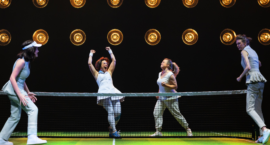
I saw Billie Jean, the new play about Billie Jean King, at the Chicago Shakespeare Theater. And just like that, something inside me reignited.

I’m writing thisn ot to share a story about a play, but to share a truth about persistence. The path to equality is long, winding and punishing. But it is also worth every step.

Artist Autumn Breon’s Requiem for Reproductive Freedom: Honoring Adriana Smith Through Performance

Autumn Breon is using performance and mixed media art to both celebrate Black women’s achievements and honor their struggles. Her latest performance, Dignity Denied, shines a light on the case of Adriana Smith.

“I wanted to show what lack of autonomy, what surveillance looks like, and durational performance felt like the best way to highlight her situation.”

“You might have a six-week abortion ban. You might have whatever other oppressive policies in place. We have always found ways to aid and abet each other, and we always will.”

‘Behind Every Ban Is a Body’: Idaho Activists Bring Abortion Truths to NYC Theater

On June 2, a new play, One Body: Dispatches from Idaho, brought the harrowing reality of Idaho’s abortion ban to the New York City stage. Performed at Theater 555 in midtown Manhattan, the one-woman show explores the devastating consequences of Idaho’s extreme abortion ban, drawing on over 30 interviews with women, doctors, lawmakers and activists.

“With One Body, we’re not just telling stories; we’re building infrastructure for change,” said Jen Jackson Quintano, an abortion activist and co-writer of the play. “By placing rural Idahoans’ experiences front and center—elevating stories too often silenced—we not only humanize the stakes of reproductive rights, we create a blueprint for community-centered activism that can travel anywhere.”

Organizers hope to spark momentum—and raise funds—for a nationwide tour and an off‑Broadway production of One Body in the future.

Weekend Reading on Women’s Representation: Honoring Stonewall’s Legacy; NYC Mayor Race Shows Benefits of Ranked-Choice Voting for Women

A compilation about women’s representation in politics, sports and entertainment, judicial offices and the private sector—with a little gardening mixed in!

This week:
— New York City Council Speaker Adrienne Adams is expected to qualify for public matching funds this week after a late surge in campaign donations, thanks to a surprising boost from a rival.
—progress made towards gender parity in international elections
—In South Korea’s June presidential election, young women played a pivotal role in electing Lee Jae-myung, leading one reporter to call it “the anti-anti-feminist election.”
—June is Pride Month, marking the anniversary of the 1969 Stonewall Uprising in New York City, a turning point in queer activism in the United States.

… and more.

‘We Need a Gentle Anger’: The Triangle’s Raging Grannies are Protesting Injustice through Music

Founded in Canada in the 1980s, the Raging Grannies have gaggles around North America—and plenty to sing about. 

Even in a crowd of thousands, they’re instantly recognizable by sight and sound: silver-haired women wearing colorful aprons and floppy hats, brandishing cardboard signs and sheafs of lyrics, singing acerbic protest songs set to cheerful nursery tunes.

Theater in the Time of Trump: Feminist Storytelling Against the Backdrop of Authoritarianism

The Trump administration’s assault on the John F. Kennedy Center for the Performing Arts continues, with another tranche of staff fired last Friday—employees in its government relations, marketing and social media departments. A prevailing question remains: What does the future of national public theater hold? Will the show(s) go on?

News of the latest job cuts overlapped with the one-year anniversary of opening night of the Broadway show Suffs. Its anniversary got me thinking about the vital role of feminist storytelling against the backdrop of authoritarianism. We know that in a robust democracy, live performance is not merely “nice to have” or an outlet for escape. The ideas to which we are exposed in the theater mean exponentially more: They are a measurement of our collective pulse, a gauge of our collective potential and a glimpse into how much farther forward we might propel (or fall).

With all that in mind, I headed off to Broadway to check out the shows I suspected might smack of such sensibility. With Tony nominations just one week away, here are recommendations for the hottest shows for which pro-democracy viewers can root.

Why Weren’t Women Allowed to Act in Shakespeare’s Plays?

Numerous English theatergoers considered seeing women on the public stage for the first time a pivotal moment.

The role of Desdemona, the devoted, loving wife murdered by her husband in Othello, wasn’t performed by a woman until 1660—about six decades after Shakespeare wrote the play. This is because when Shakespeare was writing for the early modern stage, young men and boys performed all the women’s parts.