


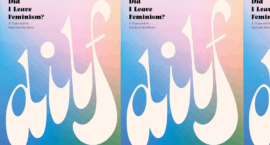
‘DILF (Did I Leave Feminism?)’ Is a New Transmasculine Manifesto

An excerpt from Jude Ellison S. Doyle’s new book, DILF (Did I Leave Feminism?), out Oct. 21:

Transmasculine people are one of feminism’s biggest blind spots. No one knows quite what to do with us, so it’s easier to pretend we’re not there. Books on “male feminism” or “feminist men” mostly teach men how to be allies to women’s struggle—the idea that there might be men who actually experience pregnancy, or abortion, or being cat-called or sexually harassed or pay-gapped or any of the other things we traditionally call “women’s issues” is not accounted for. Books on trans feminism understandably stress the importance of feminism for trans women—which is important, what with them being women and all—but do tend to reinforce the assumption that feminism is just for girls.

Meet Dr. Lincoln, the Internet’s Favorite OB-GYN

You may know—and love—Dr. Jennifer Lincoln already. If you are unfamiliar, she’s a board-certified OB-GYN and a famous content creator with 2.8 million followers on TikTok and large platforms on Instagram and YouTube. Dr. Lincoln is also a practicing OB-hospitalist who works in labor and delivery, night and day.

She makes content to dispel medical misinformation, a frequent tool of the patriarchy. As ‘MAHA’ influencers decry everything from birth control to Tylenol, at the expense of women, she’s pushing back with evidence-based information.

Like most Americans, I felt uninformed about sexual reproductive health, even after my in-school health classes. In high school, I searched YouTube for information about reproductive health, where I found my way to Dr. Lincoln, who not only provided the health class I never had, but also ignited my interest in reproductive justice. Without her influence, I likely would not have become a feminist writer at Ms.

Over Zoom, I had the privilege of chatting with Dr. Lincoln about her journey from OB-GYN to viral educator, how the post-Dobbs landscape has reshaped her work, and why she believes accurate, inclusive sex education is one of the most powerful tools we have for liberation. Our conversation spanned everything from social media strategy to Christian nationalism—and what it really means to fight misinformation with empathy.

Technical Difficulties: How Social Media Is Impacting the Landscape of Misinformation About Reproductive Health

There’s a lot of unreliable information circulating about birth control—and it’s doing real harm.

The Trump administration is mischaracterizing contraceptives as abortifacients and using that false claim to justify plans to destroy nearly $10 million worth of birth control. For now, the supplies sit in a Belgian warehouse, their fate uncertain.

Meanwhile, social media is flooded with misleading videos about hormonal contraception, watched billions of times. This wave of misinformation is helping drive a decline in contraceptive use among young women that can’t be explained by access alone.

We know from experience that accurate, engaging storytelling can counter these lies—shows like East Los High have proven it—and the same approach could transform TikTok and other short-form platforms.

‘Freedom Is Worth Struggle’: Bonnie Thornton Dill Accepts the University of Maryland’s Highest Honor

In her remarks accepting the University of Maryland’s highest honor, the President’s Medal, writer and anthropologist Bonnie Thornton Dill reflects on her decades of feminist scholarship and leadership:

“In these times, it might have been easier—or safer—to give this institution’s highest honor to some other deserving recipient. After all, much of my life’s work is under assault. Women’s and gender studies departments are being eliminated nationwide. Concepts that best express my scholarship have been targeted for censorship. Many of the books and sources that inform or cite my work have been banned. Continuing struggle and strategic action are essential if the ideals that I and so many others have championed are to be reestablished.”

“Our collective voices are most powerful in a community that nurtures the contributions of all members, harvests them to conduct our business collaboratively, and through that challenging process, creates bonds so strong they magnify our strength and the impact of our mission.”

Keeping Score: Trump’s Dangerous Claims About Tylenol; Government Shutdown Begins; Diddy’s Four-Year Sentence

In every issue of Ms., we track research on our progress in the fight for equality, catalogue can’t-miss quotes from feminist voices and keep tabs on the feminist movement’s many milestones. We’re Keeping Score online, too—in this biweekly roundup.

This week:
—Doctors push back against Trump’s dangerous claims that Tylenol in pregnancy increases the risk of autism.
—The U.S. entered a government shutdown, affecting millions of federal workers.
—Sean “Diddy” Combs was sentenced to four years in prison.
—Zoologist and anthropologist Jane Goodall died at age 91.
—University of California students and faculty are suing the Trump administration for violating free speech rights.
—Student activists are stepping up to get around birth control bans on campus.
—Louisiana admits non-citizens voting is not a systemic problem.
—The ACLU and religious freedom organizations are suing to block 14 more Texas school districts from implementing a law requiring classrooms to display Ten Commandments posters.

… and more.

Mary Beth Tinker Is Still Teaching the World How Kids Can Change It

Five students, including Mary Beth Tinker, were suspended from school in 1965 for wearing black armbands to support a Christmas truce in the Vietnam War and mourn the deaths of Vietnamese people and U.S. soldiers. Tinker was an eighth grader at the time. Represented by the ACLU, the students sued for freedom of speech after their suspension.

On Feb. 24, 1969, the Supreme Court reached a landmark ruling on student speech in Tinker v. Des Moines, cementing the precedent that students and teachers retain their First Amendment rights in public K-12 classrooms so long as they do not substantially disrupt education.

More than 50 years later, Mary Beth Tinker is still an activist for demilitarization, children’s rights, free speech, LGBTQ+ rights, environmental protection and transnational feminism.

From Veterans to Caregivers—The Importance of Expanding Remote Education for Women Worldwide

We need to continue normalizing and destigmatizing nontraditional remote learning opportunities as valid, accessible pathways toward women’s realization of their right to an education. 

This means expanding the number of hybrid and remote learning options available through well-established colleges and universities.

It means rethinking the types of technological adaptations deemed as “undue hardships” in the context of student disability.

It means investing in longitudinal research regarding best pedagogical practices—the impacts of evidence-based instructional interventions in the remote learning milieu—and in the professional development of online instructors in synchronous and asynchronous online programs to ensure impact. 

To do so is to ensure that those who fight to pursue their education in nontraditional ways are not shortchanged, but rather equipped with the social and intellectual capital needed to work against the existential threats of our time.

Vile Reactions to Strong Women Can’t Silence Our Voices

Being on the receiving end of yet another violent and targeted email from a stranger hit a little differently this week, as the nation grapples with the murder of Charlie Kirk and its fallout.

Mostly what I’m feeling since receiving an email from Robert G. Smith—who signs off as “Bonecrusher Bob”—is a deep sense of obligation to the girls and women in my life. In his message, he attacked me with grotesque language, mocking my intelligence, my sexuality and my writing on menopause, telling me to “stick to brainwashing the little insurrectionist bastards who attend [my] shithouse skool.”

Much of my work is about developing leaders—running a law school center and fellowship program, mentoring high school and college students to become public writers, and helping grassroots leaders use the op-ed as a tool for advocacy. My own writing shines a light on women’s health issues that have long been ignored, like menopause, highlighting not just problems but solutions lawmakers can get behind.

The Bonecrusher Bobs of the world will not deter me, and I see the same resilience in those around me.

Just this past weekend, a teenager I mentor asked how to handle an op-ed she’d drafted about aggressive masculinity at her school; my answer was simple: We keep raising our voices with conviction, exposing lies, and showing up fully as ourselves. And when necessary, yes, we share screenshots.

Facing Our Violent Histories: Teaching Empathy in a Divided World

One of my international conflict management students at Kennesaw State University recently approached me with a question: How can they be sure that they are not—like the “white theory” dudes they study—imposing their own worldview on the Global South communities they are researching?

As a woman of color from the Global South whose scholarship and practice centers around decolonial feminist peace, my response to my students and others who ask me: Your whiteness does not affect the good work you do; however, not understanding and fully accepting this whiteness as it informs your work probably does.

Decolonial feminism calls for critically reflecting on our own role in generating knowledge (aka conducting research) within the academy, as well as the changes that our scholarship hopes to effect in the real world. When applied to our everyday practice, such reflexivity can minimize the harm we sometimes inadvertently inflict on vulnerable communities and violence-affected people.