

Keeping Score: 137 Women Are Killed by Partners or Family Per Day; Bipartisan Push for Epstein Files; Trans Day of Remembrance and Native Women’s Equal Pay Day

In every issue of Ms., we track research on our progress in the fight for equality, catalogue can’t-miss quotes from feminist voices and keep tabs on the feminist movement’s many milestones. We’re Keeping Score online, too—in this biweekly roundup.

This week:
—137 women and girls are killed by intimate partners or family members every day.
—Congress votes overhwlemingly to force the Justice Department to release their Epstein files.
—Donald Trump snaps at women journalists: “Quiet, piggy” and “you are an obnoxious—a terrible, actually a terrible reporter.”
—Violence against trans women remains high.
—DACA recipients are being targeted and detained under the Trump administration.
—Higher-income college students often receive more financial support than they need, while low-income students struggle.
—Tierra Walker died from preeclampsia in Texas after being repeatedly denied an abortion.
—Viola Ford Fletcher died at age 111. She was the oldest living survivor of the 1921 Tulsa Race Massacre. 
—North Dakota’s total abortion ban was reinstated after the state’s Supreme Court reversed a temporary injunction from a lower court. There are now 13 states with total bans.

… and more.

Ms. Global: 300 Schoolchildren Kidnapped in Nigeria, Italian Parliament Recognizes Femicide and More

The U.S. ranks as the 19th most dangerous country for women, 11th in maternal mortality, 30th in closing the gender pay gap, 75th in women’s political representation, and painfully lacks paid family leave and equal access to health care. But Ms. has always understood: Feminist movements around the world hold answers to some of the U.S.’s most intractable problems. Ms. Global is taking note of feminists worldwide.

This week: News from Nigeria, Afghanistan, Japan and more.

Toward More Connected, Caring and Equitable Online Classrooms: Groundbreaking Anthology Advances Feminist Approaches to Remote Teaching

An exciting new anthology, Feminist Pedagogy for Teaching Online synthesizes decades of experience and pushes forward dynamic conversations about feminist pedagogy and remote learning, offering a meaningful and much-needed contribution to this area of research and teaching.

Overall, the collection strives to explore how online education can “align more thoughtfully with intersectional feminism and practices of social justice education.”

Feminist Pedagogy for Teaching Online, in print and as an electronic book, was preceded by the FeministsTeach.org website. The website went viral in August 2020 when large numbers of college professors were grappling with how to teach online. Two of the anthology’s coeditors compiled resources for colleagues at the Newcomb Institute at Tulane University for online teaching.

Six Ways Masculine Stereotypes Are Still Limiting Boys

Rigid norms of manhood—based in manly confidence and toughness, emotional stoicism, disdain for femininity and dog-eat-dog banter—are influential among boys and young men.

Between one quarter and one half of boys and young men endorse these norms. Over half feel pressure from others to live up to them, believing most people expect them always to be confident, strong and tough.

These are some of the findings from a new Australian survey of adolescents aged 14-18 years, conducted by The Men’s Project at Jesuit Social Services.

In a climate of heightened concern about boys and young men and violent masculinity, this study provides invaluable data on boys’ and young men’s own views. This includes the pressures they feel to live up to stereotypical masculine norms and the profound impact of those beliefs.

The Politics of ‘Audit’: How Texas Is Using Bureaucracy to Erase Gender Studies

Professor Melissa McCoul was dismissed in September after teaching LGBTQ+ themes in her children’s literature course at Texas A&M. Just this week, a faculty council determined McCoul’s firing violated her academic freedom.

But politicians and activists who oppose what they call “woke gender ideology,” are galvanized and doubling down, using this Texas A&M case to push for curricular reviews aimed at eliminating women’s, gender and sexuality studies from public colleges and universities across Texas.

Framed as bureaucratic oversight, conservatives seek to eliminate gender studies and related fields through procedural mechanisms that evade public scrutiny. The assaults on gender studies in Texas are not just a local issue; they are a national bellwether. They signal a coordinated effect to dismantle feminist and queer inquiry and remind us that silence, in the face of repression, is complicity.

Virginia Will Choose Its First Woman Governor in November’s High-Stakes Election

Over the next month into Election Day on Nov. 4, 2025, Virginia voters will decide not only the state’s next governor, but also control of the House of Delegates. The outcome will determine the direction of Virginia’s policies for years to come, and will send powerful signals about the nation’s political climate. 

The race is already historic. For the first time, both major party candidates for governor are women: former U.S. Rep. Abigail Spanberger (D) and Lt. Gov. Winsome Earle-Sears (R). Whoever wins will become the state’s first woman governor. 

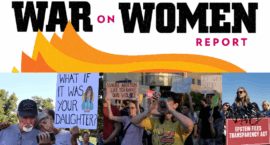
The War on Women Report: New Texas Law Targets Abortion Pills; More Planned Parenthoods Close Amid Federal Funding Cuts

MAGA Republicans are back in the White House, and Project 2025 is their guide—the right-wing plan to turn back the clock on women’s rights, remove abortion access, and force women into roles as wives and mothers in the “ideal, natural family structure.” We know an empowered female electorate is essential to democracy. That’s why day after day, we stay vigilant in our goals to dismantle patriarchy at every turn. We are watching, and we refuse to go back. This is the War on Women Report.

Since our last report:
—A judge in Missouri is currently deciding whether a proposed amendment that would ban abortion in the state’s constitution can appear on the 2026 ballot … even though Missourians voted just last fall to keep abortion legal in the state.
—The Trump administration announced in August that it would remove gender-affirming care from the health services offered to federal workers.
—Mississippi declared a public health emergency as the state’s infant mortality rate soars to a rate nearly double the national average.

… and more.

Recovery Saved My Life. It Can Also Save U.S. Democracy.

For many years, alcohol and other substances felt like the only thing that made me feel safe, seen and comfortable in my own skin. Growing up in a small Midwestern town, I never fit the mold of what a boy was “supposed” to be. I was bullied for how I dressed and looked, and called names when I showed emotion or vulnerability. The message was clear: Who I was wasn’t acceptable. Anxiety and depression followed, and by the time I discovered alcohol as a teenager, it felt like the only thing that made life bearable. But that relief was fleeting. My life spiraled into darkness—I failed out of college, lost relationships and, most painfully, felt like I was losing myself. Recovery gave me my life back. It reminded me that no matter how dark life becomes, there is always a way forward.

But recovery is not just a personal journey—it is a political one. When people recover, they become active participants in their communities. They vote, parent, work, study and volunteer. Recovery teaches us how to sit beside people who are different from us, offer a hand, and say: You got this, you are not alone. At a time when our democracy feels fractured and so many are isolated and hurting, recovery provides a roadmap for how we can heal together. It’s not only about saving individual lives—it’s about restoring the conditions that make democracy possible: connection, resilience and shared purpose.

***

The road to recovery—and the right to recovery—is essential to a free and fair democracy. This essay is part of a new multimedia collection exploring the intersections of addiction, recovery and gender justice. The Right to Recovery Is Essential to Democracy is a collaboration between Ms. and the O’Neill Institute for National and Global Health at Georgetown Law, in honor of National Recovery Month.

From Veterans to Caregivers—The Importance of Expanding Remote Education for Women Worldwide

We need to continue normalizing and destigmatizing nontraditional remote learning opportunities as valid, accessible pathways toward women’s realization of their right to an education. 

This means expanding the number of hybrid and remote learning options available through well-established colleges and universities.

It means rethinking the types of technological adaptations deemed as “undue hardships” in the context of student disability.

It means investing in longitudinal research regarding best pedagogical practices—the impacts of evidence-based instructional interventions in the remote learning milieu—and in the professional development of online instructors in synchronous and asynchronous online programs to ensure impact. 

To do so is to ensure that those who fight to pursue their education in nontraditional ways are not shortchanged, but rather equipped with the social and intellectual capital needed to work against the existential threats of our time.

Community Is as Important to the Fight for Democracy as Everything Else

It has been a hell of a week for gridlock in my hometown, New York City, as global leaders convene for the 80th United Nations General Assembly—where on Monday, President Donald Trump delivered an hour-long rant calling climate change a hoax and claiming to have personally ended seven wars in his first seven months in office.

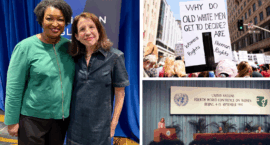
It wasn’t all grievance and gloom. Monday also marked the 30th anniversary of the historic United Nations Fourth World Conference on Women in Beijing, where 189 nations adopted an ambitious “Platform for Action” to acknowledge and advance women’s rights. It was there that future Secretary of State Hillary Rodham Clinton famously pronounced “women’s rights are human rights.” For more about the anniversary, read this extraordinary report, released this week and co-authored by Contrarian contributor Jennifer Klein, “Beijing+30: A Roadmap for Women’s Rights for the Next Thirty Years.” It details the myriad ways regression on women’s freedom is also an early sign of weakened democracy and outlines critical priorities to advance women’s rights in the immediate future.