Keeping Score: 137 Women Are Killed by Partners or Family Per Day; Bipartisan Push for Epstein Files; Trans Day of Remembrance and Native Women’s Equal Pay Day

In every issue of Ms., we track research on our progress in the fight for equality, catalogue can’t-miss quotes from feminist voices and keep tabs on the feminist movement’s many milestones. We’re Keeping Score online, too—in this biweekly roundup.

This week:
—137 women and girls are killed by intimate partners or family members every day.
—Congress votes overhwlemingly to force the Justice Department to release their Epstein files.
—Donald Trump snaps at women journalists: “Quiet, piggy” and “you are an obnoxious—a terrible, actually a terrible reporter.”
—Violence against trans women remains high.
—DACA recipients are being targeted and detained under the Trump administration.
—Higher-income college students often receive more financial support than they need, while low-income students struggle.
—Tierra Walker died from preeclampsia in Texas after being repeatedly denied an abortion.
—Viola Ford Fletcher died at age 111. She was the oldest living survivor of the 1921 Tulsa Race Massacre. 
—North Dakota’s total abortion ban was reinstated after the state’s Supreme Court reversed a temporary injunction from a lower court. There are now 13 states with total bans.

… and more.

The Ripple Effects of the U.S. Retreat from International Reproductive Care

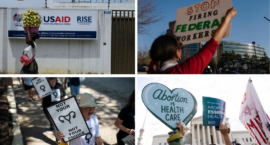
The U.S. withdrawal of international reproductive health funding is already having devastating effects around the world. Clinics are closing, health workers go unpaid, and essential medications and contraceptives sit unused in warehouses while millions of women and families lose access to life-saving care.

These abrupt cuts are not just administrative—they are a direct attack on decades of global health progress, putting children, pregnant women and marginalized communities at heightened risk of preventable disease, unintended pregnancy and death.

Yet there is still a path forward. The infrastructure to deliver reproductive and public health services remains in place, and health workers are ready to act. If funding is restored, we can prevent the worst outcomes, safeguard global health, and ensure that the fundamental human rights to health, life and bodily autonomy are protected.

The global community must act urgently to reverse the harm and prevent a full-scale public health and human rights crisis.

Keeping Score: Diddy’s Incomplete Conviction ‘Failed to Protect Survivors’; Inhumane Conditions in Alligator Alcatraz; What’s in the ‘Big Beautiful Bill’?

In every issue of Ms., we track research on our progress in the fight for equality, catalogue can’t-miss quotes from feminist voices and keep tabs on the feminist movement’s many milestones. We’re Keeping Score online, too—in this biweekly roundup.

This week:
—Trump’s reconciliation bill will prevent millions from accessing healthcare and food assistance.
—IWMF announced this year’s Courage in Journalism Awards.
—Many prison systems lack accommodations for pregnant inmates.
—Sean “Diddy” Combs found not guilty of sex trafficking.
—The Supreme Court’s decision on LGBTQ books in public schools lays the foundation for new assault on books of all kinds in schools.
—Rep. Maxwell Frost (D-Fla.) called out the hypocrisy of “pro-choice” members of Congress in a House Rules committee meeting: “They say they’re pro-life because they want the baby to be born, go to school and get shot in the school.”
—A group of actors including Jane Fonda and Rosario Dawson wrote a letter to Amazon, after allegations that the company has frequently refused to accommodate pregnant workers. 
—Mahmoud Khalil is suing the Trump administration for $20 million.
—July 10 was Black Women’s Equal Pay Day, marking when Black women’s earnings catch up to what white men earned in 2024.

… and more.

‘The Strong Do What They Please’: Dr. Judith Herman on Trump, Trauma and Tyranny

Feminist writers have long argued that there is an intrinsic relationship between patriarchy, rape and colonialism. The seizure of land by force is comparable to the seizure of a woman’s body—and historically rape and war have often gone hand-in-hand. 

In order to get a better understanding of how Donald Trump’s attitudes towards women might be related to his foreign policy, I reached out to Dr. Judith Herman, a world-renowned expert in trauma studies.

“The rules are pretty straightforward: The strong do what they please because they can. The weak submit because they have no other choice. And the bystanders are either complicit or too terrified to intervene, or just don’t care. These are the same rules whether we are talking about international relations or whether we’re talking about intimate personal relations.”

Keeping Score: Trump Threatens Students and Universities; Texas Midwife Arrested for Abortion Care; Americans Criticize Federal Worker Firings, ‘It’s Time to Fire Elon Musk’

In every issue of Ms., we track research on our progress in the fight for equality, catalogue can’t-miss quotes from feminist voices and keep tabs on the feminist movement’s many milestones. We’re Keeping Score online, too—in this biweekly roundup.

This week: Trump pulled university funding and arrested student leaders over pro-Palestine protests; a Texas midwife faces felony charges for providing abortion care; Congress members avoid town halls after Department of Education and other federal agencies were decimated; abortion bans threaten the lives of Black mothers; and more.

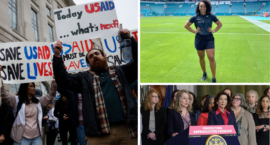
Keeping Score: Devastating Attacks on USAID; Louisiana Indicts N.Y. Doctor; Autumn Lockwood Is First Black Woman Coach to Win Super Bowl

In every issue of Ms., we track research on our progress in the fight for equality, catalogue can’t-miss quotes from feminist voices and keep tabs on the feminist movement’s many milestones. We’re Keeping Score online, too—in this biweekly roundup.

This week: Musk and Trump’s USAID attacks have devastating impacts; 80% of the clean energy investments from the 2022 Inflation Reduction Act—which Trump wants to roll back—are in Republican congressional districts; Louisiana indicts a New York doctor for prescribing abortion pills; new executive orders go after workers and LGBTQ people; the Laken Riley Act was signed into law; childcare costs affect the health of parents; and more.

Keeping Score: Trump’s Executive Orders Undo Progress; Meta Allows Hate Against Women and LGBTQ People; Abortion Ban States Are Losing Residents

In every issue of Ms., we track research on our progress in the fight for equality, catalogue can’t-miss quotes from feminist voices and keep tabs on the feminist movement’s many milestones. We’re Keeping Score online, too—in this biweekly roundup.

This week: Trump enacts harmful executive actions on immigration, global abortion care, DEI and foreign assistance; Trump’s new treasury secretary said expanding tax cuts for the wealthy is “the single most important economic issue of the day”; Trump pardoned anti-abortion extremists; ICE raids spread fear; 1.4 percent of trans teens participate in sports, but 40 percent are bullied at school; Whole Woman’s Health has expanded its 24/7 abortion care services; states hostile to abortion rights see challenges attracting and retaining workers; female firefighters will now receive federal compensation for treatment for reproductive cancers; remembering Cecile Richards, and more.

How Does AI Shape Global Relationships? The Ms. Q&A with Under Secretary for Public Diplomacy and Public Affairs Elizabeth Allen

AI implicates fundamental human rights such as privacy and individual freedoms; environmental concerns and natural resource distribution; governance and civic engagement and healthcare service delivery. 

Ms. sat down with former Under Secretary for Public Diplomacy and Public Affairs Elizabeth M. Allen to discuss the perils and promise of AI, and how the U.S. government is leading efforts fostering innovation while minimizing harms.

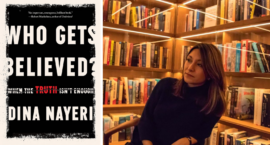
Telling the ‘Right’ Story: Dina Nayeri on Refugee Credibility

In her newest book, Who Gets Believed?, writer and refugee Dina Nayeri explores the role of credibility in seeking aid, from access to asylum to the criminal justice system. According to Nayeri, the most vulnerable (the uneducated, neurodivergent, etc.) are often deemed the least credible, because they don’t know how to tell the “right” story: the one that could save their life.

“We come at our most wretched moment to other people’s doors. And we should not have to be thinking about how we come across, or how we present right then.”