Keeping Score: 137 Women Are Killed by Partners or Family Per Day; Bipartisan Push for Epstein Files; Trans Day of Remembrance and Native Women’s Equal Pay Day

In every issue of Ms., we track research on our progress in the fight for equality, catalogue can’t-miss quotes from feminist voices and keep tabs on the feminist movement’s many milestones. We’re Keeping Score online, too—in this biweekly roundup.

This week:
—137 women and girls are killed by intimate partners or family members every day.
—Congress votes overhwlemingly to force the Justice Department to release their Epstein files.
—Donald Trump snaps at women journalists: “Quiet, piggy” and “you are an obnoxious—a terrible, actually a terrible reporter.”
—Violence against trans women remains high.
—DACA recipients are being targeted and detained under the Trump administration.
—Higher-income college students often receive more financial support than they need, while low-income students struggle.
—Tierra Walker died from preeclampsia in Texas after being repeatedly denied an abortion.
—Viola Ford Fletcher died at age 111. She was the oldest living survivor of the 1921 Tulsa Race Massacre. 
—North Dakota’s total abortion ban was reinstated after the state’s Supreme Court reversed a temporary injunction from a lower court. There are now 13 states with total bans.

… and more.

State Courts Hold the Power to Free Us Or Erase Us

While national headlines fixate on the U.S. Supreme Court, state courts shape nearly every part of our lives. From traffic violations and business disputes to child custody and criminal charges, an estimated 95 percent of all legal cases in the United States are handled in state courts. 

State courts decide whether you can access abortion care, whether your protest leads to jail time, whether you keep custody of your child and whether your gender identity is protected or punished.

Despite their vast power, state courts remain one of the most overlooked battlegrounds—and opportunities—in the fight for justice. As organizers, we’ve seen the cost of that neglect. Now we’re calling on progressive movements to treat state courts not as a footnote, but as a headline.

(This essay is part of a collection presented by Ms. and the Groundswell Fund highlighting the work of Groundswell partners advancing inclusive democracy.)

Doesn’t Gen Z Have the Right to Life? Young People Sue Trump Administration Over Climate Catastrophe as State-By-State Battle Continues

At least 137 people are dead after devastating flash-flooding in Texas in early July, including many children. As climate change induced disasters grow more common and the Trump administration rolls back environmental protections, several organizations are pursuing creative legal strategies to defend children’s fundamental right to a safe, healthy and stable natural environment.

On behalf of 22 young people, Our Children’s Trust filed Lighthiser v. Trump in May as part of its multi-case Youth v. Gov effort, asserting that three of the president’s pro-fossil fuel executive orders violate their constitutional rights to life, health and safety.

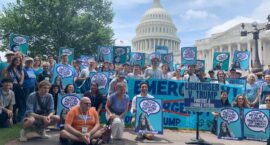
On July 16, hundreds gathered outside the U.S. Capitol to hear from Lighthiser plaintiffs and members of Congress at a press conference hosted by Our Children’s Trust and several organizational partners.

The same day, the Children’s Fundamental Rights to Life and a Stable Climate System resolution was introduced by Sen. Merkley (D-Oreg.) and Reps. Schakowsky (D-Ill.), Jayapal (D-Wash.) and Raskin (D-Md.). More than 50 additional senators and representatives joined the resolution as cosponsors.

Eva Lighthiser and Lander Busse were also plaintiffs in Held v. State of Montana, in which the Montana Supreme Court ruled that state law restricting consideration of climate change in environmental reviews violated youth plaintiffs’ right to a clean and healthful environment. The suit saw success largely because Montana has a Green Amendment—a constitutional amendment in the Bill of Rights section of the state Constitution explicitly declaring the legal right to a safe, healthy and stable natural environment for all people. Thus far, only Montana, Pennsylvania and New York have Green Amendments. The organization Green Amendments for the Generations (GAFTG) is working state-by-state alongside community partners to get new state-level Green Amendments passed.

‘I’m a Native Woman Before I’m Anything Else’: The Personal Is Political for New Mexico Senator Angel Charley

New Mexico state Sen. Angel Charley’s journey to elected office began with feminist organizing. Now she’s centering Indigenous women’s rights during a historic moment for gender representation in New Mexico politics.

“I’m a mom. I’m a daughter of parents that are getting older. I’m a wife and a partner, but I’m also an Indigenous woman. I’m a Native woman before I’m anything else in this world. … I’m constantly asking: How is this going to affect tribes, nations and pueblos? Have we consulted with them?”

Hear more from Charley and other feminists on the newest Ms. podcast, Looking Back, Moving Forward—the first episode is out now on Spotify, Apple Podcasts or wherever you get your podcasts.

From the Battle of Little Bighorn, to the Ballot Box: Native Resistance Then and Now

On June 25-26, 1876, a pivotal moment in Native history unfolded along the banks of the Little Bighorn River in present-day Montana: Lakota, Cheyenne and Arapaho warriors stood against Lieutenant Colonel George Armstrong Custer and the Seventh Cavalry of the U.S. Army to defend their way of life.

Today—nearly 150 years later—their same spirit of resistance and determination lives on … in legislative chambers, courtrooms and school board meetings. And while the battlegrounds may have changed, the stakes remain.

(This essay is part of a collection presented by Ms. and the Groundswell Fund.)

In Montana, Native Women Are Reshaping Politics and Reclaiming Civic Space

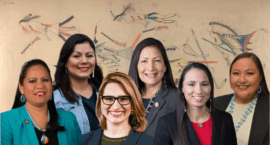
Amid political uncertainty, Native American women in Montana are leading social justice movements and shaping public policy. Historically marginalized in policymaking, Native voices are now gaining equitable representation at the state level, driving impactful change. In 2024, Montana had twelve Democratic Native legislators, including five women: Sen. Susan Webber, Rep. Jade Sooktis, Rep. Shelly Fyant, Sen. Jacinda Morigeau, and Rep. Thedis Crowe. These leaders advocate and take action, transforming Montana’s policy landscape and inspiring future generations.

(This essay is part of a collection presented by Ms. and the Groundswell Fund.)