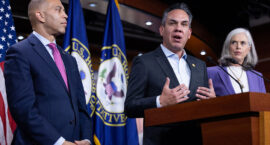
Congress Went on Recess. Americans Got Higher Healthcare Bills.

Congressional discussions on extending the Affordable Care Act (ACA) tax credits, which are set to expire Dec. 31, remain deadlocked as Congress begins its winter recess. Now, millions will see their premiums increase as a result: Payments will more than double on average—some even quadrupling—for enrollees who were eligible for the tax credits.

Without the extension, more and more ACA marketplace enrollees will drop their increasingly costly health insurance plans. This comes at a time when the ACA is more popular than ever—recent polls show that across the political spectrum, three quarters of voters support extending the tax credits.

Could the administration’s latest attack on transgender young people be the administration’s way of deflecting attention from the disaster unfolding in real time for millions of families in need of healthcare?  

Where ACA Premiums Could Spike Most in 2026 if Congress Lets Enhanced Tax Credits Expire

The Affordable Care Act (ACA) offers premium tax credits to help make health insurance more affordable. Under original Affordable Care Act provisions, an income cap for premium tax credits was set at 400 percent of the federal poverty level. Above that threshold, federal financial assistance was not available, creating a “subsidy cliff.”

Enhanced premium tax credits expire at the end of this year. Enrollees currently receiving premium tax credits at any level of income will see their federal assistance decrease or disappear if enhanced premium tax credits expire, with an average increase of 114 percent to what enrollees pay in premiums net of tax credits.

The impact will be greatest for those whose unsubsidized premiums are highest: older Marketplace enrollees and those living in higher-premium locales.

‘The Rent Eats First’: Rationing Expired Food in the Wealthiest Country in the World

Throughout the United States, the millions of families that rely on Supplemental Nutrition Assistance Program (SNAP) benefits—which make up 12.3 percent of Americans—have spent at least 10 days without them. The uncertainties about whether they will return, and when, has left families desperate. For many, the crisis has reinforced what they’ve long felt: The nation’s social safety programs are failing to meet real, everyday needs—and across Iowa, Michigan and Pennsylvania, Americans are growing disillusioned with politicians who can’t protect their most basic ones.

For many disabled Americans, losing SNAP also means losing the nutritional needs that help keep them out of the floundering U.S. healthcare system. They shared with Ms. a glimpse into what the past 10 days without SNAP have looked like, and what millions of Americans who rely on these programs actually need.

“If I lose benefits, am I going to be able to remain going to school?”

“They’re thinking about next week. Will they have food? Will they be hungry?”

“The problem is, the rent always eats first, or the house payment is going to eat first. After that? Are you going to [get your] medicine? No, we [have to pay] our utilities…. then you [think], ‘Okay, I’ve only got enough for either food or my medicine.’”

The War on Women Report: Government Shutdown Continues; Another Woman Denied Emergency Abortion Care; FDA Approves Generic Mifepristone

MAGA Republicans are back in the White House, and Project 2025 is their guide—the right-wing plan to turn back the clock on women’s rights, remove abortion access, and force women into roles as wives and mothers in the “ideal, natural family structure.” We know an empowered female electorate is essential to democracy. That’s why day after day, we stay vigilant in our goals to dismantle patriarchy at every turn. We are watching, and we refuse to go back. This is the War on Women Report.

Since our last report:
—Turning Point hosted an event at the University of Alabama advocating the death penalty as punishment for abortion patients.
—After being denied care for her ectopic pregnancy by an antiabortion OB-GYN, a 28-year-old woman in Illinois was forced to travel to multiple hospitals and healthcare centers before receiving life-saving care.
—Vocal abortion opponent Sen. Josh Hawley (R-Mo.) introduced the Prohibiting Abortion and Transgender Procedures on the Exchanges Act, seeking to halt any healthcare plans under the Affordable Care Act (ACA) from funding abortions, even in states that preserve abortion access. 
—The Texas Supreme Court has ruled that judges can decline to marry same-sex couples if doing so goes against their religious beliefs.

… and more.

Keeping Score: No Kings Protest Turnout Makes History; SCOTUS Threatens Voting Rights; Gen Z Women Are Most Liberal in U.S.

In every issue of Ms., we track research on our progress in the fight for equality, catalogue can’t-miss quotes from feminist voices and keep tabs on the feminist movement’s many milestones. We’re Keeping Score online, too—in this biweekly roundup.

This week:
—No Kings Day marks the largest single-day protest in American history.
—The ongoing government shutdown could soon disrupt SNAP benefits, another unprecedented moment in U.S. history. “We have never seen our government turn on its people this way,” said Abby Leibman, president and CEO of MAZON.
—House Democrats rebuke Pete Hegseth’s hostility towards women in the military.
—Speaker Mike Johnson refuses to swear in newly elected Democrat, Rep. Adelita Grijalva.
—Return-to-office policies are pushing women out of the workforce.
—Remembering legendary trans activist Miss Major Griffin-Gracy.
—The Supreme Court heard arguments challenging the Voting Rights Act.

… and more.

Millions Face Sharp Increases in ACA Premiums if Enhanced Tax Credits Expire

Affordable Care Act (ACA) enhanced premium tax credits—first introduced in 2021 and extended through 2025 by the Inflation Reduction Act—are set to expire at the end of this year. These tax credits have made Marketplace coverage far more affordable for millions of Americans, both by increasing financial assistance for low-income enrollees and by extending eligibility to many middle-income families for the first time. Since their introduction, enrollment in the ACA Marketplace has more than doubled—from about 11 million to over 24 million people.

If Congress allows the enhanced tax credits to expire, most Marketplace enrollees will face steep premium hikes. According to new analysis by KFF, the average enrollee’s annual premium payment would more than double—from $888 in 2025, to $1,904 in 2026. Some families would lose eligibility for any financial help at all.

A 60-year-old couple earning $85,000, for example, would see their premiums rise by over $22,600 next year—nearly a quarter of their income.

Without congressional action, millions could lose access to affordable coverage, threatening one of the ACA’s most significant achievements: making health insurance accessible to Americans across income levels.

This Manufactured Shutdown Threatens Healthcare and Reproductive Freedom

This is not governing—it’s sabotage, carried out at the expense of Americans’ health and freedoms.

In July, House Republicans created a healthcare crisis when they rammed through a budget that gutted Medicaid, defunded Planned Parenthood and put a target on the Affordable Care Act. Now, instead of fixing the mess they made, they’re steering us toward a government shutdown that will only compound the damage.

Americans across the political spectrum value these programs. Medicaid, Planned Parenthood and the ACA are lifelines in red states and blue states alike. People may disagree on politics, but they overwhelmingly agree that their families deserve access to affordable healthcare. That’s why the position to protect care and keep the government open is both the responsible path forward and the popular one.

Keeping Score: Trump’s Dangerous Claims About Tylenol; Government Shutdown Begins; Diddy’s Four-Year Sentence

In every issue of Ms., we track research on our progress in the fight for equality, catalogue can’t-miss quotes from feminist voices and keep tabs on the feminist movement’s many milestones. We’re Keeping Score online, too—in this biweekly roundup.

This week:
—Doctors push back against Trump’s dangerous claims that Tylenol in pregnancy increases the risk of autism.
—The U.S. entered a government shutdown, affecting millions of federal workers.
—Sean “Diddy” Combs was sentenced to four years in prison.
—Zoologist and anthropologist Jane Goodall died at age 91.
—University of California students and faculty are suing the Trump administration for violating free speech rights.
—Student activists are stepping up to get around birth control bans on campus.
—Louisiana admits non-citizens voting is not a systemic problem.
—The ACLU and religious freedom organizations are suing to block 14 more Texas school districts from implementing a law requiring classrooms to display Ten Commandments posters.

… and more.

How the Government Shutdown Is Hitting the Healthcare System—and What the Battle Over ACA Subsidies Means

Major rifts over key healthcare issues are at the heart of the federal government shutdown that began at the stroke of midnight on Oct. 1, 2025. Without a budget agreement in place, Trump ordered most federal agencies to wind down their nonessential activities. The shutdown will continue until Congress passes either a short-term or long-term funding bill and Trump signs it.

Government shutdowns are nothing new, but as a health policy expert, I worry this time around the impasse may have far-reaching effects on healthcare.