Cuts to Lifesaving Hunger Aid Could Impact Millions: ‘Our President and Congress Think Budget Cuts Will Help People Achieve Self-Sufficiency. They Won’t.’

When Crystal FitzSimons became president of the 55-year-old, Washington, D.C.-based Food Research and Action Center (FRAC) in May, she anticipated attacks on federal food and nutrition programs. But she calls what has unfolded unprecedented, and makes clear that unless Congress changes course and passes the Restoring Food Security for American Families and Farmers Act of 2025, millions of U.S. residents will lose some or all of the benefits they’re receiving through the Supplemental Nutrition Assistance Program, better known as SNAP.  

Other pending changes that FitzSimons is expecting will take the shape of denying SNAP to the few immigrants who were previously eligible for benefits, such as asylum seekers, refugees and international survivors of domestic violence.

“We are working at the state and federal levels and are collecting stories of different people who will be directly impacted by the cuts—the grandmother who relies on SNAP and helps watch her grandchildren while her daughter is at work; disabled people who use SNAP to support their independence; and older adults who are no longer able to work. We share their stories because we know that the real experiences of real people are critical in helping lawmakers and others understand who benefits from SNAP.”

“Every dollar spent on SNAP generates up to $1.80 in economic activity at the community level during economic downturns.”

Defunding and Refunding the Women’s Health Initiative: Why States Must Focus on Menopausal Women’s Health

The ongoing decimation of the federal funding landscape brings some good(ish) news for women: the role of state legislatures in stepping up to help improve and advance the health of menopausal women.

Thus far, 13 states—a record one in four—have introduced more than 20 bills focused on menopause care, proposing changes that could permanently reshape insurance coverage and educational and health care resources. Public officials in Michigan, Illinois and West Virginia announced support for menopause reforms. Michigan Gov. Gretchen Whitmer recently hosted a roundtable for leaders and a statewide listening tour. The latest slate of bills—introduced in red and blue states alike—would bolster workplace supports and dedicate resources to public education. The bills are being proposed at such a fast clip that menopause was named on a “Ones To Watch: Legislation Landscape for 2025” list.

Coretta Scott King’s Influence on the Civil Rights Movement: An Excerpt From ‘King of the North’

An excerpt from King of the North: Martin Luther King Jr.’s Life of Struggle Outside the South:

“Women have been the backbone of the whole civil rights movement,” Coretta Scott King stressed in a 1966 interview with New Lady magazine. The national media, like most politicians and pundits of the time, had trained the spotlight on the male leaders like her husband, missing the many women that had envisioned, led and organized the movements burgeoning around the country. They could not conceive of Coretta Scott King as Martin Luther King’s political partner. She later lamented how she was “made to sound like an attachment to a vacuum cleaner, the wife of Martin, then the widow of Martin, all of which I was proud to be. But I was never just a wife, nor a widow. I was always more than a label.”  

Thought-Provoking, Policy-Changing and Narrative-Shifting: Ms. Magazine’s 10 Most Impactful Print Articles of 2024

Ms. spurred thought-provoking, policy-changing, narrative-shifting change in 2024—and created new feminist strategies and solutions for the year ahead. In a word: “impact.” Ms. commissioned high profile analysis and investigative journalism by some of feminism’s best journalists and thinkers, focusing on key issues impacting women and girls at a critical moment across the globe. Here are the Ms. editors’ top 10 impact articles in the past year, as seen in the print magazine.

(Join the Ms. community today and you’ll get the issues delivered straight to your mailbox.)

What to Know About How Hurricanes and Voter Purges Are Affecting Early Voting

In less than a month, Hurricane Helene and Hurricane Milton have caused record storm surge and damage in multiple southeastern states, including Florida, North Carolina, Georgia and Tennessee. With Election Day just weeks away (and early voting starting much sooner), will the storms force voters away from the polls in the South?

Meanwhile, the hurricanes aren’t the only challenge facing would-be voters. Right now, voters in states from Texas to Ohio are facing the additional threat of racist voter purges. In the wake of Donald Trump’s baseless comments about migrants in Springfield, Ohio, third-party groups are attempting to challenge voter registration lists with unfounded claims that non-citizen immigrants are voting illegally.

Ohio Governor Vetoes Gender-Affirming Care Ban—Showing Republicans *Can* Respect Personal Medical Decisions

Ohio Gov. Mike DeWine is the first Republican governor to veto a ban on healthcare for transgender youth.

Politicians are not doctors and have no place intruding on decisions that go against the combined expertise of patient and provider. Laws banning abortion and essential healthcare for transgender people interfere with individual decisions about our health, bodies and our ability to control our futures.

Just When You Thought the Abortion Battle in Ohio Was Settled

After a resounding win for abortion rights in Ohio, one would hope that the issue had at last been put to rest in the state. But now, the city of Lebanon, Ohio, is debating whether or not to retain its status as a sanctuary city for the unborn. 

It’s all in service of anti-abortion activist Mark Lee Dickson’s vision: “outlawing abortion, one city at a time.”

The Republican Crusade Against Issue 1: Ohio’s Reproductive Freedom Amendment

In the face of a referendum that could add a right to reproductive freedom to the Ohio constitution, state Republicans have organized a campaign to confuse voters and undermine the democratic process.

As Ohioans United started collecting signatures to make sure the Reproductive Freedom Amendment would be on the ballot in November, state Republicans started plotting. They first tried to make it more difficult to pass referenda. Thankfully, Ohio voters showed up during an August special election to defeat the amendment—by a 14-point margin. Unfazed by the loss, state Republicans embarked on a crusade to push voters away from the Reproductive Freedom Amendment. 

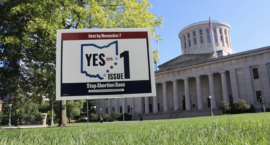
This November, Abortion Is on the Ballot in Ohio. Here’s What You Need to Know to Vote

This November, Ohioans will decide whether to add to the state’s constitution the right for individuals to make their own reproductive healthcare decisions, including abortion. Early voting in the election has already begun. 

A coalition of reproductive, women’s and civil rights organizations, Ohioans United for Reproductive Rights, is urging voters to vote YES on Issue 1 to protect reproductive freedom.

Ohioans, here’s all you need to know about how to vote in this election.