‘We Heard You’: Judge Addresses Victims After Handing Sean ‘Diddy’ Combs a Four-Year Sentence

A federal judge sentenced music mogul Sean “Diddy” Combs on Friday to 50 months in prison—just over four years—marking an end to a trial against one of the most influential names in entertainment. Combs must also pay a $500,000 fine.

“To Ms. Ventura and the other brave survivors that came forward, I want to say first: We heard you,” Judge Arun Subramanian said after he pronounced the sentence.

Trump and RFK’s Pseudoscience Is Another Tool to Control Women

We have reached the point in American politics at which a sitting U.S. president sees fit to decree pregnant women must “tough it out.”

We all would be wise to strenuously push back on junk science—not just for our safety here and now, but in service of a future that doesn’t create new inroads for punishment of pregnancy.

‘We Need Equal Rights in the Constitution’: NOW’s New Leaders Kim Villanueva and Rose Brunache See ‘a Lot of Energy for Advocacy’

Almost 60 years ago, in 1966, Pauli Murray, a queer Episcopal priest and legal scholar, approached noted feminist Betty Friedan about the need for an organization to push the Equal Employment Opportunity Commission to enforce the Civil Rights Act. Although the Act had passed in 1964 and banned discrimination based on race, color, national origin, sex, and religion, Murray understood that the law’s promise would remain unfulfilled without vigilance and pressure from activists. Friedan agreed, and later that year, the National Organization for Women (NOW) was created.

Newly-installed president Kim Villanueva—the former president of NOW’s Illinois chapter, cofounder of the Asian American and Pacific Islander Caucus and chair of the National Election Committee—and vice president Rose Brunache, former president of the DC chapter, spoke to Ms. reporter Eleanor J. Bader one month after taking office.

The Beijing Conference Was a Victory for Women’s Movements. It’s Time to Believe in Them Again.

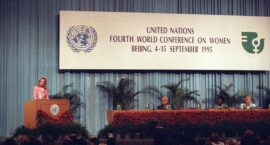
Thirty years ago this month, 45,000 women from around the world converged in Beijing and neighboring Huairou for the historic United Nations Fourth World Conference on Women. In today’s hyperconnected world, it’s easy to miss how groundbreaking the mere fact of this gathering was: The largest number of women at that point in history assembled to lobby the world’s governments for their rights. As Gertrude Mongella, the legendary Tanzanian leader who served as Secretary General of the conference, told the crowd: “The time has come for women to receive their rightful place in all societies and be recognized once and for all, that they are no more guests on this planet. This planet belongs to them too.” 

For funders, governments and individuals—including those gathered at the U.N. General Assembly this week—the message is clear. If you don’t already support and fund women’s movements, start. If you already fund them, stand by your investments, which pay dividends for all the issues you care about. And if you’re marking the Beijing anniversary, know that any progress made since then was no accident. 

The Push to Eliminate New York State’s Voluntary Intoxication Loophole: ‘You Should Be Allowed to Get Drunk and Not Be Taken Advantage Of’

Under current New York law, if someone was drinking by choice when they were assaulted, prosecutors can decide not to pursue the case. This law provides prosecutors with an out when it comes to sexual assault, and statistics show they take it. In 2019, prosecutors dropped nearly half of all sexual assault cases in the Manhattan district attorney’s office. A bill proposed in the state legislature is looking to make it harder for prosecutors to throw out sexual assault and rape cases by prohibiting the use of intoxication of the victim as a defense. 

Vile Reactions to Strong Women Can’t Silence Our Voices

Being on the receiving end of yet another violent and targeted email from a stranger hit a little differently this week, as the nation grapples with the murder of Charlie Kirk and its fallout.

Mostly what I’m feeling since receiving an email from Robert G. Smith—who signs off as “Bonecrusher Bob”—is a deep sense of obligation to the girls and women in my life. In his message, he attacked me with grotesque language, mocking my intelligence, my sexuality and my writing on menopause, telling me to “stick to brainwashing the little insurrectionist bastards who attend [my] shithouse skool.”

Much of my work is about developing leaders—running a law school center and fellowship program, mentoring high school and college students to become public writers, and helping grassroots leaders use the op-ed as a tool for advocacy. My own writing shines a light on women’s health issues that have long been ignored, like menopause, highlighting not just problems but solutions lawmakers can get behind.

The Bonecrusher Bobs of the world will not deter me, and I see the same resilience in those around me.

Just this past weekend, a teenager I mentor asked how to handle an op-ed she’d drafted about aggressive masculinity at her school; my answer was simple: We keep raising our voices with conviction, exposing lies, and showing up fully as ourselves. And when necessary, yes, we share screenshots.


Facing Our Violent Histories: Teaching Empathy in a Divided World

One of my international conflict management students at Kennesaw State University recently approached me with a question: How can they be sure that they are not—like the “white theory” dudes they study—imposing their own worldview on the Global South communities they are researching?

As a woman of color from the Global South whose scholarship and practice centers around decolonial feminist peace, my response to my students and others who ask me: Your whiteness does not affect the good work you do; however, not understanding and fully accepting this whiteness as it informs your work probably does.

Decolonial feminism calls for critically reflecting on our own role in generating knowledge (aka conducting research) within the academy, as well as the changes that our scholarship hopes to effect in the real world. When applied to our everyday practice, such reflexivity can minimize the harm we sometimes inadvertently inflict on vulnerable communities and violence-affected people.

The Long Shadow of Dr. George Tiller: Abortion Providers Under Attack [Part 2 of 4]

Julie Burkhart has spent decades on the frontlines of abortion care—from witnessing the “Summer of Mercy” blockades in Wichita to reopening a clinic after her mentor, Dr. George Tiller, was assassinated in 2009. In 2022, before she could open a new clinic in Wyoming, an arsonist burned it down. “It’s definitely more of an unsettling time,” Burkhart told Ms.

The threats extend beyond firebombs. In Pennsylvania this summer, antiabortion activists staged a Red Rose Rescue invasion, disrupting care with fake IDs, “holy water,” and “tickets to heaven.” Several participants had been pardoned by Trump months earlier. Advocates say such incidents show a growing pattern: emboldened extremists traveling across state lines to terrorize clinics.

Murder, Pardons and Impunity: How Antiabortion Violence Escalated Under Trump [Part 1 of 4]

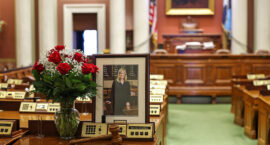
Her friend Melissa Hortman, a longtime Minnesota lawmaker, was murdered at home in June—shot by a man posing as a police officer who had also wounded two others and left behind a hit list of dozens of abortion-rights supporters. Among the names was Ruth Richardson, CEO of Planned Parenthood North Central States. “It was one thing to get a threat; it’s another to have confirmed threats where you have a friend and colleague who is assassinated,” she told Ms.

This tragedy unfolded against a backdrop of federal retreat: Trump pardoned extremists convicted of clinic blockades and violence, and his Justice Department declared it would largely stop enforcing the FACE Act, the law meant to protect providers. Advocates warn these decisions have emboldened extremists, leaving abortion providers more vulnerable than at any time in decades.

Whose Violence Is Taken Seriously Is Political

Weeks of shocking political violence has made one thing painfully clear: Whose suffering is taken seriously is deeply political. From the assassination of Charlie Kirk, to attacks on Democratic elected officials like Minnesota’s Melissa Hortman and her husband, the public and media response reveals a stark double standard.

While some deaths are weaponized to fuel extremism, others—like domestic violence victims, immigrants and marginalized communities—are routinely ignored.

This selective attention reflects the gendered and ideological framing of violence in the U.S. Today, more than ever, it’s crucial to recognize how political rhetoric and societal blind spots shape which acts of violence are acknowledged—and which are dismissed, leaving vulnerable populations at heightened risk.