Six Ways Masculine Stereotypes Are Still Limiting Boys

Rigid norms of manhood—based in manly confidence and toughness, emotional stoicism, disdain for femininity and dog-eat-dog banter—are influential among boys and young men.

Between one quarter and one half of boys and young men endorse these norms. Over half feel pressure from others to live up to them, believing most people expect them always to be confident, strong and tough.

These are some of the findings from a new Australian survey of adolescents aged 14-18 years, conducted by The Men’s Project at Jesuit Social Services.

In a climate of heightened concern about boys and young men and violent masculinity, this study provides invaluable data on boys’ and young men’s own views. This includes the pressures they feel to live up to stereotypical masculine norms and the profound impact of those beliefs.

Rest in Power: Jane Goodall, the Gentle Disrupter Whose Research on Chimpanzees Redefined What It Meant to Be Human

To the public, she was a world-renowned scientist and icon. To me, she was Jane—my inspiring mentor and friend.

Goodall spoke of animals as having emotions and cultures, and in the case of chimps, communities that were almost tribal. She also named the chimps she observed, an unheard-of practice at the time, garnering ridicule from scientists who had traditionally numbered their research subjects.

Goodall was persuasive, powerful and determined, and she often advised me not to succumb to people’s criticisms. Her path to groundbreaking discoveries did not involve stepping on people or elbowing competitors aside.

How the Take It Down Act Tackles Nonconsensual Deepfake Porn—And How it Falls Short

President Trump signed the Take It Down Act into law, a bipartisan bill that makes it a federal offense to share both real and digitally altered sexually explicit images of individuals online without their consent.

While the Take It Down Act offers a lifeline to victims of deepfake and revenge porn, critical blind spots, burdensome procedures, loopholes for offenders and a reactive framework threaten to undercut its promise.

Scientists Understood Physics of Climate Change in the 1800s—Thanks to a Woman Named Eunice Foote

Long before the current political divide over climate change, and even before the U.S. Civil War (1861-1865), an American scientist named Eunice Foote documented the underlying cause of today’s climate change crisis.

The year was 1856. Foote’s brief scientific paper was the first to describe the extraordinary power of carbon dioxide gas to absorb heat—the driving force of global warming.

Social Movements Constrained Trump in His First Term—More Than People Realize

As The New York Times noted not long ago, Trump “had not appeared to be swayed by protests, petitions, hashtag campaigns or other tools of mass dissent.” That’s a common perspective these days. But what if it’s wrong?

In fact, popular resistance in Trump’s first term accomplished more than many observers realize; it’s just that most wins happened outside the spotlight. In my view, the most visible tactics—petitions, hashtags, occasional marches in Washington—had less impact than the quieter work of organizing in communities and workplaces.

Understanding when movements succeeded during Trump’s first term is important for identifying how activists can effectively oppose Trump policy in his second administration.

Centuries After Christine de Pizan Wrote a Book Railing Against Misogyny, Taylor Swift Is Building Her Own ‘City of Ladies’

In her work, Taylor Swift has taken inspiration from women of the past, including actress Clara Bow, socialite Rebekah Harkness and her grandmother Marjorie Finlay, who was an opera singer.

But sometimes I wonder what the 34-year-old pop star would think of the life and work of Italian-born French writer Christine de Pizan.

Back in the 15th century, Christine—who scholars customarily refer to using her first name, because “de Pizan” simply reflects her place of birth, and she may not have had a last name—dealt with her share of “dads, Brads and Chads,” just as Swift has in the 21st century.

Caroline Herschel Was England’s First Female Professional Astronomer, but Still Lacks Name Recognition Two Centuries Later

Most people today haven’t heard of Caroline Herschel, the first English professional female astronomer. Despite having several astronomical objects—and even a satellite—named after her, she doesn’t have the same name recognition as the other astronomers of her time. Her story reflects not only the priorities of astronomy but also how credit is assigned in the field.

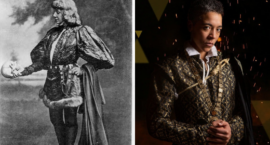
Why Weren’t Women Allowed to Act in Shakespeare’s Plays?

Numerous English theatergoers considered seeing women on the public stage for the first time a pivotal moment.

The role of Desdemona, the devoted, loving wife murdered by her husband in Othello, wasn’t performed by a woman until 1660—about six decades after Shakespeare wrote the play. This is because when Shakespeare was writing for the early modern stage, young men and boys performed all the women’s parts.

Emmy Noether Faced Sexism and Anti-Semitism. Over 100 Years Later, Her Contributions to Ring Theory Still Influence Modern Math

When Albert Einstein wrote an obituary for Emmy Noether in 1935, he described her as a “creative mathematical genius” who—despite “unselfish, significant work over a period of many years”—did not get the recognition she deserved.

Noether made groundbreaking contributions to mathematics at a time when women were barred from academia and when Jewish people like herself faced persecution in Nazi Germany, where she lived.

A Young Black Scientist Discovered a Pivotal Leprosy Treatment in the 1920s. An Older White Male Colleague Took the Credit.

Hansen’s disease, also called leprosy, is treatable today—and that’s partly thanks to a curious tree and the work of a pioneering young scientist Alice Ball in the 1920s. She laid fundamental groundwork for the first effective leprosy treatment globally. But her legacy still prompts conversations about the marginalization of women and people of color in science today.