Calling Foul: Breaking Down WNBA Pay and Why It Matters

There’s a long history of women in sport fighting for equal pay, and what’s happening with the WNBA today is less of a mirror of the current gender pay gap and more of a throwback to a time when women’s efforts were even more deeply devalued. The WNBA is a visible legacy of Title IX, and an indication of how far there is left to go. 

These are women at a pinnacle of professional achievement, who are still beholden to structural barriers. This is not a sports issue. It is a feminist issue.

This International Day of the Girl, ‘Doing Nothing Is Not an Acceptable Choice’

On Oct. 11, we celebrate International Day of the Girl, a global call to recognize girls’ rights and confront persistent inequality.

When hope wavers and progress stalls, I look for words that steady me. Recently, I found them in writer Roxane Gay’s powerful essay in The New York Times, “Civility Is a Fantasy,” where she writes: “As a writer, as a person, I do not know how to live and write and thrive in a world where working for decency and fairness and equality can be seen as incivility … I worry and I worry and I worry, and I feel helpless and angry and tired, but also recognize that doing nothing is not an acceptable choice.”

After reading Gay’s words, I reminded myself of the girl I am and the change I lead, and thought about the many girls who might be feeling that same helplessness right now—those watching rights roll back, hearing their worth debated or wondering if their voices still matter. So, on International Day of the Girl, this letter is for them. It’s a call for action.

Tradwives and ‘The People That People Come Out Of’

For the first time in years, the number of U.S. mothers with young children in the workforce is shrinking—over 212,000 women left between January and June 2025 alone.

Childcare costs, in-office pressures, and a cultural nudge toward traditional gender roles are pushing moms out, while men in power nod along.

Meanwhile, the tradwife movement parades its perfect, baked-from-scratch, filtered-life versions of domesticity online, making the impossible look effortless.

It’s absurd. It’s dangerous. And it’s time we stop letting the economy treat raising kids as invisible labor.

How Rising Prices and Policy Cuts Are Squeezing Moms and Families

Articles on tariffs, the labor market, and economic growth or decline often neglect to report how these policies are affecting real people’s ability to keep a roof over their head or put food on the table for their families each night.

When U.S. companies face higher costs for importing goods, those costs get passed directly to consumers, which means everyday goods—from diapers to carrots—become more expensive. Women, in particular, shoulder the brunt of these increased costs.

When we make sure moms and babies have what they need to thrive, we’re not just addressing today’s crises … we’re building tomorrow’s prosperity.

‘If You’re Not Centering the People Who Are Most Impacted, Your Policy Solution Will Fall Apart’: Gaylynn Burroughs Is Fighting for Economic Justice at the Intersections

Burroughs, the vice president of education and workplace justice at the National Women’s Law Center, connected the dots between poverty, policy and culture change in the latest episode of the Ms. Studios podcast Looking Back, Moving Forward. “Once you start seeing these problems as being problems that policy can solve,” she told me, “a whole world opens up.”

Listen to the latest episode of Looking Back, Moving Forward, “Women Can’t Afford to Wait for a Feminist Economic Future (with Premilla Nadasen, Rakeen Mabud and Lenore Palladino, Aisha Nyandoro, Gaylynn Burroughs, and Dolores Huerta)” on Spotify, Apple Podcasts or wherever you get your podcasts.

Poverty Is a Policy Choice—and Women Deserve More 

In the third episode of the Ms. Studios podcast Looking Back, Moving Forward, economists and advocates break down how our economy is leaving women behind and lay out strategies for advancing a feminist economic future.

“Poverty is the result of systems that have been intentionally put in place that the majority of us benefit from,” said Aisha Nyandoro, founding CEO of Springboard to Opportunities, home to the Magnolia Mother’s Trust guaranteed income program.

“So much of the conversation among economists and among policy people about infrastructure has always been about male-dominated infrastructure,” Lenore Palladino said. “We cannot rebuild our economy or build back better, as it were, with male-dominated sectors and not female-dominated sectors.”

“We have to continually ask: In whose interests are we fighting? Who will benefit from the work that I’m doing right now? Who should we put at the center of our organizing campaigns?” said Premilla Nadasen, labor and women’s historian.

The newest Ms. podcast, Looking Back, Moving Forward is out now on Spotify, Apple Podcasts or wherever you get your podcasts.


Now Streaming: New Film ‘Lilly’ Tells Transformative Story of Equal-Pay Hero Lilly Ledbetter

It’s tempting these dark days to dismiss the idea that any one person can make a difference. And yet, every day ordinary people fight injustice. And some days, those people persist long enough, resist long enough, that their fights rise to national prominence.

One such fight is chronicled in the new film Lilly, released in theaters this May and now available for rent. The brainchild of director Rachel Feldman, Lilly tells the story of Lilly Ledbetter, “an ordinary woman who became extraordinary,” in the words of Patricia Clarkson, who portrays her in the film.

Keeping Score: Americans Oppose Mass Deportations; Supreme Court Upholds Free Preventive Care Under ACA

In every issue of Ms., we track research on our progress in the fight for equality, catalogue can’t-miss quotes from feminist voices and keep tabs on the feminist movement’s many milestones. We’re Keeping Score online, too—in this biweekly roundup.

This week:
—marking three years since the Dobbs decision overturned Roe v. Wade
—”Deep cracks are showing in the Trump and Miller mass deportation agenda,” said Vanessa Cárdenas, executive director of America’s Voice.
—Rest in power, Minnesota Speaker Emerita Melissa Hortman and her husband Mark, who were assassinated in an act of political violence. “Political violence of any kind has no place in our democracy,” said Democratic Women’s Caucus chair Rep. Teresa Leger Fernández (D-N.M.).
—The Supreme Court upheld bans on gender-affirming care for minors.
—Harvey Weinstein was again convicted of a criminal sex act.
—raising awareness for LGBTQ Equal Pay Day
—82% of Democrats and 68% of Republicans believe funding for childcare should increase. 

… and more.

Why Democracy Needs Data—and What Happens When It Vanishes

In the first few months of Donald Trump’s return to the presidency, one thing has become crystal clear: The war on gender and racial equity is being waged in a new arena—on the battleground of data.

This fight isn’t waged with tweets or soundbites. It’s carried out through budget cuts, shuttered research programs and disappearing federal surveys. It’s a quiet but devastating assault on the tools we rely on to tell the truth—and to hold those in power accountable. And the message is chilling: If we can’t measure inequality, maybe we can pretend it doesn’t exist.

When race is stripped from maternal health reports, we overlook the crisis facing Black mothers. When LGBTQ+ identity is erased from youth surveys, we lose critical insight into mental health and safety. When disability status is omitted from labor market data, inequities in access and pay go unaddressed.

We need a renewed federal commitment to the research infrastructure that allows us to see and solve inequality—not ignore it.

Democratic Women in Congress Demand Treasury Address Gendered Impact of Trump Tariffs

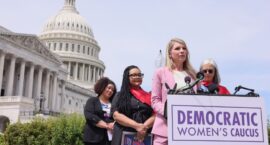
On Wednesday, June 18, the Democratic Women’s Caucus issued a letter to U.S. Treasury Secretary Scott Bessent urging the Treasury Department to analyze the impact the Trump administration’s tariff policies on women, and address financial inequities immediately, especially the ways escalated tariffs affect women-headed households.

The letter spearheaded by Reps. Brittany Pettersen (Colo.) and Lizzie Fletcher (Texas) highlights various gender-based tariffs—like those on apparel, for example, which make up about three-fourths of all U.S. tariff burdens and disproportionately cost women in the U.S. a collective $2 billion a year more than men.