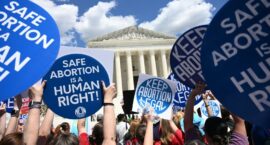
The Supreme Court Case That Could Shield Unregulated Pregnancy Clinics From Oversight

On Dec. 2, the U.S. Supreme Court heard oral arguments in First Choice Women’s Resource Centers v. Platkin, an unregulated pregnancy clinic’s constitutional challenge to the New Jersey attorney general’s subpoena for information about its operations, including donor records. 

Despite being awash in revenue, and serial reports of fraud, waste and illegal use of taxpayer funds, these antiabortion clinics are positioning to realize a long-term goal: to “replace” Planned Parenthood and Title X programs and secure federal taxpayer funds to advance an agenda that promotes childbirth and undermines evidence-based healthcare. 

As right-wing politicians decimate the reproductive health delivery system for low-income and uninsured Americans, the UPC industry is ramping up the narrative that their unregulated pregnancy clinics are the answer to the maternal healthcare deserts their policies have created. 

Most media observers are predicting the Court will rule for the crisis pregnancy center, First Choice. If it does, unregulated pregnancy clinics nationwide will be further emboldened to resist any state oversight, including of their medical services. A bold, innovative, multi-front action by reproductive justice advocates, public health professionals and pro-choice officials is the only way we ensure they can’t succeed. 

Novel ‘Truth Is’ Shows What It Really Takes for a Teen to Get an Abortion in 2025

Truth Is is a pro-choice novel in every sense of the phrase. Truth’s choice to move forward with an abortion is made early on in the novel and the majority of the book focuses on her life and her choices after her decision.

I hope that years from now, a student picks up this book and reads about the challenges that the book’s main character Truth faces and goes, “Is that really how it was back then?”

For adults who engage with Truth’s story, I want us to consider the limitations we sometimes unknowingly put on young people. I want us to consider the heights young people could reach if they were granted opportunities and community support, the way Truth ultimately does in the novel.

Dobbs Has Triggered Widespread Discrimination in Non-Reproductive Healthcare

In the years since Roe was overturned, physicians across a wide range of medical specialties have described how abortion bans are undermining their ability to follow evidence-based standards of care. Dermatologists, oncologists, neurologists, cardiologists and others told Physicians for Human Rights (PHR) that they are regularly forced to alter treatment plans, delay urgent care or avoid prescribing the most effective medications simply because those treatments could harm a pregnancy. These constraints are creating a chilling effect that reaches far beyond reproductive health and into the everyday practice of medicine.

As PHR’s Michele Heisler and Payal Shah explained, abortion bans are also fueling discriminatory care. Reproductive-age women are routinely denied the best available treatments, while men with the same conditions face no such barriers. Even within the group of reproductive-age women, clinicians are making decisions based on subjective judgments about a patient’s “contraceptive reliability”—a practice that opens the door to bias and disproportionately harms marginalized patients.

This two-tiered system of care is not hypothetical: It is already shaping medical decision-making in ban states, with dangerous consequences for patients’ health and lives.

Alliance Defending Freedom Succeeded in Overturning Roe. Now It’s Turning to the United Kingdom.

If you follow the fight over abortion access in the U.S., you’ve likely heard of the Alliance Defending Freedom (ADF). The powerful nonprofit was instrumental in Dobbs v. Jackson Women’s Health Organization, the Supreme Court case that overturned Roe v. Wade in 2022. ADF drafted model legislation used to defend Mississippi’s 15-week ban and has long championed policies targeting LGBTQ+ rights, contraception access and same-sex marriage.

Now, ADF is setting its sights across the Atlantic. The organization—which boasts operations in 112 countries—has been quietly expanding its influence in Britain through its new alliance with the right-wing Reform Party, led by populist figure Nigel Farage.

The Reform-ADF partnership is following a familiar playbook: reframing reproductive rights as a free-speech issue. ADF has backed efforts to challenge the Public Order Act of 2023, which established “safe access zones” around abortion clinics—150-meter perimeters designed to prevent harassment and obstruction. Despite broad public support for these zones (77 percent of Britons favor them), Farage and his allies have called the policy a “sinister crackdown on expression.”

“There is a clear pattern here of U.S.-funded antiabortion activists testing the limits of the new U.K. law, seemingly trying to find the most acceptable-looking behavior to gain public sympathy, and then using that to try to tear down the law,” said Karen Wright, public affairs manager for Humanists U.K. “It is deeply concerning to see efforts from outside groups attempting to influence domestic law, particularly when it comes to women’s reproductive freedom and bodily autonomy.”

New California Shield Law Protects Abortion Pill Patients, Prescribers and Pharmacists

California’s new shield law, AB 260, represents a bold reimagining of what it means to protect reproductive freedom in a post-Dobbs America. By allowing prescribers and pharmacies to omit identifying information from mifepristone labels—and by ensuring that confidential logs can’t be accessed by out-of-state authorities—the law does more than safeguard privacy. It dismantles the machinery of fear and surveillance that antiabortion extremists have built to track, intimidate and punish people for exercising bodily autonomy. In a nation where a single prescription can become evidence in a courtroom, California has declared: not here.

The legislation’s power lies in its refusal to accept intimidation as the cost of care. It shields patients, prescribers and pharmacists alike, and even mandates coverage of mifepristone regardless of the FDA’s shifting political winds. At its core, AB 260 is both a legal and moral statement—that access to abortion medication is not a privilege to be defended in court, but a right to be protected in law. For anyone navigating pregnancy in hostile states, California’s message carries weight and relief: You can seek care without fear that your name, your doctor’s name or your pharmacist’s name will be weaponized against you.

America Is an Increasingly Dangerous Place for Women and Girls 

In America’s hyper-macho, gun-drenched culture, growing up female has never been safe. But under the Trump administration, America is becoming a much more dangerous place for women and girls.

America is dangerous for women and girls because our leaders choose to make it so. The Trump administration has already begun blocking access to abortion and Medicaid coverage for reproductive health, as well as targeting the rights of pregnant people within the 2023 Pregnant Workers Fairness Act.

Already, the macho culture of the U.S. has steadily made women’s safety in the nation decline. Around 41 percent of women in the U.S. have experienced sexual violence, while a third of women reported severe assault by a husband or boyfriend. The normalization of gun violence and violent pornography have also run rampant across the country, making America more dangerous day by day.

Americans Oppose Criminalizing Abortion. Too Many Policymakers Aren’t Listening.

Since the Supreme Court decided on Dobbs v. Jackson and overturned Roe v. Wade in 2022, more than half of U.S. states have passed laws that dramatically restrict and criminalize abortion. These laws assign criminal penalties—including fines and prison time—not only to healthcare providers who provide abortions or write prescriptions for abortion pills, but in some cases, also to people who assist abortion seekers. Yet, a growing body of research suggests these punitive measures do not reflect the views of most Americans.

Texas’ Newest Abortion Restriction Tells Us What We Already Knew: It Was Never About States’ Rights

In a move that surprised no one, Texas Gov. Greg Abbott recently signed HB 7 into law, allowing private citizens to sue anyone who manufactures, distributes or mails abortion medication to Texas residents. But this law is more than just another restriction—it signals that Texas isn’t content to enforce its near-total abortion ban within state lines. With HB 7, the state is now targeting out-of-state actors, making clear that antiabortion lawmakers are determined to export their bans beyond Texas and reshape abortion access nationwide.

This tactic exposes the lie at the heart of the “states’ rights” argument that fueled the fight to overturn Roe v. Wade. The goal was never to return abortion policy to individual states; it was always to prevent access wherever abortion is legal. Post-Dobbs, patients have continued to travel or use telehealth to obtain care, and states like Texas are responding with aggressive measures—state “trafficking” laws and multi-state lawsuits—to block access across borders. HB 7 is just the latest example of how far antiabortion states will go to control abortion nationally.

In Upcoming Virginia, N.J. and Pennsylvania Elections, Women’s Votes Will Decide the Future of Reproductive Rights and Equality

All eyes will be on the elections this fall in Virginia, New Jersey, Pennsylvania and beyond. These contests are not just bellwethers for next year’s midterms—they’re critical tests of how far Americans will go to defend women’s rights and equality at the state and national levels.

Women’s votes will be decisive. Pollster Celinda Lake told Ms. that women “are our own voters, we make up our own minds.” That independence has shaped elections for decades, with women consistently leaning more Democratic than men. This fall—from Virginia’s history-making two-woman governor’s race, to Pennsylvania’s Supreme Court retention battles—reproductive rights and equality are squarely on the ballot.

The message is clear: State-level elections matter profoundly, especially for women. The Dobbs decision pushed abortion and gender equality battles back to the states, and now voters must decide who will stand up for their rights.

‘Dad Went to War’: The Radical Faith Behind the Minnesota Assassinations [Part 3 of 4]

When Minnesota police arrested 57-year-old Vance Boelter after a two-day manhunt, they uncovered notebooks filled with names and addresses of elected officials and abortion providers. The suspect, who authorities say stockpiled 48 firearms, had already gunned down two people and left others gravely wounded. His writings and sermons hint at extremist religious currents, including ties to the New Apostolic Reformation.

“Their vision is violent at the outset,” says Frederick Clarkson, a longtime researcher of Christian extremism.

Advocates warn that rhetoric casting abortion as a holy war is not fringe—it is increasingly mainstream within the movement, fueling both deadly plots and everyday harassment of patients and providers.