What the ‘Wicked’ Weight-Loss Discourse Gets Wrong

We can’t afford to look away from changing beauty norms in our society, and how they are fueling eating disorders. 

Jennifer Rollin, an eating disorder therapist based in Maryland, says, “What I hear from a lot of clients is that when they are trying to recover from their eating disorder in this society, it almost feels wrong, because ‘everyone around me is talking about Ozempic,’ and ‘all the celebrities are talking about their big amount of weight loss.’”

But while it can feel cathartic to criticize or distance ourselves from prominent women who seem to be conforming to dangerous beauty standards, that criticism is harmful and does not bring us any closer to addressing the problem.

Trump’s Silence on World AIDS Day Revives a New Lavender Scare

Last month, the State Department warned employees not to commemorate World AIDS Day through official work accounts, including social media, nor should they use government funds to mark Tuesday, Dec. 2, as World AIDS Day. The day came and went in a quiet, cold Washington, D.C., without the president marking what it represented—the more than 700,000 Americans who died from HIV/AIDS-related causes in the United States since 1981. 

If his intentions were unclear, Trump’s budget proposed ending all CDC HIV prevention programs this past June, and Congress continues to negotiate next year’s budget, proposing massive cuts to HIV programs. 

For many young people who never lost friends or family, there may be the misconception that the HIV/AIDS crisis of the 1980s was localized and small, but nearly 300,000 men who have sex with men have died from AIDS-related complications, with over 6,000 deaths in 2019 alone. To put this in perspective, this would be as if over half of Wyoming’s population disappeared, or if everyone in Pittsburgh, Penn., vanished overnight. 

Even Madonna criticized Trump’s move, posting on Instagram, “It’s one thing to order federal agents to refrain from commemorating this day, but to ask the general public to pretend it never happened is ridiculous, it’s absurd, it’s unthinkable. I bet he’s never watched his best friend die of AIDS, held their hand, and watched the blood drain from their face as they took their last breath at the age of 23.” 

Dying to Be Men: American Masculinity as Death Cult

Much as owing guns at home is most likely to injure or kill the people living with those guns than the supposed threats posed by home invaders, the violent discourse espoused by Charlie Kirk and many others has resulted in his murder in front of a crowd of thousands of students.

Kirk built his career on racism and misogyny, encouraging young Americans to the side of a fully radicalized and extremist Republican party that has abandoned any pretense of caring for Americans and instead has become a propaganda machine pathetically flaying to prove that they are all men.

I’m sorry for Charlie Kirk and all the other men like him that have been raised in this America and with these ideals of masculinity. I’m sorry that he decided to adopt this hateful ideology and to profit from it. And as the mother to a boy and a girl, my heart breaks for the America these children are growing up in. Here’s hoping we can save ourselves.

In the Fall Issue of Ms. Magazine: Abortion’s Foes Turn Deadly

The work of advocating for abortion rights has always been dangerous. But under the second Trump administration, which has enabled antiabortion lawmakers and vigilantes through policies and rhetoric, that danger has escalated dramatically, as state Rep. Melissa Hortman’s murder proves.

In our Fall issue, we delve into the motivations behind the shootings, and talk to the people who are trying to prevent further violence.

Here’s what else you’ll find in the Fall issue:

—a deep dive into how the Trump administration’s immigration policies are impacting families across the country—and advocates’ visions for a more just future.
—a visit to Syria’s “village of women,” which offers Kurdish women a refuge—one they’ll fight to protect.
—investigating how the Medicaid and SNAP cuts in the Republican budget bill will impact women and children.

You Must Have Your Baby, But Sorry, You Have No Insurance

Medicaid is a cornerstone of maternal healthcare, providing coverage for nearly two-thirds of women of reproductive age and financing 42 percent of all births in the United States, according to an analysis by KFF. That means almost half of all new parents—disproportionately low-income—depend on it for prenatal care, safe delivery and postpartum support.

Unfortunately, pregnant and postpartum people are at the center of the crisis created by the One Big Beautiful Bill—recently passed by both the House and Senate and signed into law by Donald Trump—which guts Medicaid by nearly $1 trillion over the next decade.

If clinics are shuttered, hospitals are closed and providers are stripped from Medicaid, what happens to people forced to carry pregnancies without care? They will face unmanaged labor, untreated postpartum depression, and dangerous complications alone.

In a nation that mandates childbirth but slashes access to care, the question isn’t whether outcomes will worsen. It’s how many will suffer—and how many won’t survive.

America’s Healthcare Crisis Is Coming for All Women

Less access to healthcare—either by cutting Medicaid benefits or discouraging doctors from practicing in restrictive states—will affect antiabortion and pro-abortion women equally.

This is about far more than abortion. There will be more maternal deaths. There will be more deaths from cervical and breast cancer. More women will die from complications of cardiovascular disease and diabetes. There will be more suffering from infertility, endometriosis and fibroids.

Does anyone in power care? We certainly do. And we better make sure our voices are heard. All of our lives depend on it.

An Open Letter to Rep. Kat Cammack From a Medical Doctor: It’s Abortion Bans That Make Doctors Afraid to Act, Not ‘the Radical Left’

No woman may escape the cruelty of the nebulous and varying restrictions on reproductive healthcare in the post-Roe world—as Rep. Kat Cammack (R-Fla.) discovered in May 2024 when faced with a life-threatening ectopic pregnancy shortly after Florida’s six-week abortion ban took effect. Concerned by the lack of clarity in the wording of the law on the limits of intervention in pregnant patients, doctors reportedly delayed administering intramuscular methotrexate to terminate the pregnancy, out of fear of prosecution.

I’m a doctor. In this chaotic landscape, where reproductive healthcare policy and medical reality appear woefully divorced, my colleagues and I don’t know what misstep could land us in senseless litigation or with felony charges.

Rep. Cammack, your voice and your story have power. I hope you use them to reintroduce nuance and common sense to the discussion on women’s lives. There are many of us who will extend a hand across the aisle and work together with you to right some of the senseless wrongs. 

Weekend Reading on Women’s Representation: Elected Leaders Should Be Able to Serve Without Fear; Honoring Opal Lee, Grandmother of Juneteenth

Weekend Reading for Women’s Representation is a compilation of stories about women’s representation. 

This week:
—new research on the importance of women’s leadership
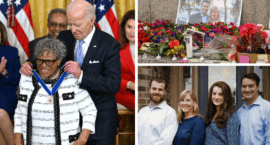
—how Opal Lee became known as the Grandmother of Juneteenth
—No matter who wins the race, Virginia’s next governor will be the first woman to ever hold the office.

… and more.

Rest in Power, Melissa Hortman—The Kind of Leader Patriarchy Fears

“I’m not sorry. … I’m really tired of watching women of color in particular being ignored.”

Over the weekend, the feminist movement lost a lion. Melissa Hortman, former speaker of the Minnesota House and longtime champion of reproductive justice, climate action and racial equity, was senselessly gunned down in a targeted attack at her home. Her husband, Mark, was also killed. 

Kelly Dittmar, a political science professor at Rutgers University-Camden and the director of research at the Center for American Women and Politics, shared on social media a powerful speech Hortman gave eight years ago, when she was the minority leader, on the House floor about the power of women’s voices. In it, she interrupted and called out white male legislators during a key debate—and when asked to apologize for her candor, she didn’t flinch.

As Antiabortion Violence Surges, Republicans Vote to Strip Federal Protections for Providers

Early Saturday morning, news broke of the assassination of Melissa Hortman, a Democratic Minnesota state legislator and former speaker, along with her husband Mark. State Senator John Hoffman and his wife Yvette were also shot multiple times; both survived and are fighting for their lives following emergency surgery. The suspect had a list of more than 50 additional “targets,” including other Democratic officials, some from outside Minnesota, as well as abortion facilities and leading abortion rights advocates in the state.

Although we don’t yet know if his extremist views on abortion were the driving cause in his murderous rampage, it is proof of the ongoing threats to abortion providers in this climate of escalating political violence.

Yet, just weeks after the suicide bombing of a Palm Springs fertility clinic, and despite rising rates of threats and violence against abortion clinics after the Dobbs decision, Republicans on the House Judiciary Committee unanimously voted to advance HR 589, the FACE Act Repeal Act of 2025. The bill would repeal the federal Freedom of Access to Clinic Entrances Act, a statute protecting clinicians’ and patients’ right to safely provide and access reproductive healthcare. All Democrats on the committee voted against the proposed bill.