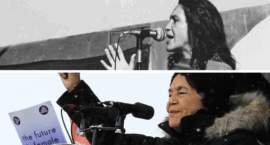
The Promise of the Equal Rights Amendment Is More Urgent Than Ever

In the fifth episode of Looking Back, Moving Forward, advocates and experts reflect on more than 50 years of activism to ratify the ERA—and the power that would come from women’s constitutional equality to redefine our democracy, protect our fundamental rights and change the stories of women’s lives.

Listen to the latest episode of Looking Back, Moving Forward, “The Feminist Fight For The Equal Rights Amendment Is Far From Over—and More Urgent Than Ever (with Pat Spearman, Ellie Smeal, Carol Moseley Braun, Kathy Spillar, and Ting Ting Cheng)” on Spotify, Apple Podcasts or wherever you get your podcasts.
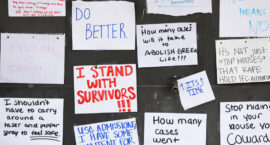
‘A Patriarchal, Male-Dominated, Use-of-Violence Society Is Not Good for Anybody’: Ellen Sweet on the Historic Ms. Study of Campus Rape, 40 Years Later

The former senior editor and writer for Ms. coordinated what became the first-ever national survey of campus sexual violence. In the latest episode of Looking Back, Moving Forward, Sweet assesses what she learned from the study about rape, activism, and backlash—and what has and hasn’t changed since it was published.

Listen to the latest episode of Looking Back, Moving Forward, “How Feminists are Breaking the Cycle of Gender-Based Violence and Harassment (with Ellen Sweet, Jane Caputi, Vanessa Tyson, Victoria Nourse, and Debra Katz)” on Spotify, Apple Podcasts or wherever you get your podcasts.

The 19th Amendment, Explained

It took more than a century of fighting by generations of activists to achieve suffrage for all American women.

The 19th Amendment to the U.S. Constitution reads, “The right of citizens of the United States to vote shall not be denied or abridged by the United States or by any State on account of sex.” The amendment granting women the right to vote was enacted at the start of the Roaring Twenties, decades after a prolonged and meandering fight for enfranchisement. 

The 19th Amendment codified women’s suffrage nationwide, but long before its ratification, unmarried women who owned property in New Jersey could and did cast ballots between 1776 and 1807. Beginning in 1869, women in Western territories won the right to vote. And in the decade leading up to the 19th Amendment’s passage, 23 states granted women full or partial voting rights through a series of successful campaigns.

Remembering the Mother’s Letter That Secured the 19th Amendment

Weekend Reading for Women’s Representation is a compilation of stories about women’s representation in politics, sports and entertainment, judicial offices and the private sector—with a little gardening mixed in! 

This week:
“Dear Son … Hurray and vote for Suffrage and don’t keep them in doubt.” On Aug. 18, 1920, Tennessee became the 36th state to ratify the 19th Amendment when young legislator, Harry Burn, followed the advice of his mother, Febb Burn, and cast the decisive vote in favor. Febb—a college-educated widow who read three newspapers a day and strongly felt her mind was the equal of any man’s—had long impressed upon her son the importance of suffrage.
—California women are far more likely than men to be “energy burdened,” spending more than 6 percent of their income on home energy costs, including utilities for heating, cooling and power.
—RepresentWomen’s 2025 Gender Parity Index (GPI) offers encouraging news: Women’s political power in the United States is reaching new heights, with states like New Hampshire, Oregon and Maine achieving gender parity for the first time in history. But the United States still has a way to go, ranking 77th globally in women’s representation, but more importantly, it lags behind nearly all its major democratic allies.
—Economic struggle, especially among women, is profoundly shaping the political moment heading into 2026. Understanding the significance for female voters is not merely a political embellishment; it is fundamental to securing electoral victories in the midterm elections and effecting meaningful change.

… and more.

In the Ms. Archive: Does Feminism Have a Problem With Femininity?

Femininity has long been the elephant in the room of feminism.

On the one hand, femininity doesn’t just name what it means, culturally, to be a woman—femininity lies at the heart of many women’s own sense of self. And yet, feminists identify femininity as a source of oppression, a straight-jacket imposed on women to keep us in our place.

Victoria Nourse Helped Write the Violence Against Women Act. She Knows Policy Change Matters in the Struggle to End Gender-Based Violence.

On the latest episode of Looking Back, Moving Forward, the Georgetown Law professor and vice chair of the U.S. Commission on Civil Rights reflected on how VAWA has shifted culture when it comes to gender-based violence—and what tools activists can use now to continue the work.

“No one would’ve thought someone like me would’ve been able to do the kinds of things I’ve done. My older sisters didn’t have the opportunities I have … but the world opened up. Things can change quite quickly in politics.”

“There’s just many, many reasons why ERA is something not to let go of. … They never really say women are unequal. They believe women are equal, but they say, ‘Oh, but transgender,’ ‘Oh, but something else,’ and so, they divide us. It’s really important for all of us to be united because Congress can change the deadline [in the preamble of the ERA].”

Listen to the latest episode of Looking Back, Moving Forward, “How Feminists are Breaking the Cycle of Gender-Based Violence and Harassment (with Ellen Sweet, Jane Caputi, Vanessa Tyson, Victoria Nourse, and Debra Katz)” on Spotify, Apple Podcasts or wherever you get your podcasts.

‘In Whose Interests Are We Fighting?’ What Historian Premilla Nadasen Learned About Economic Justice from the Domestic Workers’ Rights Movement

Nadasen, who teaches history at Barnard College, offered lessons from the domestic workers’ movement for the current moment in the latest episode of Looking Back, Moving Forward. “We, as feminists today, like domestic workers in the 1970s and in the early 2000s,” she told me, “need to think outside the box.”

Listen to the latest episode of Looking Back, Moving Forward, “Women Can’t Afford to Wait for a Feminist Economic Future (with Premilla Nadasen, Rakeen Mabud and Lenore Palladino, Aisha Nyandoro, Gaylynn Burroughs, and Dolores Huerta)” on Spotify, Apple Podcasts or wherever you get your podcasts.

Why Dolores Huerta Is Hopeful About the Fight for a Feminist Future: ‘We’re Going to Be Able to Overcome’

Dolores Huerta has spent 70 years at the frontlines of the intertwined fights for economic justice and women’s rights. Huerta has pioneered campaigns to expand political representation for women and people of color; advance policies that improve the lives of women, LGBTQ+ folks, farmworkers, communities of color, and the poor; and spark dialogue around the intersectional fight for economic justice, and the ways it is intertwined with our democracy.

“This is a very, very scary time—and god knows it’s a time for women to rise up!” Huerta told Ms.

Listen to the latest episode of Looking Back, Moving Forward, “Women Can’t Afford to Wait for a Feminist Economic Future (with Premilla Nadasen, Rakeen Mabud and Lenore Palladino, Aisha Nyandoro, Gaylynn Burroughs, and Dolores Huerta)” on Spotify, Apple Podcasts or wherever you get your podcasts.

The Purse Is More Than a Fashion Statement. It’s a Historical and Social Signifier.

Americans have long used items of apparel such as hats and shoes to express aspirations, amplify differences and alleviate anxieties, but only the purse—with its cavernous, pocketed interior—has also provided marginalized people with much-needed space, privacy and power.

The Things She Carried: A Cultural History of the Purse—out Aug. 4—examines how a variety of bags and purses became meaningful for Americans often ignored in studies of fashion and whose possessions are largely left out of museum artifact collections. It asks how one seemingly ordinary object became so ubiquitous, unpacking how and why it became almost exclusively linked to women.

Poverty Is a Policy Choice—and Women Deserve More 

In the third episode of the Ms. Studios podcast Looking Back, Moving Forward, economists and advocates break down how our economy is leaving women behind and lay out strategies for advancing a feminist economic future.

“Poverty is the result of systems that have been intentionally put in place that the majority of us benefit from,” said Aisha Nyandoro, founding CEO of Springboard to Opportunities, home to the Magnolia Mother’s Trust guaranteed income program.

“So much of the conversation among economists and among policy people about infrastructure has always been about male-dominated infrastructure,” Lenore Palladino said. “We cannot rebuild our economy or build back better, as it were, with male-dominated sectors and not female-dominated sectors.”

“We have to continually ask: In whose interests are we fighting? Who will benefit from the work that I’m doing right now? Who should we put at the center of our organizing campaigns?” said Premilla Nadasen, labor and women’s historian.

The newest Ms. podcast, Looking Back, Moving Forward is out now on Spotify, Apple Podcasts or wherever you get your podcasts.