

Russia Was Once a Revolutionary Feminist Motherland

Russia’s hostility to feminism today stems not from its foreignness, but from memory. A century ago, it was Russian women who lit the first sparks of revolution. On International Women’s Day in 1917, factory workers filled the streets of Petrograd demanding bread, peace and equality—an uprising that toppled the Romanovs and pulled the world into modernity. Under the Bolsheviks, women won the right to vote, divorce became accessible and abortion was legalized. For a brief, radical moment, the Soviet experiment made women’s liberation a pillar of the state.

Julia Ioffe’s book, Motherland: A Feminist History of Modern Russia, from Revolution to Autocracy, reminds us that today’s Russia rejects feminism precisely because it once knew what it could do: ignite revolutions, upend hierarchies and reimagine power itself.

Who Gets to Procreate and Parent? A Black Feminist Critique of the Pronatalist Agenda

Pronatalism is not simply about encouraging births—it is a political project rooted in racism and control. Its goal is to engineer a future that permits only certain people to bear and raise children while coercing or punishing others for reproducing or parenting.

Adriana Smith’s experience of coerced reproduction is a devastating example: a Black nurse and mother declared brain-dead, yet kept on life support for months to sustain her pregnancy under Georgia’s restrictive abortion laws. This is what pronatalism looks like in practice—the state asserting ownership over a Black woman’s body.

As Black feminists, we understand that reproductive choices are personal, but they are also deeply shaped by structural power. Pronatalist leaders and influencers cloak their agenda in the language of family and morality, but in truth, they seek to restrict autonomy and consolidate control. Reproductive justice, by contrast, insists on every person’s right to decide whether and how to have children, and to parent in safety and dignity.

After the War: Author and Aid Worker Claudia Krich Challenges the Myths of Vietnam

American humanitarian worker Claudia Krich—co-director of the American Friends Service Committee medical relief program from 1973 to 1975—was one of only a handful of Americans who stayed in Vietnam past April, 30, 1975, after the war ended. (She and her husband finally left in July 1975.)

Fifty years later, in April, Krich published her full journal from those months in Vietnam. Those Who Stayed: A Vietnam Diary, now available from the University of Virginia Press, combines Krich’s 1975 diary—including sections originally published in Ms.‘ July 1976 print issue—with extra historical content and some first-person accounts by people mentioned in or relevant to the book.

To celebrate the book’s release earlier this year, Claudia Krich communicated with Ms. about her book and her experiences as an American woman living and working in Vietnam during this historic moment.

“People think the war was North versus South, but that’s not true. … I hope my book motivates more people to travel, to take risks, to be outspoken, to record what they experience.”

Grief, Power and the Ongoing Fight for Women’s Rights

From daily violence to decisions over their bodies, women’s suffering is ignored and their losses go largely ungrieved—a reflection of a culture that shapes which rights are protected and whose lives are mourned.

The newly released Beijing report warns that progress is not guaranteed, and regression is already underway. This anniversary must be more than a commemoration; it must be a recommitment. As Hillary Clinton cautions: “This is an all-hands-on-deck moment for women across the world who have benefited from the changes in the laws, regulations, and norms over the last 30 years to realize that there are strong forces at work to try and turn the clocks back.”

The clock will not be turned back—not if we raise our voices, grieve loudly for women and refuse silence.

‘We Need Equal Rights in the Constitution’: NOW’s New Leaders Kim Villanueva and Rose Brunache See ‘a Lot of Energy for Advocacy’

Almost 60 years ago, in 1966, Pauli Murray, a queer Episcopal priest and legal scholar, approached noted feminist Betty Friedan about the need for an organization to push the Equal Employment Opportunity Commission to enforce the Civil Rights Act. Although the Act had passed in 1964 and banned discrimination based on race, color, national origin, sex, and religion, Murray understood that the law’s promise would remain unfulfilled without vigilance and pressure from activists. Friedan agreed, and later that year, the National Organization for Women (NOW) was created.

Newly-installed president Kim Villanueva—the former president of NOW’s Illinois chapter, cofounder of the Asian American and Pacific Islander Caucus and chair of the National Election Committee—and vice president Rose Brunache, former president of the DC chapter, spoke to Ms. reporter Eleanor J. Bader one month after taking office.

Mary Beth Tinker Is Still Teaching the World How Kids Can Change It

Five students, including Mary Beth Tinker, were suspended from school in 1965 for wearing black armbands to support a Christmas truce in the Vietnam War and mourn the deaths of Vietnamese people and U.S. soldiers. Tinker was an eighth grader at the time. Represented by the ACLU, the students sued for freedom of speech after their suspension.

On Feb. 24, 1969, the Supreme Court reached a landmark ruling on student speech in Tinker v. Des Moines, cementing the precedent that students and teachers retain their First Amendment rights in public K-12 classrooms so long as they do not substantially disrupt education.

More than 50 years later, Mary Beth Tinker is still an activist for demilitarization, children’s rights, free speech, LGBTQ+ rights, environmental protection and transnational feminism.

A Message From the Life of Urvashi Vaid: Do Not Remain Silent

When the 18-minute documentary There Are Things To premiered in Provincetown, Mass., in 2023, it was never meant to be a global statement. It was meant to be a love letter, a short community film about a long legacy. But like the woman it honors— activist Urvashi Vaid—it refused to stay small.

And how could it? We are living through a time when naturalized citizens are being threatened with denaturalization, children are being separated from their parents during immigration raids, people are crossing state lines just to access basic reproductive healthcare, and pregnant women who desperately want children are dying in homes and hospitals or on their way to seek medical care because doctors delay or deny treatment under strict abortion laws. These are not fringe headlines—they are daily realities in one of the most powerful nations in the world.

Against this backdrop, There Are Things to Do (now available for streaming on PBS) arrives like a gentle ambush. Its power is subtle, but the provocation is clear: What if the most radical thing an immigrant could do in America is not assimilate, but organize?

Twenty-Five Years of Mifepristone: How Activists Brought the Abortion Pill to America and Changed Reproductive Health Forever

At the urging of antiabortion advocates and politicians, and based on a flawed and biased report put out by an antiabortion group, the Trump administration announced the launch of a new review of mifepristone—despite 100 peer-reviewed scientific studies proving the safety and efficacy of these medications and safe use by over 7.5 million U.S. women.

On the 25th anniversary of FDA approval of mifepristone, reproductive rights supporters are celebrating the creative, determined and courageous advocates who brought this medication to market.

One organization that played a critical role in bringing mifepristone, known as RU-486, to the United States was the Feminist Majority Foundation (FMF)—today the publisher of Ms.

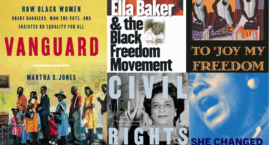
Five Best Books on Black Women’s Political Leadership

While writing my new book about the contributions Black women have made in the global struggle for human rights, I was humbled to see, over and over, how many of these women did not come from rich families, or hold positions of great power, or even have all that much education. But they did the hard and dangerous work required, day in and day out, because they believed in equal rights for everyone, around the world.

‘Who Could Be Opposed to This?’: Why the ERA Is Kathy Spillar’s ‘North Star’ in the Fight for Gender Equality 

Kathy Spillar, executive editor of Ms. magazine, became involved in feminist organizing when the supposed ratification deadline for the Equal Rights Amendment expired in 1982. In the final episode of the Ms. podcast Looking Back, Moving Forward, she explains why, 40 years later, she’s still calling for constitutional equality.

Listen to the latest episode of Looking Back, Moving Forward, “The Feminist Fight For The Equal Rights Amendment Is Far From Over—and More Urgent Than Ever (with Pat Spearman, Ellie Smeal, Carol Moseley Braun, Kathy Spillar, and Ting Ting Cheng)” on Spotify, Apple Podcasts or wherever you get your podcasts.