


‘Our Federal Constitution Doesn’t Protect Us’: How the Women’s Law Project Redefined the Fight for Abortion Rights in Pennsylvania

“We got here because we have the gender ruling class desperately holding onto their privilege—using any means necessary,” said WLP executive director Susan Frietsche on the latest episode of Looking Back, Moving Forward.

Listen to the second episode —”Inside the Feminist Fight to Reclaim Our Reproductive Freedom (with Renee Bracey Sherman, Michele Goodwin, Angie Jean-Marie and Amy Merrill, Susan Frietsche, and Gov. Maura Healey)”—on Spotify, Apple Podcasts or wherever you get your podcasts.

‘We Are Continuing Our Work, Despite What Politicians and Antis Say’: Plan C Isn’t Backing Down from the Fight for Abortion Pills

The co-directors of the organization, which provides information and resources about abortion pills and self-managed medication abortions, spoke out about their work—and their visions for the future of abortion—in the latest episode of the Ms. Studios podcast Looking Back, Moving Forward.

“Our ability to share information is protected speech. We have the right to share information, and that hasn’t changed.”

“Our role is being this steadfast organization and initiative that’s doing the research, day in, day out, trying to understand what’s happening in this ecosystem, publishing it online and doing our very best to share this information as widely as possible.”

Listen to the second episode —”Inside the Feminist Fight to Reclaim Our Reproductive Freedom (with Renee Bracey Sherman, Michele Goodwin, Angie Jean-Marie and Amy Merrill, Susan Frietsche, and Gov. Maura Healey)”—on Spotify, Apple Podcasts or wherever you get your podcasts.

‘We Are the Experts of Our Experiences’: Why Renee Bracey Sherman Wants You to Tell Your Abortion Story

The We Testify founder and executive director explored the white supremacist roots of modern antiabortion policies—and the subversive power of abortion storytelling—in the latest episode of the Ms. Studios podcast Looking Back, Moving Forward.

“I had an abortion when I was 19 … even though I grew up in a family that was supportive of abortion, and I knew what I wanted … it still was really emotionally hard because I felt really alone. … I felt like there wasn’t anyone who looked like me talking about it or having an abortion. … Later, I ended up seeing For Colored Girls, the Tyler Perry film, and Tessa Thompson’s character had an abortion. I then saw someone who looks like me, even though my decision was completely different than hers and the experience was completely different than hers. … I felt so seen. … A lot of my work has been about ensuring that people who have abortions see versions of themselves, and ensuring that they get to be that version for someone else—and that they get to share their whole story.”

Listen to the second episode —”Inside the Feminist Fight to Reclaim Our Reproductive Freedom (with Renee Bracey Sherman, Michele Goodwin, Angie Jean-Marie and Amy Merrill, Susan Frietsche, and Gov. Maura Healey)”—on Spotify, Apple Podcasts or wherever you get your podcasts.
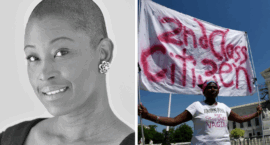
‘Women Here Are Going to Have Access to Abortion’: How Gov. Maura Healey Made Massachusetts into a Beacon for Reproductive Freedom

In the second episode of Looking Back, Moving Forward—a Ms. podcast exploring the history of the magazine and the feminist movement—Gov. Maura Healey talked about how Massachusetts prepared for the Trump administration’s attacks on abortion, what other states can do to protect and enshrine abortion access, and how her Title IX story led her to the governor’s mansion.

Listen to the second episode —”Inside the Feminist Fight to Reclaim Our Reproductive Freedom (with Renee Bracey Sherman, Michele Goodwin, Angie Jean-Marie and Amy Merrill, Susan Frietsche, and Gov. Maura Healey)”—on Spotify, Apple Podcasts or wherever you get your podcasts.

The U.S. Built Wealth Off Enslaved Women and Girls: Michele Goodwin on the History of Reproductive Injustice

Goodwin, an expert in constitutional law and health policy, uncovers the reproductive health rights stories embedded in American history—and what they tell us about the future of our fight for reproductive freedom.

Listen to the second episode Ms. podcast, Looking Back, Moving Forward—”Inside the Feminist Fight to Reclaim Our Reproductive Freedom (with Renee Bracey Sherman, Michele Goodwin, Angie Jean-Marie and Amy Merrill, Susan Frietsche, and Gov. Maura Healey)”—on Spotify, Apple Podcasts or wherever you get your podcasts.

Attacks on Abortion Access Are as Old as White Supremacist Patriarchy Itself. Here’s How We Fight Back.

What really underlies attacks on our bodily autonomy isn’t a devotion to “life,” but a desire for dominance. “In the history of abortion, every single time there is a wave of criminalization of abortion, it’s at the same time that the people in power, the forces that be, are concerned about losing power,” says Renee Bracey Sherman.

In the second episode of Looking Back, Moving Forward, advocates, lawmakers and experts explore the real roots of abortion criminalization throughout U.S. history — and lay out visions for where the fight for reproductive freedom must go next.

Listen to the second episode Ms. podcast, Looking Back, Moving Forward—”Inside the Feminist Fight to Reclaim Our Reproductive Freedom (with Renee Bracey Sherman, Michele Goodwin, Angie Jean-Marie and Amy Merrill, Susan Frietsche, and Gov. Maura Healey)”—on Spotify, Apple Podcasts or wherever you get your podcasts.

‘Feminist Activism Plays a Long Game’: Jennifer M. Piscopo on the Lessons the U.S. Can Learn from Mexico

The professor and researcher has watched gender quotas transform the political landscape in Mexico over the last two decades. Here’s what she thinks feminists in the U.S. can learn from their example.

“There has always been resistance to expanding women’s rights—in Mexico, in the U.S., everywhere—whether in politics or different spheres, but we are at this moment where that resistance seems to be having its own moment, and has been able to walk back a lot of gains.

“The past 50 years have shown that democracy is bound up with gender equality. … Feminist claims have always been about making democracy work for those usually excluded.”

Hear more from Piscopo and other feminists on the newest Ms. podcast, Looking Back, Moving Forward—the first episode is out now on Spotify, Apple Podcasts or wherever you get your podcasts.

‘Misogyny Is a System’: Julie Suk Wants to Reimagine U.S. Institutions—and Build a Democracy of Equality

“The entire infrastructure by which women have been excluded from real participation in decision making and power — that continues,” the legal scholar explains in the first episode of Looking Back, Moving Forward.

Hear more from Suk and other feminists on the newest Ms. podcast, Looking Back, Moving Forward—the first episode is out now on Spotify, Apple Podcasts or wherever you get your podcasts.

‘The Feminist Agenda Is Wildly Popular’: Celinda Lake on the Political Power of Feminist Voters

Pollster and leading Democratic strategist Celinda Lake has been examining the data on women and feminist voters for decades. I talked to her about what Americans really want. (Spoiler alert: It’s not Project 2025.)

“People think that feminism is a dirty word. In fact, it’s a very strong word. Particularly for progressives and Democrats—feminism is highly correlated with voting for Democrats. Half of Independents consider themselves feminists; when you describe it, a third of Republicans and 83 percent of Democrats do. Our voters consider themselves feminists. It is a very quiet movement out there that is really underestimated. …

“Feminist issues, however we define them, are doing quite well. What we don’t have is we don’t have enough of them out front. We don’t have enough leaders taking them on.”

‘We Need to Shift Who Has Power in This Country’: Cynthia Richie Terrell Knows How We Can Cultivate Gender Balance in Politics

In the first episode of the Ms. Studios podcast Looking Back, Moving Forward, Richie Terrell talked to Ms. consulting editor Carmen Rios about the vision of democracy she’s inspired by, practical strategies for advancing gender balance in politics, and what she considers the “gold standard” for equitable voting. 

“It’s no coincidence that the 50 top countries for women’s representation all have either a form of gender quotas, legislative or party-based, or constitutional, or they have a proportional voting system.”