

Sex, Power and Impunity: Epstein’s Legacy in Historical Perspective

The scandal that has preoccupied much of mainstream U.S. politics has, been, at one level, delightful: We have seen extremist Republicans—Reps. Marjorie Taylor Greene, Lauren Boebert, Thomas Massie and Nancy Mace—break with their party and its president in an effort to force into light the U.S. Department of Justice files on convicted sex trafficker and pedophile Jeffrey Epstein. 

The story is almost irresistible for critics of the current national administration, feminists among them: Will we finally get to items from Epstein like the CD labeled “girl pics nude book 4”? What might these materials reveal? And whose misbehavior might they reveal?  

Fire the starting gun on analyses from every liberal, left, critical corner. Claims abound of shifting coalitions, changing tides, pages turned, a president’s authority shredded. 

But there are still as many questions stirring in the Epstein pot as there are answers. Why did these particular Republicans break from the pack? Is this a contemporary Republican version of feminism? 

And beneath them all: What good does it actually do us—or Epstein’s particular victims, or the scads of other victims of sexual coercion, trafficking and other mistreatment—to raise the heat so high on this particular scandal?

Shout Your Abortion Short Films Seek to Normalize Keeping Abortion Pills at Home: ‘You Always Have Options’

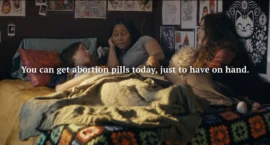
The grassroots abortion-stigma-busting juggernaut Shout Your Abortion has released two new powerful public service announcements urging people across the U.S. to order abortion pills in advance to have on hand, in case they have an unwanted pregnancy.

Made by Detroit-based filmmaker Na Forest Lim, the short films follow two women—a teenager named Dani and a single mother in her 30s named Poppy—who find out they are pregnant and use abortion pills at home, supported by friends and family.

Both of the main characters have easy access to abortion pills: Dani’s friend arrives with pills in her backpack, and Poppy keeps a pack tucked away in her top dresser drawer.

Building on that vision of easy access, the Dani PSA shows what it looks like when abortion pills are already part of teenagers’ lives and a pregnancy never has the chance to become a crisis.

War on Women Report: Antiabortion Extremist Charged in S.C. Shooting; Army OB-GYN Accused of Abusing Over 85 Women Patients

MAGA Republicans are back in the White House, and Project 2025 is their guide—the right-wing plan to turn back the clock on women’s rights, remove abortion access, and force women into roles as wives and mothers in the “ideal, natural family structure.” We know an empowered female electorate is essential to democracy. That’s why day after day, we stay vigilant in our goals to dismantle patriarchy at every turn. We are watching, and we refuse to go back. This is the War on Women Report.

Since our last report:
—North Dakota’s Supreme Court reinstated a total abortion ban, making it the 13th state with a near-total ban on abortion.
—Trump ordered Catherine Lucey, a woman reporter for Bloomberg, to be “quiet, piggy.”
—The U.S. moved to categorize countries with state-sponsored abortion and DEI policies as violators of human rights.
—Florida Attorney General James Uthmeier has sued Planned Parenthood over allegedly “misrepresenting the safety” of abortion pills.
—On Thursday, Dec. 4, an unprecedented law banning doctors from shipping abortion pills takes effect in Texas.
—”The country’s most respected newspaper hosted a conversation about whether women’s equality and freedom was a mistake.”
—Doctor Maj. Blaine McGraw, an OB-GYN at Fort Hood military base in Texas, the third-largest base in the country, is under investigation for sexual abuse against patients. As of Monday, 85 victims have come forward.
—With Jeffrey Epstein survivors watching from the gallery above, the House agreed in a near-unanimous vote to force the release of all files related to the investigation of the convicted sex offender.

… and more.

Breaking the Silence: Zimbabwe Initiative Reaches Survivors of Violence

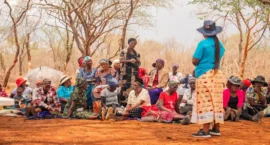
For years, Tjedza endured sexual violence at the hands of her father. Clara, an elderly woman, experienced abuse at the hands of her son. And for most of Tabeth’s married life, she bore abuse at the hands of her husband. 

These abuses—and many more like them—went unseen for far too long. Yet in rural Zimbabwe, services to support survivors of gender-based violence are often out of reach. Survivors often must travel long distances to seek help, and when they do, they risk facing stigma and blame from the very responders who are meant to protect them.  

But today, for survivors like Tjedza, Clara and Tabeth, the years of fear and silence are over. 

An initiative in Zimbabwe’s Bubi District, known as Women at the Center, is improving access to essential protection and support services—and improving the quality and delivery of these services as well. Now, when one survivor receives respectful care and protection, others are emboldened to speak out too.

“I only got the confidence to report after seeing how other survivors had received care and were in a much better place,” Tjedza shared.

“This program didn’t just save my life; it gave me back my dignity,” said Clara.

Twenty Thousand Stillbirths a Year, and No Federal Plan to Prevent Them

The U.S. loses over 20,000 babies to stillbirth each year, with many preventable. Across the country, pregnant women say their concerns are dismissed, with devastating consequences for maternal and fetal health. Yet stillbirth remains largely invisible in policy and public discourse, and families are left to deal with these tragic and costly losses with little support.

A new documentary from ProPublica, Before a Breath—based on the outlet’s Pulitzer Prize finalist reporting—follows three mothers who turn their grief from stillbirth into advocacy for safer pregnancies and better outcomes for expecting parents.

Inside the Global Network of Abortion Doulas Supporting Self-Managed Care

As barriers to clinic-based abortion care have increased in recent years, an increasing number of women are self-managing their abortions: finding and using abortion pills independently of the formal medical system. They are obtaining abortion pills through online abortion pill services, community networks sharing pills for free and websites selling pills.

To support self-managed abortion, feminists are creating a global network of online abortion doulas—trained companions who offer one-on-one support by phone, email and text to people using abortion pills. A leader in this effort is the organization Rouge Doulas, which runs the Rouge Abortion Doula School.

Arrests in Memphis as Antiabortion Training Camp Sparks New Era of Clinic Blockades

Randall Terry, the founder of Operation Rescue, is trying to make a comeback by teaming up with antiabortion extremist group PAAU (the so-called “Progressive” Anti-Abortion Uprising group associated with dozens of clinic and pharmacy invasions), to kick off “Rescue Resurrection.” Their stated goal is to revive large-scale clinic blockades with a formal kick-off training and series of events starting Dec. 3 in Memphis, Tenn.

On Friday morning, Dec. 5, approximately 25 individuals participating in the Rescue Resurrection training blockaded the Planned Parenthood health center in Memphis, even though abortion is already banned in Tennessee. Fourteen individuals were arrested.

Terry was one of the leaders of mass clinic blockades that took antiabortion extremism to a new level in the late 1980s and early 1990s. Operation Rescue’s (OR’s) orchestrated blockades in Atlanta, Memphis and Wichita drew massive media coverage. During the sieges, accessing a targeted abortion clinic meant getting through a gauntlet of bodies blocking clinic doors and driveways. Antiabortion activists traveled state to state in order to participate, blockading clinics, going limp when arrested (to represent the “unborn”) and requiring three to four police officers to remove each protester arrested and carry them to waiting police buses.

Dobbs Has Triggered Widespread Discrimination in Non-Reproductive Healthcare

In the years since Roe was overturned, physicians across a wide range of medical specialties have described how abortion bans are undermining their ability to follow evidence-based standards of care. Dermatologists, oncologists, neurologists, cardiologists and others told Physicians for Human Rights (PHR) that they are regularly forced to alter treatment plans, delay urgent care or avoid prescribing the most effective medications simply because those treatments could harm a pregnancy. These constraints are creating a chilling effect that reaches far beyond reproductive health and into the everyday practice of medicine.

As PHR’s Michele Heisler and Payal Shah explained, abortion bans are also fueling discriminatory care. Reproductive-age women are routinely denied the best available treatments, while men with the same conditions face no such barriers. Even within the group of reproductive-age women, clinicians are making decisions based on subjective judgments about a patient’s “contraceptive reliability”—a practice that opens the door to bias and disproportionately harms marginalized patients.

This two-tiered system of care is not hypothetical: It is already shaping medical decision-making in ban states, with dangerous consequences for patients’ health and lives.

Her Pregnancy Wasn’t Viable. Wisconsin’s Laws Still Made Her Fight for an Abortion.

Abortion may be legal in Wisconsin, but the hurdles still involved forced mom Gracie Ladd, 33, to flee the state anyway.

“He recommended terminating the pregnancy because I was so low on amniotic fluid that Connor would most likely pass away before birth, which would put me at serious risk for infection. … I was aware Wisconsin had an abortion ban, but I was shocked to learn only two hospitals would do D&Es for someone 20 weeks pregnant.

“There was so much nonsense just for a woman to get essential care. …

“I received a huge amount of support from many people, even those I didn’t expect. That opened a door for me to use this experience to help other moms. … When Roe v. Wade fell, I wondered, ‘How do I help?’ But I felt insignificant, like my voice wouldn’t matter. But after this happened with Connor, it gave me a way to get involved and a reason to speak out about how abortion is healthcare.”