From Alligator Alcatraz to National Guard Patrols: What Is the Cost of the Trump Administration’s Cruelty?

Reserve forces of the U.S. Army, 800 National Guardsmen, and for some reason, 120 FBI agents, are being newly assigned by El Presidente to patrol our national capital—citing crime as his motive, though it’s dropped by a third in recent (Biden) years. He’s already done this in Los Angeles for the last 60 days and predicts other cities are on his list: Baltimore, Chicago, Oakland, New York City—all places that just happen to vote blue.

Early on, the Pentagon testified it would spend about $134 million for the LA deployment, which sounds like a low-ball figure to anyone who’s recently shopped for groceries to feed 5,000 hungry young men three meals a day. And now, California’s governor is asking for the total cost to taxpayers of this “unlawful” deployment—because whether it’s political theater or not, we’re the ones footing the bill.

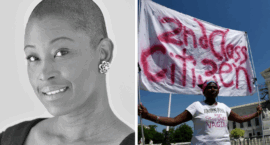
‘If You’re Not Centering the People Who Are Most Impacted, Your Policy Solution Will Fall Apart’: Gaylynn Burroughs Is Fighting for Economic Justice at the Intersections

Burroughs, the vice president of education and workplace justice at the National Women’s Law Center, connected the dots between poverty, policy and culture change in the latest episode of the Ms. Studios podcast Looking Back, Moving Forward. “Once you start seeing these problems as being problems that policy can solve,” she told me, “a whole world opens up.”

Listen to the latest episode of Looking Back, Moving Forward, “Women Can’t Afford to Wait for a Feminist Economic Future (with Premilla Nadasen, Rakeen Mabud and Lenore Palladino, Aisha Nyandoro, Gaylynn Burroughs, and Dolores Huerta)” on Spotify, Apple Podcasts or wherever you get your podcasts.

Doesn’t Gen Z Have the Right to Life? Young People Sue Trump Administration Over Climate Catastrophe as State-By-State Battle Continues

At least 137 people are dead after devastating flash-flooding in Texas in early July, including many children. As climate change induced disasters grow more common and the Trump administration rolls back environmental protections, several organizations are pursuing creative legal strategies to defend children’s fundamental right to a safe, healthy and stable natural environment.

On behalf of 22 young people, Our Children’s Trust filed Lighthiser v. Trump in May as part of its multi-case Youth v. Gov effort, asserting that three of the president’s pro-fossil fuel executive orders violate their constitutional rights to life, health and safety.

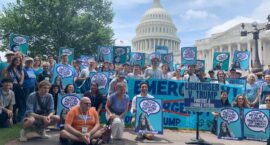
On July 16, hundreds gathered outside the U.S. Capitol to hear from Lighthiser plaintiffs and members of Congress at a press conference hosted by Our Children’s Trust and several organizational partners.

The same day, the Children’s Fundamental Rights to Life and a Stable Climate System resolution was introduced by Sen. Merkley (D-Oreg.) and Reps. Schakowsky (D-Ill.), Jayapal (D-Wash.) and Raskin (D-Md.). More than 50 additional senators and representatives joined the resolution as cosponsors.

Eva Lighthiser and Lander Busse were also plaintiffs in Held v. State of Montana, in which the Montana Supreme Court ruled that state law restricting consideration of climate change in environmental reviews violated youth plaintiffs’ right to a clean and healthful environment. The suit saw success largely because Montana has a Green Amendment—a constitutional amendment in the Bill of Rights section of the state Constitution explicitly declaring the legal right to a safe, healthy and stable natural environment for all people. Thus far, only Montana, Pennsylvania and New York have Green Amendments. The organization Green Amendments for the Generations (GAFTG) is working state-by-state alongside community partners to get new state-level Green Amendments passed.

The U.S. Built Wealth Off Enslaved Women and Girls: Michele Goodwin on the History of Reproductive Injustice

Goodwin, an expert in constitutional law and health policy, uncovers the reproductive health rights stories embedded in American history—and what they tell us about the future of our fight for reproductive freedom.

Listen to the second episode Ms. podcast, Looking Back, Moving Forward—”Inside the Feminist Fight to Reclaim Our Reproductive Freedom (with Renee Bracey Sherman, Michele Goodwin, Angie Jean-Marie and Amy Merrill, Susan Frietsche, and Gov. Maura Healey)”—on Spotify, Apple Podcasts or wherever you get your podcasts.

‘They’re Not Following the Law—They’re Imposing Conservative Values’: Key Takeaways From the Ms. 2025 Supreme Court Term in Review

Friday, June 27, marked the final day of the ’24-’25 Supreme Court term. This year brought a series of stunning, high-stakes decisions that delivered major setbacks for reproductive rights and civil liberties—from a landmark case threatening judiciary checks and birthright citizenship and a ruling that expands parental opt-outs in public schools, to the Court’s decision to uphold both South Carolina’s ban on Medicaid funding for Planned Parenthood and Tennessee’s ban on gender-affirming healthcare for trans teens.

On July 2, the O’Neill Institute for National and Global Health Law at Georgetown University hosted its annual Supreme Court Term in Review, co-hosted by Ms. magazine, Ms. Studios, the Brennan Center for Justice and the American Constitution Society. The event brought together legal scholars, litigators, journalists and activists to reflect on the most consequential rulings of the 2024-’25 term.

“We should not have to have seances with slave owners to know what our rights are today.”
—Lourdes A. Rivera

“The president can, with the stroke of a pen, revoke your constitutional right to citizenship.”
—Jamelle Bouie

“The Supreme Court and Congress are basically enabling this. Not just being feckless, but enabling it.”
—Lourdes A. Rivera

“I thought Justice Barrett was extraordinarily disrespectful toward Justice Jackson in that opinion.”
—Mark Joseph Stern

“We get hope from our clients and the communities that are stepping up when many elite institutions are not.”
—Skye Perryman

The Supreme Court’s Ruling on National Injunctions Will Hurt Us All—Immigrants First

In a 6-3 decision last Friday, the Supreme Court granted the Trump administration a partial, but crucial, victory in its efforts to stop federal courts from blocking Trump’s agenda.

The vehicle for this power grab, CASA v. Trump, is a case about the legality of denying citizenship to children born to parents who are in the U.S. unlawfully or temporarily. In the majority’s ruling that nationwide injunctions were probably outside the federal judiciary’s authority, and therefore, judges should limit their orders to the parties and plaintiffs before them, it has tipped the balance of power to the president. And that is going to make many people’s lives—immigrants and nonimmigrants alike—much more difficult.

Three Years After Dobbs, a Coordinated Campaign Aims to Eliminate Abortion Pills Nationwide

Medication abortion has become the most popular form of abortion in the U.S. post-Dobbs, providing potentially lifesaving access to people residing in states with abortion bans in place. Because of this, the antiabortion right-wing machine’s dogged attacks on mifepristone should be seen for what they are: an attempt at a backdoor national abortion ban.

Revoking access to mifepristone is key in the antiabortion machine’s fight to maintain control over pregnant women’s bodies and lives.

What Comes After Roe? Fear, Surveillance and Felony Charges

A new survey reveals that a majority of likely voters oppose policies that grant legal rights to fertilized eggs, embryos and fetuses. They also oppose the criminalization of pregnancy loss, denial of emergency medical care and broader threats to reproductive freedom.

Yet here we are, with bills to codify those rights brewing in a quarter of U.S. states this year.

Even when they do not succeed, we cannot simply ignore them or hope their proponents call it quits. Rather, this is a prime opportunity to double down on educating people and harnessing public opinion.

From Reckoning to Backlash, Black Women Reflect on the Stakes of the Moment

In 2020, the killing of George Floyd shocked Americans into action and into the streets by the millions, protesting the unrelenting killing of Black people by police. 

The moment sparked a nascent reckoning in America around systemic racism and institutional inequality—in many cases, with Black women at the center. Already the backbone of our democracy, many were called on to also be a bridge to racial healing.

Five years later, many of these same Black women find themselves at the center of a backlash, confronted with attacks on the diversity, equity and inclusion efforts that were previously championed.