Activating Art for Women’s Rights and Democracy: Tiffany Shlain’s Feminist Monument Makes it to the Midwest in Advance of Pivotal Elections

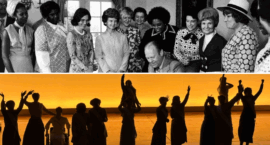
For three years running, artist and activist Tiffany Shlain has created calls to action around her feminist history tree ring sculpture in advance of U.S. elections where women’s voting rights, reproductive rights and long held democratic principles face historic setbacks. The milestones and tribulations of women’s history seared onto its surface are particularly resonant now, as many records of women’s presence and accomplishments are disappearing from public view.  

Russia Was Once a Revolutionary Feminist Motherland

Russia’s hostility to feminism today stems not from its foreignness, but from memory. A century ago, it was Russian women who lit the first sparks of revolution. On International Women’s Day in 1917, factory workers filled the streets of Petrograd demanding bread, peace and equality—an uprising that toppled the Romanovs and pulled the world into modernity. Under the Bolsheviks, women won the right to vote, divorce became accessible and abortion was legalized. For a brief, radical moment, the Soviet experiment made women’s liberation a pillar of the state.

Julia Ioffe’s book, Motherland: A Feminist History of Modern Russia, from Revolution to Autocracy, reminds us that today’s Russia rejects feminism precisely because it once knew what it could do: ignite revolutions, upend hierarchies and reimagine power itself.

Trey Reed’s Death—and Its Swift Labeling as Suicide—Demands the Scrutiny Ida B. Wells Called For

Trey Reed, a young Black student, was found hanging from a tree on his college campus of Delta State University in Mississippi on Sept. 15, 2025. Trey Reed was a computer science major from Grenada, Miss., and a first-generation student, described as ambitious and eager to create a positive future for himself and his family.

Mississippi police and the Bolivar County coroner’s office have labeled the death a suicide. But Reed’s family members and other advocates, including Reps. Bennie Thompson (D-Miss.) and Ayanna Pressley (D-Mass.), activist and former NFL quarterback Colin Kaepernick, attorneys Ben Crump and Vanessa J. Jones (both of whom are representing the family), are calling for further investigation. 

Cases like Reed’s awaken questions rooted in legacies of racial violence in the South. “While the details of this case are still emerging, we cannot ignore Mississippi’s painful history of lynching and racial violence against African Americans,” said Thompson in the days following Reed’s death. That history is not distant: Mississippi recorded more lynchings than any other state, and the echoes of those crimes persist in how the deaths of Black people are investigated and discussed. The reflex to dismiss possible racial motives—or to declare a death a suicide before all evidence is known—reflects a deeper national unwillingness to confront the full scope of anti-Black violence.


Celebrating Women’s Equality Day—105 Years After the 19th Amendment

Weekend Reading for Women’s Representation is a compilation of stories about women’s representation in politics, sports and entertainment, judicial offices and the private sector—with a little gardening mixed in!

This week:
– Marking 105 years since the 19th Amendment certified women’s right to vote.
– Democrat Catelin Drey wins a special election in Iowa, breaking the GOP’s majority in the state’s chamber.
– Australia’s youngest-ever senator, Labor Senator Charlotte Walker, delivers her first speech to Parliament.
– Women’s Emergency Response Rooms in Sudan are signs of Democracy.

… and more.

Tradwives and ‘The People That People Come Out Of’

For the first time in years, the number of U.S. mothers with young children in the workforce is shrinking—over 212,000 women left between January and June 2025 alone.

Childcare costs, in-office pressures, and a cultural nudge toward traditional gender roles are pushing moms out, while men in power nod along.

Meanwhile, the tradwife movement parades its perfect, baked-from-scratch, filtered-life versions of domesticity online, making the impossible look effortless.

It’s absurd. It’s dangerous. And it’s time we stop letting the economy treat raising kids as invisible labor.

Women’s Equality Day Has Never Been More Urgent

From reproductive rights and workplace protections, to access to education and voting, the freedoms women have fought for are under attack like never before.

This Women’s Equality Day cannot be symbolic. It must be a reckoning. Because if women’s rights continue to erode, it won’t just be women who lose—it will be democracy itself.

The time for quiet patience is over. The only way forward is louder, stronger and unstoppable.

Real Change for Women in Politics Requires Fixing Broken Systems

The fight for women’s equality isn’t stalled because women aren’t stepping up to run—it’s stalled because our systems are built to protect incumbents and the status quo. The good news is we know how to fix those systems. Tools like ranked-choice voting and proportional representation give voters more voice, create real opportunities for women and people of color, and help build a democracy that reflects us all. Change is possible, but only if we act.

The 19th Amendment, Explained

It took more than a century of fighting by generations of activists to achieve suffrage for all American women.

The 19th Amendment to the U.S. Constitution reads, “The right of citizens of the United States to vote shall not be denied or abridged by the United States or by any State on account of sex.” The amendment granting women the right to vote was enacted at the start of the Roaring Twenties, decades after a prolonged and meandering fight for enfranchisement. 

The 19th Amendment codified women’s suffrage nationwide, but long before its ratification, unmarried women who owned property in New Jersey could and did cast ballots between 1776 and 1807. Beginning in 1869, women in Western territories won the right to vote. And in the decade leading up to the 19th Amendment’s passage, 23 states granted women full or partial voting rights through a series of successful campaigns.

Remembering the Mother’s Letter That Secured the 19th Amendment

Weekend Reading for Women’s Representation is a compilation of stories about women’s representation in politics, sports and entertainment, judicial offices and the private sector—with a little gardening mixed in! 

This week:
“Dear Son … Hurray and vote for Suffrage and don’t keep them in doubt.” On Aug. 18, 1920, Tennessee became the 36th state to ratify the 19th Amendment when young legislator, Harry Burn, followed the advice of his mother, Febb Burn, and cast the decisive vote in favor. Febb—a college-educated widow who read three newspapers a day and strongly felt her mind was the equal of any man’s—had long impressed upon her son the importance of suffrage.
—California women are far more likely than men to be “energy burdened,” spending more than 6 percent of their income on home energy costs, including utilities for heating, cooling and power.
—RepresentWomen’s 2025 Gender Parity Index (GPI) offers encouraging news: Women’s political power in the United States is reaching new heights, with states like New Hampshire, Oregon and Maine achieving gender parity for the first time in history. But the United States still has a way to go, ranking 77th globally in women’s representation, but more importantly, it lags behind nearly all its major democratic allies.
—Economic struggle, especially among women, is profoundly shaping the political moment heading into 2026. Understanding the significance for female voters is not merely a political embellishment; it is fundamental to securing electoral victories in the midterm elections and effecting meaningful change.

… and more.

Women’s Equality Day: Celebrate the Victories. Confront the Backlash.

Tuesday, Aug. 26, marks 104 years since the 19th Amendment was certified, recognizing women’s constitutional right to vote. But anniversaries like Women’s Equality Day are not just about looking back. They remind us of unfinished business.

The proposed SAVE Act threatens to make voting harder for students, married women, low-income voters and communities of color. Dark money is flooding state races aimed at rolling back abortion access, LGBTQ+ protections and civil rights. And without congressional recognition of the ERA, gender equality remains absent from the Constitution.

But wins are possible.