Election Results: Historic Gender Gaps Shape 2025 Outcomes in Virginia, New Jersey and Beyond

We’ve curated the results of all the state-by-state election results that feminists most care about.

Together, the early data from this week’s elections paints a clear picture: Women voters were the decisive force in the 2025 elections, driving sweeping Democratic victories across key states. Women turned out at higher rates than men and made up a majority of voters. Support for women’s rights, reproductive freedom, gender equality and fair immigration policies powered a Democratic sweep this election season.

Historic gender gaps reshaped the political landscape:
—In Virginia, 65 percent of women voted for Democrat Abigail Spanberger for governor, compared to just 48 percent of men, a 17-point gender gap
—In New Jersey, women backed Democrat Mikie Sherrill by 62 percent, compared with 49 percent of men, a 13-point gap that proved decisive in her win. 

Immigrant and First-Generation Women Are Changing What Leadership Looks Like in America

Running for office in the United States has never been an even playing field. Women face steep hurdles including misogyny, difficulties raising money and building political networks, and shouldering the demands of family and work. On top of that, immigrant women often face increased barriers, contending with racism, xenophobia and constant doubts about whether they “fit the image” of a politician.

Men are usually assumed to be qualified. Women have to prove it—over and over again.

At New American Leaders, we prepare women to anticipate these double standards and to campaign with confidence and authenticity. NAL is women-led and stands as the only nonprofit, nonpartisan organization in the United States that trains and supports immigrants, children of immigrants and refugees for civic leadership or running for office.

(This essay is part of a collection presented by Ms. and the Groundswell Fund highlighting the work of Groundswell partners advancing inclusive democracy.)

Keeping Score: No Kings Protest Turnout Makes History; SCOTUS Threatens Voting Rights; Gen Z Women Are Most Liberal in U.S.

In every issue of Ms., we track research on our progress in the fight for equality, catalogue can’t-miss quotes from feminist voices and keep tabs on the feminist movement’s many milestones. We’re Keeping Score online, too—in this biweekly roundup.

This week:
—No Kings Day marks the largest single-day protest in American history.
—The ongoing government shutdown could soon disrupt SNAP benefits, another unprecedented moment in U.S. history. “We have never seen our government turn on its people this way,” said Abby Leibman, president and CEO of MAZON.
—House Democrats rebuke Pete Hegseth’s hostility towards women in the military.
—Speaker Mike Johnson refuses to swear in newly elected Democrat, Rep. Adelita Grijalva.
—Return-to-office policies are pushing women out of the workforce.
—Remembering legendary trans activist Miss Major Griffin-Gracy.
—The Supreme Court heard arguments challenging the Voting Rights Act.

… and more.

Our Favorite Protest Signs From No Kings 2.0

On Saturday, Oct. 18, 2025, millions of Americans poured into the streets for the second No Kings protest this year. Organizers from hundreds of national and local progressive groups say nearly 7 million people participated in about 2,700 different No Kings events. In every state, in cities big and small, protesters used signs, costumes and chants to double down on democracy and accuse President Donald Trump of behaving more like a monarch than an elected official during his first 10 months back in office.

Marchers carried “We the People” signs and references to the U.S. Constitution, including: “The Constitution is not optional,” “Democracy not monarchy” and “No kings since 1776.” Signs and chants varied by region: In New York City, protesters dressed up as the Statue of Liberty; in Florida, signs said the Florida heat would melt ICE; in Texas, marchers called for Gov. Abbott and Sen. Cruz to stand up to the Trump administration’s abuses of power.

Here are some of our favorite signs from Saturday’s No Kings protests.

Trey Reed’s Death—and Its Swift Labeling as Suicide—Demands the Scrutiny Ida B. Wells Called For

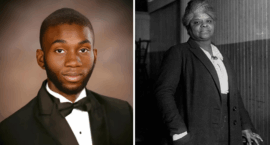
Trey Reed, a young Black student, was found hanging from a tree on his college campus of Delta State University in Mississippi on Sept. 15, 2025. Trey Reed was a computer science major from Grenada, Miss., and a first-generation student, described as ambitious and eager to create a positive future for himself and his family.

Mississippi police and the Bolivar County coroner’s office have labeled the death a suicide. But Reed’s family members and other advocates, including Reps. Bennie Thompson (D-Miss.) and Ayanna Pressley (D-Mass.), activist and former NFL quarterback Colin Kaepernick, attorneys Ben Crump and Vanessa J. Jones (both of whom are representing the family), are calling for further investigation. 

Cases like Reed’s awaken questions rooted in legacies of racial violence in the South. “While the details of this case are still emerging, we cannot ignore Mississippi’s painful history of lynching and racial violence against African Americans,” said Thompson in the days following Reed’s death. That history is not distant: Mississippi recorded more lynchings than any other state, and the echoes of those crimes persist in how the deaths of Black people are investigated and discussed. The reflex to dismiss possible racial motives—or to declare a death a suicide before all evidence is known—reflects a deeper national unwillingness to confront the full scope of anti-Black violence.

What Feminist Wins Can Teach Us About Immigration [Part 3 of 3]

Past feminist policy victories can guide the way toward more humane and effective immigration reform. The Violence Against Women Act (VAWA) of 1994 is a prime example—its architects successfully integrated immigration protections for women into a broader effort to combat gender-based violence. By framing immigrant women’s rights as part of protecting all women from abuse, advocates made it harder for opponents to isolate or attack these provisions. That approach, centered on shared values rather than political fault lines, offers a valuable lesson: Immigration reform succeeds when it’s connected to the broader goals of safety, equality and community well-being.

Today, we need a similar framework to move the immigration debate beyond fear and division. A new vision—what I call the RESPECTED framework, for Restoring Economic Opportunity, Protecting Every Community, and Treating Everyone with Dignity—invites us to see immigration policy not as an isolated crisis but as part of building a fairer, safer and more prosperous society.

Legalization, for example, shouldn’t just be about paperwork—it’s about removing barriers that keep women in low-wage, unsafe jobs and making economic opportunity real for everyone.

Ultimately, the RESPECTED approach asks a simple but transformative question: How can immigration policy help us build the future we want together? By embedding immigration reform within shared priorities—economic security, community safety and human dignity—we can replace the politics of exclusion with a politics of belonging.

The struggle is far from over, especially for women fleeing violence and seeking asylum. But if we listen, learn and lead with respect, we can carry forward the feminist lessons that made change possible before—and make them work again today.


Sahaj Kohli Is Helping Immigrant Daughters Break the Silence They Inherited

Seventy-seven percent of Indian Americans ages 25 and older hold a bachelor’s or advanced degree—one of the highest education levels of any group in the country. However, there aren’t many that are civically active in their communities. Few post about controversial issues. Fewer donate. Almost none speak publicly. These are the women who are otherwise bold: executives, founders, fundraisers, moms who command rooms. But when it comes to controversial topics—especially anything that could “stir the pot”—there’s a quiet, familiar retreat.

Therapist and founder of Brown Girl Therapy, Sahaj Kohli has spent years studying this phenomenon. Through a book, a podcast and a mental health community for bicultural and immigrant women, she’s helping these women understand “your voice doesn’t have to be angry or loud in order for it to be brave. It just has to be yours.”

As we celebrate Diwali—a festival that honors light’s triumph over darkness—it’s worth remembering that our voices are part of that light. Choosing to speak, even when it’s uncomfortable, is how we brighten the path for those who come after us.

Immigration Isn’t a Problem—It’s Part of the Solution [Part 2 of 3]

The challenges facing women seeking asylum are just one piece of a much larger immigration crisis decades in the making. Since the 1996 Illegal Immigration Reform and Immigrant Responsibility Act, the U.S. system has skewed toward deportation, introduced new barriers to asylum and limited judges’ discretion.

Advocates say the resulting system fuels chaos, disrupts families and touches every aspect of society—from economic opportunity to civic trust.

Cynthia Buiza, former executive director of the California Immigrant Policy Center, argues that fixing immigration requires a broader vision. “Rather than focus solely on reforming immigration laws, we need to pass laws that incorporate immigration into broader objectives such as improving the economy, promoting opportunities for youth or addressing disparities in the judicial system,” she says.

Programs like Welcoming America show that community-based solutions can help. By fostering inclusion and mutual understanding, local initiatives demonstrate that immigration reform doesn’t have to exist in isolation—it can be part of a larger framework that benefits everyone.

Yearning to Breathe Free [Part 1 of 3]

In the matter of K-E-S-G-, a Salvadoran woman stalked and threatened by gang members was denied asylum by the U.S. Board of Immigration Appeals on July 18, even though her persecution stemmed from her gender in a country that treats women as property. Advocates warn that this ruling could make it much harder for women fleeing violence to prove gender-based claims and may embolden immigration judges to discount their stories.

“This isn’t the first time the Trump administration has singled out women seeking asylum, and we know where this path leads,” said Neela Chakravartula of the Center for Gender & Refugee Studies. “More judges denying protection to women who qualify for it. More refugees being deported to danger.”

The decision highlights the ongoing struggle to recognize gender as a protected basis for asylum. Afghan and Salvadoran women, among others, may now face even steeper barriers to protection—a chilling effect that experts say could deter survivors from seeking safety in the U.S.

The Trump Administration Is Paying Children $2,500 to Give Up Their Rights

The Trump administration’s latest immigration scheme offers unaccompanied children $2,500 to “voluntarily” give up their legal rights and return to the very countries they fled. Officials are calling it a resettlement stipend, but in reality, it’s a disingenuous and dangerous form of coercion. Children in federal custody—many without attorneys—are being asked to make life-altering decisions under duress, with money dangled as an incentive to abandon their claims. Far from empowering them with choice, this program undermines the legal protections Congress established to keep children safe.

It’s one more example of the administration’s incremental intimidation of children—this time, with a price tag attached.