
Gender-Based Violence Is Everywhere. What Will It Take to Break the Cycle?

In the fourth episode of Looking Back, Moving Forward, advocates and experts name the sociopolitical factors that fuel gender-based violence, and outline what it will take—in the courts, legislatures and our communities—to finally break the cycle.

“What does it mean that so many women, in particular, have to shoulder the burdens of violence and abuse in our day-to-day lives?”

“We’re in the middle of this terrible backlash because patriarchy does feel so threatened … It’s terrible, and it’s getting worse, but it’s because we have been so successful so far.”

Listen to the latest episode of Looking Back, Moving Forward, “How Feminists are Breaking the Cycle of Gender-Based Violence and Harassment (with Ellen Sweet, Jane Caputi, Vanessa Tyson, Victoria Nourse, and Debra Katz)” on Spotify, Apple Podcasts or wherever you get your podcasts.

FX’s ‘The Bear’ Season 4 Embraces Feminist Leadership, Challenging Aggressive Masculinity and Reimagining the Workplace

The renowned show’s newest season is carving a new, feminist path for recognition of women-led workplaces, in spite of a history of white, male dominance.

Cultural depictions of feminist leadership, even when fictional, can help us both imagine and demand better. We need not settle for egotistical, unpredictable, manipulative leaders who focus on personal gains and grievances.

‘If You’re Not Centering the People Who Are Most Impacted, Your Policy Solution Will Fall Apart’: Gaylynn Burroughs Is Fighting for Economic Justice at the Intersections

Burroughs, the vice president of education and workplace justice at the National Women’s Law Center, connected the dots between poverty, policy and culture change in the latest episode of the Ms. Studios podcast Looking Back, Moving Forward. “Once you start seeing these problems as being problems that policy can solve,” she told me, “a whole world opens up.”

Listen to the latest episode of Looking Back, Moving Forward, “Women Can’t Afford to Wait for a Feminist Economic Future (with Premilla Nadasen, Rakeen Mabud and Lenore Palladino, Aisha Nyandoro, Gaylynn Burroughs, and Dolores Huerta)” on Spotify, Apple Podcasts or wherever you get your podcasts.

Poverty Is a Policy Choice—and Women Deserve More 

In the third episode of the Ms. Studios podcast Looking Back, Moving Forward, economists and advocates break down how our economy is leaving women behind and lay out strategies for advancing a feminist economic future.

“Poverty is the result of systems that have been intentionally put in place that the majority of us benefit from,” said Aisha Nyandoro, founding CEO of Springboard to Opportunities, home to the Magnolia Mother’s Trust guaranteed income program.

“So much of the conversation among economists and among policy people about infrastructure has always been about male-dominated infrastructure,” Lenore Palladino said. “We cannot rebuild our economy or build back better, as it were, with male-dominated sectors and not female-dominated sectors.”

“We have to continually ask: In whose interests are we fighting? Who will benefit from the work that I’m doing right now? Who should we put at the center of our organizing campaigns?” said Premilla Nadasen, labor and women’s historian.

The newest Ms. podcast, Looking Back, Moving Forward is out now on Spotify, Apple Podcasts or wherever you get your podcasts.
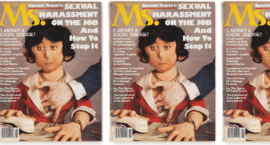
No-Rehire Clauses Let Employers Retaliate Against Harassment Victims … Legally

For Charlotte Bennett, alleged harassment at the hands of former New York Gov. Andrew Cuomo (D-N.Y.) led to years of costly litigation and “extraordinary pain.” Bennett’s state-level case was finally settled in April, with a little-known clause included: If a worker settles a case accusing their employer of sexual harassment, discrimination or any form of abuse, their employer may legally include a “no-rehire” clause in the settlement. This clause bars accusers from seeking future jobs with their employer.

No-rehire clauses can also bar workers from employment with any affiliates, subsidiaries or partners of their ex-employer’s organization. If another company hires an employee, and it is later acquired by or merged with a company that employee has a no-rehire clause with, a federal court affirmed in 2023 that the worker can legally be terminated from that new job, too.

In an age of mergers and monopolies, the consequences of a no-rehire clause may follow a victim of workplace harassment forever. Depending on the size of their former employer, an ex-employee could be barred from hundreds of different companies if their settlement includes a no-rehire clause.

New York state Assemblymember Catalina Cruz (D) introduced AB 293 to fully ban such clauses across the state. If the Assembly bill and its Senate counterpart were passed, New York would join California and Vermont as the only states prohibiting or limiting these clauses.

Now Streaming: New Film ‘Lilly’ Tells Transformative Story of Equal-Pay Hero Lilly Ledbetter

It’s tempting these dark days to dismiss the idea that any one person can make a difference. And yet, every day ordinary people fight injustice. And some days, those people persist long enough, resist long enough, that their fights rise to national prominence.

One such fight is chronicled in the new film Lilly, released in theaters this May and now available for rent. The brainchild of director Rachel Feldman, Lilly tells the story of Lilly Ledbetter, “an ordinary woman who became extraordinary,” in the words of Patricia Clarkson, who portrays her in the film.

How Trump Gave America License to Roll Back Women’s Equality—And How We Take it Back

For decades before Trump’s political rise, we fought for women’s equality, advancing one hard-won victory at a time. Reproductive freedom. Economic independence. Workplace equity. Protection from harassment and violence.

In 2022, fewer than 30 percent of Republican men believed women should return to traditional roles. By 2024, that number jumped to 48 percent.

This isn’t just political polarization. This is a fundamental rejection of women’s equality fueled by a sitting president intent on rolling back women’s progress.
Trump’s presidency has unleashed a cultural and political backlash that threatens generations of progress toward women’s equality—demanding a bold, collective response.

Every woman and man who believes in equality can fight back.

The Cost of Fine Dining: Claims of Sexual Harassment and Union-Busting at D.C.’s Elite Restaurants

While the elite of Washington, D.C. enjoy expensive meals at famed restaurants such as Pastis, Le Diplomate and Rasika, the workers behind the scenes have reportedly contended with sexual harassment, union-busting or both. 

STARR Restaurants, the high-end hospitality group led by CEO Stephen Starr, owns several hotspots, including Le Diplomate, St. Anselm and Pastis, as well as restaurants in Philadelphia, New York City, South Florida and Nashville. 

According to Unite Here Local 25, a union representing D.C.-area hotel, restaurant and casino employees, two workers at Pastis were subjected to sexual harassment by a supervising chef. The union claimed that the women experienced unwanted touch and verbal harassment, such as being grabbed by the neck from behind, being asked to kiss the chef and being called “babygirl” and “princess.”

Harvey Weinstein’s Half-Baked Verdict Reinforces a Continued Tradition of Suspicion Towards Victims of Sexual Assault

While dressed in modern garb, today’s distrust of accusers who delay reporting is hardly new. For most of our history, a “prompt outcry” rule was baked into our law, as explained in my book on accuser credibility. The rule rested on an abiding suspicion of accusers, equating delayed reporting with falsehood and allowing only rape allegations reported soon after the incident to proceed.