Election Results: Historic Gender Gaps Shape 2025 Outcomes in Virginia, New Jersey and Beyond

We’ve curated the results of all the state-by-state election results that feminists most care about.

Together, the early data from this week’s elections paints a clear picture: Women voters were the decisive force in the 2025 elections, driving sweeping Democratic victories across key states. Women turned out at higher rates than men and made up a majority of voters. Support for women’s rights, reproductive freedom, gender equality and fair immigration policies powered a Democratic sweep this election season.

Historic gender gaps reshaped the political landscape:
—In Virginia, 65 percent of women voted for Democrat Abigail Spanberger for governor, compared to just 48 percent of men, a 17-point gender gap
—In New Jersey, women backed Democrat Mikie Sherrill by 62 percent, compared with 49 percent of men, a 13-point gap that proved decisive in her win. 

Ahead of the Country: How Florida’s Progressive Fight Against Authoritarianism Is Setting the Tone

Like many others across the nation, people gathered outside the Duval County Courthouse in Jacksonville, Fla., on Oct. 18, 2025, to send a message: No Kings. People played music and danced. Kids found space to throw a football. People ran into old friends. 

“What really stood out to me was how much fun it was. I mean, people were enjoying themselves. You had people in frog costumes and other things. You had some pretty funny signs,” says Larry Hannan, communications and policy director for State Voices Florida, who attended the No Kings rally in Jacksonville. 

While Florida has trended red in the last decade, its voters have consistently favored progressive measures. In 2024, Florida’s Right to Abortion Initiative, as well as the state’s Marijuana Legalization Initiative, received 57 and 56 percent of the vote, respectively. Even though both measures were supported by the majority of voters, both initiatives were struck down because they failed to meet Florida’s 60 percent supermajority.

“In a lot of ways, the better we fight back here, the better the country is. Because a lot of people are saying, ‘Oh, I can’t believe this is happening.’ And us in Florida are saying, ‘Yeah, this happened a few years ago,’” says Hannan, who noted that Florida has served as a rough draft for the conservative MAGA movement, since many of the president’s current advisers are former Florida officials. 

The Witch Was Never the Villain. She Was the Beginning of Women’s Power.

Weekend Reading for Women’s Representation is a compilation of stories about women’s representation in politics, sports and entertainment, judicial offices and the private sector—with a little gardening mixed in!

This week:
—Long before Halloween became a night of costumes and candy, it was Samhain: a Celtic festival marking the end of harvest and the beginning of winter’s half-dark. Communities gathered to honor what had ended, prepare for what was to come, and find renewal in letting go. At the heart of those gatherings were women. When patriarchal religions spread across Europe, that spiritual authority became a threat.
—When my children were young, during the Halloween season, I remember thinking how natural it is for young children, especially young girls, to believe they can transform … to step boldly into whoever they want to be.
—As we approach another Election Week, women once again stand at the threshold between what is and what could be: Women could sweep governor elections in New Jersey and Virginia. And Women are posed for gains in city elections across the country.
—New York Attorney General Tish Janes is targeted by the DOJ.
—Ireland elects Independent Catherine Connolly as its third woman president.

… and more.

Activating Art for Women’s Rights and Democracy: Tiffany Shlain’s Feminist Monument Makes it to the Midwest in Advance of Pivotal Elections

For three years running, artist and activist Tiffany Shlain has created calls to action around her feminist history tree ring sculpture in advance of U.S. elections where women’s voting rights, reproductive rights and long held democratic principles face historic setbacks. The milestones and tribulations of women’s history seared onto its surface are particularly resonant now, as many records of women’s presence and accomplishments are disappearing from public view.  

From Iceland’s ‘Women’s Day Off’ to No Kings, Progress Begins When Women Stand Together

Weekend Reading for Women’s Representation is a compilation of stories about women’s representation in politics, sports and entertainment, judicial offices and the private sector—with a little gardening mixed in!

This week:
—Fifty years ago, the women of Iceland changed the course of their nation … not through an election or a revolution, but through one simple, collective act: They stopped. On Oct. 24, 1975, 90 percent of Icelandic women refused to work, cook or care for children for a single day. That strike, known as the Women’s Day Off, became a watershed moment for equality, but it didn’t emerge overnight.
—Women hold the majority in the Bolivia legislature.
—Japan confirms Sanae Takaichi as its first woman prime minister.

… and more.

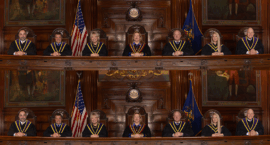
Why the Pennsylvania Supreme Court Matters—and How to Make Your Voice Heard in the Ongoing Election

The Nov. 4 Pennsylvania Supreme Court will determine Pennsylvanians’ access to education, protections for workers in the workplace, LGBTQ+ civil rights and gender equality, among other key issues.

Retaining the current justices on the state’s supreme court is crucial, especially after recent fights in the state over the 2030 census. The redistricting from the census could mean that states like Pennsylvania may have one less congressional seat. As of now, Pennsylvania has stable abortion access, but flipping the court could disrupt access to Pennsylvanians.

As Trump Targets Portland, a New Report Shows How the City Became a Model for Women’s Representation

Weekend Reading for Women’s Representation is a compilation of stories about women’s representation in politics, sports and entertainment, judicial offices and the private sector—with a little gardening mixed in!

This week:
—How did Portland, Ore., achieve one of the mosdt representative city councils in the country? Through structural reform and community-driven organizing.
—A woman will be Ireland’s next president.
—Japan is posed to make a historic shift in women’s leadership.
—For the first time, a woman will lead one of Christianity’s oldest institutions.
—We celebrate the life of Jane Goodall.
—We mark what would be Eleanor Roosevelt’s birthday. She helped craft the Universal Declaration of Human Rights—insisting that freedom must include not only political rights, but also the right to food, housing and dignity: “You cannot talk civil rights to people who are hungry.” In the midst of Cold War tension, Roosevelt’s words were a quiet but radical act—a reminder that peace often begins not in policy or power, but in empathy and connection.

… and more.

Virginia Will Choose Its First Woman Governor in November’s High-Stakes Election

Over the next month into Election Day on Nov. 4, 2025, Virginia voters will decide not only the state’s next governor, but also control of the House of Delegates. The outcome will determine the direction of Virginia’s policies for years to come, and will send powerful signals about the nation’s political climate. 

The race is already historic. For the first time, both major party candidates for governor are women: former U.S. Rep. Abigail Spanberger (D) and Lt. Gov. Winsome Earle-Sears (R). Whoever wins will become the state’s first woman governor. 

In Upcoming Virginia, N.J. and Pennsylvania Elections, Women’s Votes Will Decide the Future of Reproductive Rights and Equality

All eyes will be on the elections this fall in Virginia, New Jersey, Pennsylvania and beyond. These contests are not just bellwethers for next year’s midterms—they’re critical tests of how far Americans will go to defend women’s rights and equality at the state and national levels.

Women’s votes will be decisive. Pollster Celinda Lake told Ms. that women “are our own voters, we make up our own minds.” That independence has shaped elections for decades, with women consistently leaning more Democratic than men. This fall—from Virginia’s history-making two-woman governor’s race, to Pennsylvania’s Supreme Court retention battles—reproductive rights and equality are squarely on the ballot.

The message is clear: State-level elections matter profoundly, especially for women. The Dobbs decision pushed abortion and gender equality battles back to the states, and now voters must decide who will stand up for their rights.

Women as Teachers, Governors and Civil Service: The Fight for Women’s Leadership Everywhere

Weekend Reading for Women’s Representation is a compilation of stories about women’s representation in politics, sports and entertainment, judicial offices and the private sector—with a little gardening mixed in!

This week:
—Teachers have always been the cornerstone of thriving communities and a healthy democracy. It’s no accident that so many powerful women leaders began their journeys in classrooms. And yet, while women dominate the teaching profession, they remain underrepresented in our political institutions.
—President Trump’s recent federal workforce reductions have disproportionately harmed Black women, who are long overrepresented in civil service relative to the private sector.
—A growing number of women are entering the race for governor in 2025 and 2026.
—Debra Shigley, an attorney, small business owner and mom of five, has secured a top spot in a Georgia runoff election for a state Senate seat. Her election on Tuesday, Sept. 23, will be one to watch as women’s leadership in Georgia, and across the country, continues to grow. Georgia already uses ranked-choice voting, sometimes called “instant runoffs,” for military and overseas voters. Expanding this system statewide would guarantee majority winners in a single election.
—U.K. women are calling out dangerous narratives that weaponize sexual violence against women to scapegoat asylum seekers.
—Italian women fight digital violence and demand consent online.

… and more.