Russia Was Once a Revolutionary Feminist Motherland

Russia’s hostility to feminism today stems not from its foreignness, but from memory. A century ago, it was Russian women who lit the first sparks of revolution. On International Women’s Day in 1917, factory workers filled the streets of Petrograd demanding bread, peace and equality—an uprising that toppled the Romanovs and pulled the world into modernity. Under the Bolsheviks, women won the right to vote, divorce became accessible and abortion was legalized. For a brief, radical moment, the Soviet experiment made women’s liberation a pillar of the state.

Julia Ioffe’s book, Motherland: A Feminist History of Modern Russia, from Revolution to Autocracy, reminds us that today’s Russia rejects feminism precisely because it once knew what it could do: ignite revolutions, upend hierarchies and reimagine power itself.


One in Three U.S. Women Is Stalked. A Harvard Study Is Finally Talking About It.

When Tammy was being stalked by her ex, she didn’t know what to do or where to go. Tammy said it was the roughest part of her life, mentally and physically. Soon after, Human Options, a nonprofit based on Orange County, Calif., became her outlet and a safe haven for her to receive legal counseling and housing.

Tammy’s case is not isolated. In a recent study out of Harvard, 66,270 women were studied over a nearly 20-year period to determine the health effects of stalking: Women become more susceptible to heart disease.

Finding the Power in Single Black Motherhood

We can say, “We knew this would happen,” and tell Black single mothers, “I told you so,” all day long, but then what? There’s something hollow in the phrase—especially when it follows public documentation of abuse.

If we are people who truly believe that Halle Bailey, Keke Palmer and Skai Jackson deserved better, then we should be extending that same belief to the women we actually know.

(This essay is part of a collection presented by Ms. and the Groundswell Fund highlighting the work of Groundswell partners advancing inclusive democracy.)

‘Bluey’ Is a Feminist Parenting Tool (Missteps and All)

Bluey has been praised for challenging restrictive gender norms and modeling equitable relationships and, in a quite different take, for upholding “traditional” values by promoting respect for parents and marriage. Critics have also questioned whether the show is anti-feminist by pointing to misogynistic storylines and limited diversity. 

For me, Bluey is a tool. The seven-minute episodes often prompt conversation, offer a thoughtful guide for answering complex questions, and inspire creative and engaging play. The show has real value in our house. 

U.S. Citizen Children Are the Latest Casualty in Trump’s Immigration War

On Friday, a 2-year-old U.S. citizen was deported with “no meaningful process,” according to a federal judge. She’s one of several U.S. citizen children being torn from their home, sent to foreign countries without due process, and stripped of their rights and protection.

This little girl—and all U.S. citizen children of immigrant parents—deserves to be safe from deportation. She needs to know that the people around her love her and want to do what’s best for her. She needs to grow up in a country that wants her to thrive and succeed. She needs to believe that her family and everyone else will be able to count on the government to protect them from harm, and when necessary, to protect her from the government itself. In this moment, that may seem like a tall order, but only if we stand by while abuses like this happen. 

The government has the power to find and return these families. As a former DHS official, I know that deportation planes can be held, individuals can be taken off the manifest, and that officials can find and return people who have been wrongfully deported. It is not a question of resources, or logistics, or diplomatic niceties, or court orders. It’s a question of returning to the idea that immigration law is not a vehicle for expelling one’s enemies, but a set of laws that replicate the fundamental principles of dignity, justice and a fair day in court.

The GOP’s Next Target? No-Fault Divorce and Women’s Right to Leave

As the GOP ramps up its culture war, no-fault divorce is emerging as its latest target, with conservative politicians and activists calling for its restriction or elimination. While no-fault divorce has been law in all 50 states since 2010, its repeal would disproportionately harm women—especially survivors of domestic violence—by making it harder to leave unsafe or unhappy marriages. Framing divorce as “too easy,” right-wing leaders are pushing a regressive agenda that prioritizes traditional family structures over women’s autonomy and safety.

‘Money, Lies, and God’: The Rise of Christian Nationalism and the Battle for American Democracy

Katherine Stewart’s Money, Lies, and God exposes the alarming rise of Christian nationalism as a well-coordinated, anti-democratic movement seeking not just power, but the destruction of democracy itself. She describes this movement as “more political pathology than political program,” with its leaders intent on “burning down the house.” Stewart reveals how right-wing religious and political forces use disinformation, authoritarian alliances and targeted outreach—particularly through churches and media—to gain influence.

Despite internal contradictions, she warns that their strategy is effective: “A fractured and ill-informed public is easier to control than a well-informed one.”

However, she argues that a broad, pro-democracy coalition can push back, emphasizing the need to expose dark money, defend public education and strengthen the separation of church and state.

It’s Not ‘Divorce Month.’ It’s ‘Starting to Think About Divorce Month.’

For years, many have nicknamed January “Divorce Month” and the first working Monday as “Divorce Day,” as if floods of filings hit courthouses across the country right after the ball drops. But that’s not the case.

March is a bigger month for the D-word. August is nothing to sneeze at either, according to a study by the University of Washington. So what’s the big deal with January? You could say the first of the year pushes sideline spectators, who’ve watched others split, to start dipping their toes in the divorce waters. In the end, nearly 70 percent of divorces are initiated by women.

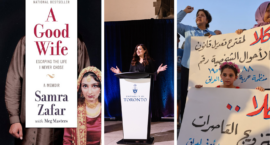
‘When Power Curdles Into Violence’: Escaping the Tradwife Lifestyle

Brides shouldn’t be thinking about homework just before their wedding day. But when I entered into an arranged marriage with a 28-year-old stranger, I was still just a 17-year-old girl who loved her private British school and her books and cricket—and so I found myself thinking about a creative-writing assignment I had recently finished. I’d written a story about a young woman who wore jewelry in the shapes of snakes. I wrote that they suddenly came to life and they slithered up to her throat, strangling her. 

As someone who was forced into a life I never chose, I am appalled that women, who are more empowered than ever, are effectively choosing a life without choice—putting themselves in a prison of their own making.