Through Art and Storytelling, Artist Harmonia Rosales’ First Book Brings African-Centered Myths to Life

When Harmonia Rosales first unveiled The Creation of God in 2017—a reimagining of Michelangelo’s The Creation of Adam with a Black woman as the divine—she didn’t just challenge art history; she remade it in her image. With her brush, Rosales flipped the script on Western depictions of power, beauty and divinity, centering Black womanhood and African spiritual traditions long erased from the canon.

Her new book, Chronicles of Ori, continues that reclamation through story. A lushly illustrated volume rooted in Yoruba mythology, the work brings to life the Orishas, divine figures of West African cosmology, and weaves them together with familiar names like Eve—both biblical and mitochondrial—into a mythology that claims space for the African diaspora beyond enslavement.

“I felt that we needed a mythology,” Rosales told Ms. “We needed something to connect to besides enslavement, because that’s what seems to be in the Western canon.”

With Chronicles of Ori, she offers that connection: a world where African gods are unmasked, women embody creation itself, and the sacred is painted in brown skin. Through her art and her words, Rosales restores what history fragmented—melding spirituality, storytelling and imagination into what she calls a new kind of mythology, one that reclaims both memory and power.

Two New Laws Could Transform Black Maternal Health in California, If We Get Implementation Right

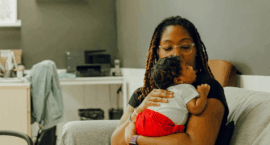
In California—a state where Black women account for 21 percent of pregnancy-related deaths and just 5 percent of births—systemic racism continues to shape maternal outcomes. Despite past reforms, accountability has fallen short.

That is why the recent signing of AB 260, the Sexual and Reproductive Health Care Act, and AB 55, the Freedom to Birth Act, represents a watershed moment.

How We Can Turn Away From Medicalized Birth Culture and Reset the U.S. Birth Care System

The U.S. has been doing birth backwards for decades, providing highly medicalized, costly care despite poor outcomes, and ignoring data that estimates at least 60 percent of U.S. pregnancies are low-risk and could be safely supported by midwives in a community setting.

Alice Walker writes, “The most common way people give up their power is by thinking they don’t have any.” It is this self-defeating pattern in the face of authoritarianism that the current U.S. federal government is counting on. And sadly, a pattern to which some of our most powerful institutions have succumbed. Fear and chaos are tried and true tools of oppression. Vision and courage, however, are exponentially stronger.

America’s birth care system can be reset, but not by fearfully resisting its collapse or playing in its rubble.

(This essay is part of a collection presented by Ms. and the Groundswell Fund highlighting the work of Groundswell partners advancing inclusive democracy.)

‘Freeing Black Girls’ and ‘Loving Black Boys’: Tamura Lomax on Revolutionary Mothering During Troubled Times

Tamura Lomax, a trailblazing Black feminist religious scholar, is on a mission to deliver a “Black feminist Bible on racism and revolutionary mother” with two companion books. The first, Freeing Black Girls, was published this year (2025); the second, Loving Black Boys, comes out next year.

Ms. contributing editor Janell Hobson spoke with Dr. Lomax about her latest works and the radical vision of “revolutionary mothering” that guides them.

“Black feminist mothering becomes this experiment. If people can teach sexism and hatred and racism, can we teach Black feminist politics? Is that possible? If we just do it from birth, and it’s just normal everyday talk it’s not this lesson that happens once at the dinner table but it’s just part of our everyday living. Can we do that the same way that we teach hatred?

“Revolutionary mothering is teaching those Black feminist politics everywhere—in the car, on the couch, during movie night, after the basketball game, in the football stands. It’s teaching a radical politics of our rights, our collective right to bodily autonomy first and foremost.”

Who Gets to Procreate and Parent? A Black Feminist Critique of the Pronatalist Agenda

Pronatalism is not simply about encouraging births—it is a political project rooted in racism and control. Its goal is to engineer a future that permits only certain people to bear and raise children while coercing or punishing others for reproducing or parenting.

Adriana Smith’s experience of coerced reproduction is a devastating example: a Black nurse and mother declared brain-dead, yet kept on life support for months to sustain her pregnancy under Georgia’s restrictive abortion laws. This is what pronatalism looks like in practice—the state asserting ownership over a Black woman’s body.

As Black feminists, we understand that reproductive choices are personal, but they are also deeply shaped by structural power. Pronatalist leaders and influencers cloak their agenda in the language of family and morality, but in truth, they seek to restrict autonomy and consolidate control. Reproductive justice, by contrast, insists on every person’s right to decide whether and how to have children, and to parent in safety and dignity.

Embattled, Yet Empowering: ‘One Battle After Another’ Smashes Centuries-Old Paradigm of Black Victimhood

Paul Thomas Anderson is not the first to subvert one Black femme stereotype after another. He’s just the whitest. However, the director’s latest film, One Battle After Another, serves to hold up a mirror to 2025 America.

Some critics have accused Anderson of writing Black women who are too sexualized, stereotypical or sidelined. However, recent interviews reveal that actors were often encouraged to go off script in order to add more authenticity to their roles. So it’s likely that many of the shades of gray used to paint these Black women as imperfect yet inspiring insurgents are derived from the Black women with whom PTA collaborates and cohabitates.

For me, the results defied history with humor and humanity.

‘I Don’t Want to Live in Low-Income Housing Forever’: How Guaranteed Income Is Helping One Mom Dream Bigger

Front & Center amplifies the voices of Black women navigating poverty—highlighting their struggles, resilience and dreams as they care for their families, build careers and challenge systems not built for their success. Now in its fourth year, Front & Center is a collaboration between Ms. and Springboard to Opportunities, a nonprofit based in Jackson, Miss., working alongside residents of federally subsidized housing as they pursue their goals.

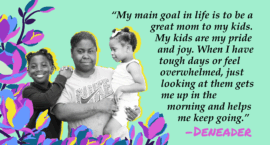
Deneader is a 37-year-old mother of three. She’s a participant in the Magnolia Mother’s Trust, receiving one year of guaranteed income as she searches for stable work and builds a better future for her family.

“I think a lot about going back to school, but my youngest needs me. Tamara is still little and having her at home takes up most of my focus.”

“I also want to get back on my feet fully and become a better person. I know the first step will be finding the right job—something stable, something that allows me to take care of my family. I don’t want to live in low-income housing forever. I know some people do it, but I want more for us.”

One Megabill for the Megarich

The Trump administration is calling its new budget “the most pro-family legislation ever crafted.” But for women like Bre’Jaynae Joiner, a single mother of two in Oakland, the cuts to Medicaid and SNAP threaten her family’s very survival.

Over the next decade, more than 11 million Americans—mostly women and children—are expected to lose health coverage, while deep food assistance cuts and work requirements will push even more families into crisis. Advocates call the bill a massive transfer of wealth to the rich at the expense of the poor, a policy that will shutter rural hospitals, deny essential care and worsen maternal mortality.

As Sen. Raphael Warnock puts it plainly: “If you cut $900 billion out of Medicaid, people are going to die.”

The Blueprint Reclaimed: Why America Needs More Black Midwives

Black women are three to four times more likely to die from pregnancy-related complications than white women. And yet, the very people we know we can rely on to protect us the most—Black midwives—have been nearly erased from the national birth narrative.

We must train more Black midwives and re-educate the public about midwifery practice. We also need funding, mentorship pipelines and community investment. We need our stories told, our legacy restored and our futures protected.

To become a Black midwife in America today is to resist and reclaim what was stolen. It is to plant seeds in soil that tried to bury us and watch them bloom anyway.

Every Black mother deserves someone who sees her. And every Black baby deserves to be welcomed into the world by someone who believes in their right to thrive.

(This essay is part of a collection presented by Ms. and the Groundswell Fund highlighting the work of Groundswell partners advancing inclusive democracy.)

Five Ways We Can Support Women in Recovery Without Punishing Them

Recovery is not just a personal journey—it is a struggle shaped by policies that too often punish women rather than support them. From losing custody of their children to facing barriers in treatment and the criminal legal system, women with substance use disorder encounter hurdles that men rarely experience. Trauma, stigma and inadequate access to care create a landscape where seeking help can feel like choosing between survival and motherhood.

My sister’s story—years of overdose, illness and family separation—mirrors countless others who live at the intersection of addiction, gender and policy neglect.

The solutions are clear but rarely implemented. Women need access to care that recognizes their lived realities, programs that allow them to keep their families together, and protections that prevent survival strategies from being criminalized. Trauma-informed, women-specific treatment, expanded childcare, extended postpartum coverage, and decriminalization of behaviors tied to survival are not optional—they are essential. Until our systems prioritize dignity, equity and healing, the numbers will keep rising and the stories will keep repeating. Recovery must be recognized as a right, not a risk.

***

The road to recovery—and the right to recovery—is essential to a free and fair democracy. This essay is part of a new multimedia collection exploring the intersections of addiction, recovery and gender justice. The Right to Recovery Is Essential to Democracy is a collaboration between Ms. and the O’Neill Institute for National and Global Health at Georgetown Law, in honor of National Recovery Month.