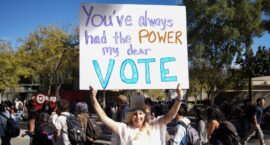
Community Is as Important to the Fight for Democracy as Everything Else

It has been a hell of a week for gridlock in my hometown, New York City, as global leaders convene for the 80th United Nations General Assembly—where on Monday, President Donald Trump delivered an hour-long rant calling climate change a hoax and claiming to have personally ended seven wars in his first seven months in office.

It wasn’t all grievance and gloom. Monday also marked the 30th anniversary of the historic United Nations Fourth World Conference on Women in Beijing, where 189 nations adopted an ambitious “Platform for Action” to acknowledge and advance women’s rights. It was there that future Secretary of State Hillary Rodham Clinton famously pronounced “women’s rights are human rights.” For more about the anniversary, read this extraordinary report, released this week and co-authored by Contrarian contributor Jennifer Klein, “Beijing+30: A Roadmap for Women’s Rights for the Next Thirty Years.” It details the myriad ways regression on women’s freedom is also an early sign of weakened democracy and outlines critical priorities to advance women’s rights in the immediate future.

Vile Reactions to Strong Women Can’t Silence Our Voices

Being on the receiving end of yet another violent and targeted email from a stranger hit a little differently this week, as the nation grapples with the murder of Charlie Kirk and its fallout.

Mostly what I’m feeling since receiving an email from Robert G. Smith—who signs off as “Bonecrusher Bob”—is a deep sense of obligation to the girls and women in my life. In his message, he attacked me with grotesque language, mocking my intelligence, my sexuality and my writing on menopause, telling me to “stick to brainwashing the little insurrectionist bastards who attend [my] shithouse skool.”

Much of my work is about developing leaders—running a law school center and fellowship program, mentoring high school and college students to become public writers, and helping grassroots leaders use the op-ed as a tool for advocacy. My own writing shines a light on women’s health issues that have long been ignored, like menopause, highlighting not just problems but solutions lawmakers can get behind.

The Bonecrusher Bobs of the world will not deter me, and I see the same resilience in those around me.

Just this past weekend, a teenager I mentor asked how to handle an op-ed she’d drafted about aggressive masculinity at her school; my answer was simple: We keep raising our voices with conviction, exposing lies, and showing up fully as ourselves. And when necessary, yes, we share screenshots.


Texas Loves Its Bounty Hunters and Hates Its Women

Over Labor Day weekend, Texas quietly rolled out yet another measure to restrict reproductive freedom. Senate Bill 33, which took effect Monday, bans municipal funding for abortion support—stripping cities like Austin and San Antonio of the ability to allocate local dollars to abortion funds, even for residents forced to travel out of state for care. The law denies “millions of Texans the opportunity” for their communities to support safe, legal abortion access, according to Jane’s Due Process, a nonprofit serving young people navigating the state’s bans.

It’s a playbook Texas has perfected. Four years ago, the state’s SB 8 created the infamous “bounty hunter” model, empowering private citizens to sue anyone who helps a person get an abortion after six weeks of pregnancy and rewarding them with $10,000. That law went into effect while Roe v. Wade was still technically the law of the land, an early harbinger of the Supreme Court’s Dobbs decision. Since then, Texas has become the national laboratory for copycat measures that push the boundaries of authoritarian control—from targeting trans people to censoring librarians.

The toll is devastating. Maternal deaths and infant mortality are on the rise; patients risk sepsis because doctors fear prosecution; and the cost of accessing abortion care has skyrocketed. Advocates like Jane’s Due Process warn that these laws are not just about abortion—they are about consolidating state power, silencing local communities and testing the limits of democracy itself. “This is another attack on democracy in an antiabortion disguise,” said Lucie Arvallo, the group’s executive director.

Of Course Trump Threatened Ballot Access on the 19th Amendment’s Anniversary

The 19th Amendment turned 105 this week. Instead of marking progress, we’re watching Trump officials entertain the idea that women’s right to vote is negotiable. Defense Secretary Pete Hegseth amplified a pastor calling for repeal of the amendment, and when pressed, his office issued a half-hearted “of course” women should vote. We’ve seen this playbook before: Roe was safe, contraception wasn’t at risk—until both were.

Trump himself piled on this week, vowing to eliminate mail-in ballots and voting machines ahead of the 2026 midterms. He can’t legally do it, but the threat is the point. Combined with the SAVE Act, which could disenfranchise married women who changed their names, the message is clear.

The anniversary of women’s suffrage is not just history—it’s a warning flare. The right to vote is under attack, and the fight this time is for all the marbles.

‘It Was Never Mine’: August, Autonomy and the America We’re Losing

Welcome, August! When my kids were young, I used to refer to it as the juiciest month of the year, loving its bloated days, all sunshine and sweat.

In 2025, I have to admit this month is yet another joy I am doing my best not to let the relentless news-and-doom cycle ruin. Curating a round-up of breaking headlines about gender and democracy is surely not for the faint of heart or spirit.

I’ll be doing all I can to channel Taylor Swift (Trump only wishes he could) and trying to salvage August so that it is “sipped away like a bottle of wine.”

Pregnant and Unmarried? In Tennessee, That’s Now Grounds for Denial of Care.

This week marked the first reported case of a woman being denied prenatal care for being unmarried in the state of Tennessee and the country. And it is the direct result of the state’s 2025 Medical Ethics Defense Act, which went into effect in April. The law enables physicians, nurses, hospitals and insurers to invoke religious, moral or ethical objections to the provision of care and treatment, with no legal requirement to provide patients with a referral or alternative.

Menopause Finally Gets a Seat at the Table

On Thursday, July 17, the FDA held a two-hour briefing featuring political leadership and a panel of doctors to focus on menopausal hormone treatments. Among the issues addressed was a decades-old labeling requirement for estrogen products—a.k.a. the “black box warning.”

FDA commissioner Martin Makary appears willing to consider scrapping it on packaging for localized vaginal estrogen treatment. The FDA should do so: The label is inaccurate and utterly alarming.

In the case of menopause, a rare combination of bipartisan commitment and robust public attention reflect not just heightened interest among constituents, but also proof of the democratic process actually working.

America’s Healthcare Crisis Is Coming for All Women

Less access to healthcare—either by cutting Medicaid benefits or discouraging doctors from practicing in restrictive states—will affect antiabortion and pro-abortion women equally.

This is about far more than abortion. There will be more maternal deaths. There will be more deaths from cervical and breast cancer. More women will die from complications of cardiovascular disease and diabetes. There will be more suffering from infertility, endometriosis and fibroids.

Does anyone in power care? We certainly do. And we better make sure our voices are heard. All of our lives depend on it.