Women’s and Girls’ Wrestling Is Ready for Its Modern Era

Women’s and girls’ wrestling has grown considerably in the U.S. since the late ’80s. After the sport’s debut at the 2004 Olympics in Athens, more and more girls began joining high school wrestling teams as more high schools began making teams for girls.

Although the sport carries a long history, women’s wrestling is now more popular than it’s ever been. The sport seeks to create community after being ignored for many years, and will be featured at the 2028 Olympic Games in Los Angeles. It will be in that moment in Los Angeles, under the Olympic flame, that women’s and girls’ wrestling will close the chapter of its trailblazing journey and launch into a modern era.

A Global Telehealth First: Women Help Women Begins Producing Abortion Pill Combipack

The feminist telehealth provider Women Help Women is redesigning how abortion pills are packaged to reflect what users actually need: a combination pack that includes one mifepristone tablet and eight misoprostol tablets for use up to 12 weeks of pregnancy.

“It’s a huge revolution of who actually gets to decide when, how and with the support of whom they can have an abortion and until when,” said Women Help Women coexecutive director Kinga Jelinska. “It centers the needs of users rather than institutions or markets. The underlying notion is that abortion can be friendly, and abortion can be easy.” 

Self-managed abortion is disruptive. We were told that abortion is a difficult decision; that it has to be difficult to access, and that only doctors control it. Self-managed abortion subverts that,” said Lucía Berro Pizzarossa, fellow coexecutive founder.

International Telehealth Provider ‘Abortion Pills in Private’ Ready to Ramp Up if FDA Restricts Mifepristone

As Trump’s FDA threatens to block U.S.-based medical providers from offering telehealth abortion, one international telehealth provider—Abortion Pills in Private—has vowed to continue providing mifepristone and misoprostol to U.S.-based patients, no matter what.

Their commitment is clear: “We will continue to send mifepristone, even if the FDA takes it off the market inside the U.S.. … We want to make this service easy, the best experience that it can be, with dignity. You can just go online, and it’s easy, and there’s no judgment. If you need this, we are here for you. Here are your pills. Here’s the support service that you need. You can do this from home. Whatever the reason is, we want to have that service there for you to be able to do that, no matter where you live.”

Their service and determination grew directly out of the post-Roe crisis. People find Abortion Pills in Private through the Plan C website. Since March 2024, they have served almost 3,500 patients in the U.S., most of them living in the hardest-hit states—those with abortion bans and severe restrictions. “They are from all over, but they are very much from banned states. Texas is always number one. Then Florida, Georgia. Even Ohio and Pennsylvania. There are some blue states too.”

Calling Foul: Breaking Down WNBA Pay and Why It Matters

There’s a long history of women in sport fighting for equal pay, and what’s happening with the WNBA today is less of a mirror of the current gender pay gap and more of a throwback to a time when women’s efforts were even more deeply devalued. The WNBA is a visible legacy of Title IX, and an indication of how far there is left to go. 

These are women at a pinnacle of professional achievement, who are still beholden to structural barriers. This is not a sports issue. It is a feminist issue.

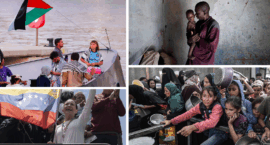
Ms. Global: Greta Thunberg Detained in Israel, Pakistani Woman Challenges Menstrual Pad Tax, and More

The U.S. ranks as the 19th most dangerous country for women, 11th in maternal mortality, 30th in closing the gender pay gap, 75th in women’s political representation, and painfully lacks paid family leave and equal access to health care. But Ms. has always understood: Feminist movements around the world hold answers to some of the U.S.’s most intractable problems. Ms. Global is taking note of feminists worldwide.

This week: News from Mali, Venezuela, Gaza, and more.

From Iceland’s ‘Women’s Day Off’ to No Kings, Progress Begins When Women Stand Together

Weekend Reading for Women’s Representation is a compilation of stories about women’s representation in politics, sports and entertainment, judicial offices and the private sector—with a little gardening mixed in!

This week:
—Fifty years ago, the women of Iceland changed the course of their nation … not through an election or a revolution, but through one simple, collective act: They stopped. On Oct. 24, 1975, 90 percent of Icelandic women refused to work, cook or care for children for a single day. That strike, known as the Women’s Day Off, became a watershed moment for equality, but it didn’t emerge overnight.
—Women hold the majority in the Bolivia legislature.
—Japan confirms Sanae Takaichi as its first woman prime minister.

… and more.

After the War: Author and Aid Worker Claudia Krich Challenges the Myths of Vietnam

American humanitarian worker Claudia Krich—co-director of the American Friends Service Committee medical relief program from 1973 to 1975—was one of only a handful of Americans who stayed in Vietnam past April, 30, 1975, after the war ended. (She and her husband finally left in July 1975.)

Fifty years later, in April, Krich published her full journal from those months in Vietnam. Those Who Stayed: A Vietnam Diary, now available from the University of Virginia Press, combines Krich’s 1975 diary—including sections originally published in Ms.‘ July 1976 print issue—with extra historical content and some first-person accounts by people mentioned in or relevant to the book.

To celebrate the book’s release earlier this year, Claudia Krich communicated with Ms. about her book and her experiences as an American woman living and working in Vietnam during this historic moment.

“People think the war was North versus South, but that’s not true. … I hope my book motivates more people to travel, to take risks, to be outspoken, to record what they experience.”

As Trump Targets Portland, a New Report Shows How the City Became a Model for Women’s Representation

Weekend Reading for Women’s Representation is a compilation of stories about women’s representation in politics, sports and entertainment, judicial offices and the private sector—with a little gardening mixed in!

This week:
—How did Portland, Ore., achieve one of the mosdt representative city councils in the country? Through structural reform and community-driven organizing.
—A woman will be Ireland’s next president.
—Japan is posed to make a historic shift in women’s leadership.
—For the first time, a woman will lead one of Christianity’s oldest institutions.
—We celebrate the life of Jane Goodall.
—We mark what would be Eleanor Roosevelt’s birthday. She helped craft the Universal Declaration of Human Rights—insisting that freedom must include not only political rights, but also the right to food, housing and dignity: “You cannot talk civil rights to people who are hungry.” In the midst of Cold War tension, Roosevelt’s words were a quiet but radical act—a reminder that peace often begins not in policy or power, but in empathy and connection.

… and more.

The Health of a Democracy Is Measured by Its Leaders: Celebrating Women’s Political Leadership in Mexico, Iraq, Nepal and More

Weekend Reading for Women’s Representation is a compilation of stories about women’s representation in politics, sports and entertainment, judicial offices and the private sector—with a little gardening mixed in!

This week:
—Suhikla Karki is the new prime minister of Nepal, following demonstrations that toppled the previous government and negotiations between Gen Z demonstrators and the military.
—On Oct. 24, an open-seat contest for Ireland’s next president is taking shape for a seven-year term, with two of the three candidates already on the ballot being women; the field will be finalized later this month.
—Mexican President Claudia Sheinbaum has one of the highest approval ratings of national leaders a year after her trailblazing elections.
—As the United Nations prepares to open its General Debate for the 80th session in New York next week, I’ve been carrying Jacinda Ardern’s words with me: “I really rebel against this idea that politics has to be a place full of ego and where you’re constantly focused on scoring hits against one another. Yes, we need a robust democracy, but you can be strong, and you can be kind.”
—Iraq will hold its next parliamentary elections in November. Women hold 28.9 percent of seats in its Parliament, just about the same as the 28.7 percent held by women in the U.S. House of Representatives. 

… and more.

Remembering the Mother’s Letter That Secured the 19th Amendment

Weekend Reading for Women’s Representation is a compilation of stories about women’s representation in politics, sports and entertainment, judicial offices and the private sector—with a little gardening mixed in! 

This week:
“Dear Son … Hurray and vote for Suffrage and don’t keep them in doubt.” On Aug. 18, 1920, Tennessee became the 36th state to ratify the 19th Amendment when young legislator, Harry Burn, followed the advice of his mother, Febb Burn, and cast the decisive vote in favor. Febb—a college-educated widow who read three newspapers a day and strongly felt her mind was the equal of any man’s—had long impressed upon her son the importance of suffrage.
—California women are far more likely than men to be “energy burdened,” spending more than 6 percent of their income on home energy costs, including utilities for heating, cooling and power.
—RepresentWomen’s 2025 Gender Parity Index (GPI) offers encouraging news: Women’s political power in the United States is reaching new heights, with states like New Hampshire, Oregon and Maine achieving gender parity for the first time in history. But the United States still has a way to go, ranking 77th globally in women’s representation, but more importantly, it lags behind nearly all its major democratic allies.
—Economic struggle, especially among women, is profoundly shaping the political moment heading into 2026. Understanding the significance for female voters is not merely a political embellishment; it is fundamental to securing electoral victories in the midterm elections and effecting meaningful change.

… and more.