A Global Telehealth First: Women Help Women Begins Producing Abortion Pill Combipack

The feminist telehealth provider Women Help Women is redesigning how abortion pills are packaged to reflect what users actually need: a combination pack that includes one mifepristone tablet and eight misoprostol tablets for use up to 12 weeks of pregnancy.

“It’s a huge revolution of who actually gets to decide when, how and with the support of whom they can have an abortion and until when,” said Women Help Women coexecutive director Kinga Jelinska. “It centers the needs of users rather than institutions or markets. The underlying notion is that abortion can be friendly, and abortion can be easy.” 

Self-managed abortion is disruptive. We were told that abortion is a difficult decision; that it has to be difficult to access, and that only doctors control it. Self-managed abortion subverts that,” said Lucía Berro Pizzarossa, fellow coexecutive founder.
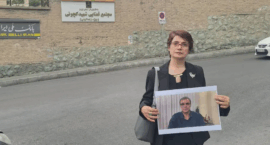
Reza Khandan: A Year in Prison for Supporting Women’s Rights

It has been a year since 60-year-old Iranian human rights activist Reza Khandan was arrested in what was clearly another official attack on his family. Political prisoners in authoritarian regimes are meant to disappear into hopeless silence, but Reza has become a force to be reckoned with.

“The crime for which Reza Khandan is in prison is the crime of love,” writes Ariel Dorfman, author and friend of Khandan and his wife, activist Nasrin Sotoudeh. “Not just love of his country and its culture. Not just love of humanity and our rights to be human. Not just love for the future. But also, the real reason why he is being punished: Reza loves the extraordinary Nasrin with whom he shares a life, a land, and a cause. How those who persecute Reza must fear his loyalty and steadfastness. He will prevail.”

“I will continue until I achieve legal rights, restore my family’s dignity, and change the conditions of the prison administration,” Khandan wrote. “May the shadow of terror and tyranny be removed from our beloved country one day. And finally, I would like to add: ‘I object to the compulsory hijab!’” 

The Resistance Is Everywhere

These past 10 months have been tough. Every day a fresh outrage, more trampling of the Constitution and a new attack on common decency. Taking a page from Hollywood, Trump and his administration seem to have embraced a strategy of “everything, everywhere all at once.” 

But, unfortunately for them: The resistance has also been everywhere all at once, too.

There is no doubt that when historians look back on this sordid moment in history, they will conclude that it was women, and feminists, who led the way out of it.

Feminists vs. Authoritarians: Honoring Leaders Holding the Line

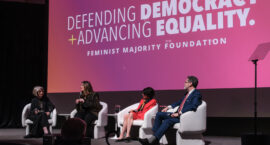
Greetings from Los Angeles—on the heels of a very special evening to celebrate the heart and soul of the democracy movement. On Tuesday night, Ms. paid tribute at the Global Women’s Rights Awards to bold leaders operating at the intersection of media, the law and storytelling—recognizing these as the essential trifecta for toppling authoritarianism. And, importantly, for fueling a feminist future.

Alliance Defending Freedom Succeeded in Overturning Roe. Now It’s Turning to the United Kingdom.

If you follow the fight over abortion access in the U.S., you’ve likely heard of the Alliance Defending Freedom (ADF). The powerful nonprofit was instrumental in Dobbs v. Jackson Women’s Health Organization, the Supreme Court case that overturned Roe v. Wade in 2022. ADF drafted model legislation used to defend Mississippi’s 15-week ban and has long championed policies targeting LGBTQ+ rights, contraception access and same-sex marriage.

Now, ADF is setting its sights across the Atlantic. The organization—which boasts operations in 112 countries—has been quietly expanding its influence in Britain through its new alliance with the right-wing Reform Party, led by populist figure Nigel Farage.

The Reform-ADF partnership is following a familiar playbook: reframing reproductive rights as a free-speech issue. ADF has backed efforts to challenge the Public Order Act of 2023, which established “safe access zones” around abortion clinics—150-meter perimeters designed to prevent harassment and obstruction. Despite broad public support for these zones (77 percent of Britons favor them), Farage and his allies have called the policy a “sinister crackdown on expression.”

“There is a clear pattern here of U.S.-funded antiabortion activists testing the limits of the new U.K. law, seemingly trying to find the most acceptable-looking behavior to gain public sympathy, and then using that to try to tear down the law,” said Karen Wright, public affairs manager for Humanists U.K. “It is deeply concerning to see efforts from outside groups attempting to influence domestic law, particularly when it comes to women’s reproductive freedom and bodily autonomy.”

Why Won’t the U.S. Stop Child Marriage?

Child marriage is a persistent, evolving, global problem, and the United States is far from immune: Between 2000 and 2018, nearly 300,000 children were married in America—most of them girls wed to adult men.

Lack of a strong legal framework to prevent child marriage in the U.S. contributes to its prevalence. Banning child marriage is still in the best interest of America’s children and teens.

From Iceland’s ‘Women’s Day Off’ to No Kings, Progress Begins When Women Stand Together

Weekend Reading for Women’s Representation is a compilation of stories about women’s representation in politics, sports and entertainment, judicial offices and the private sector—with a little gardening mixed in!

This week:
—Fifty years ago, the women of Iceland changed the course of their nation … not through an election or a revolution, but through one simple, collective act: They stopped. On Oct. 24, 1975, 90 percent of Icelandic women refused to work, cook or care for children for a single day. That strike, known as the Women’s Day Off, became a watershed moment for equality, but it didn’t emerge overnight.
—Women hold the majority in the Bolivia legislature.
—Japan confirms Sanae Takaichi as its first woman prime minister.

… and more.

Russia Was Once a Revolutionary Feminist Motherland

Russia’s hostility to feminism today stems not from its foreignness, but from memory. A century ago, it was Russian women who lit the first sparks of revolution. On International Women’s Day in 1917, factory workers filled the streets of Petrograd demanding bread, peace and equality—an uprising that toppled the Romanovs and pulled the world into modernity. Under the Bolsheviks, women won the right to vote, divorce became accessible and abortion was legalized. For a brief, radical moment, the Soviet experiment made women’s liberation a pillar of the state.

Julia Ioffe’s book, Motherland: A Feminist History of Modern Russia, from Revolution to Autocracy, reminds us that today’s Russia rejects feminism precisely because it once knew what it could do: ignite revolutions, upend hierarchies and reimagine power itself.

The Ripple Effects of the U.S. Retreat from International Reproductive Care

The U.S. withdrawal of international reproductive health funding is already having devastating effects around the world. Clinics are closing, health workers go unpaid, and essential medications and contraceptives sit unused in warehouses while millions of women and families lose access to life-saving care.

These abrupt cuts are not just administrative—they are a direct attack on decades of global health progress, putting children, pregnant women and marginalized communities at heightened risk of preventable disease, unintended pregnancy and death.

Yet there is still a path forward. The infrastructure to deliver reproductive and public health services remains in place, and health workers are ready to act. If funding is restored, we can prevent the worst outcomes, safeguard global health, and ensure that the fundamental human rights to health, life and bodily autonomy are protected.

The global community must act urgently to reverse the harm and prevent a full-scale public health and human rights crisis.