‘Mife No Matter What’: Community Abortion Providers Pledge to Continue Sharing Free Abortion Pills, Even if FDA Imposes Restrictions

Since 2022, community providers have built a nationwide network discretely mailing free abortion pills to those in ban or restricted states.

People can find community providers through several platforms that research and share information about abortion pill access, including Plan C, I Need An A and Red State Access. On these sites, visitors can search for options by their state or territory. Once the client reaches out, community providers typically respond within 24 hours and mail the pills within 48 hours. The medication typically arrives within seven days, and are shipped in an unmarked, discrete package.

More than 100 people are involved in community provision across the United States. One provider told Ms. why she stepped in to become a community provider: “I saw a great need and I could do it,” noting she is single with no children and is white, making her less vulnerable to police surveillance. “I love helping people. It’s rewarding.”

A recent client wrote back to her community provider with a message of gratitude: “I would like to extend my gratitude and appreciation. What you guys are doing is saving lives and giving us a choice when we don’t have the means of money or the resources. Thank you so much. I received the package and it worked as intended. Thank you for being here for me and millions of other girls that are in need.”

The New York Times’ Recent ‘Abortion Pollution’ Story Serves the Antiabortion Agenda

For the last three years, Students for Life of America (SFLA) has sought to use environmental concerns to attack abortion rights, claiming—without scientific evidence—that the medication mifepristone contaminates U.S. water supplies and threatens wildlife, the environment and potentially human health.

A recent New York Times article amplified this antiabortion effort, presenting these claims without substantial context. The article does not include interviews with anyone informed about the politics behind the campaign or the science of mifepristone in wastewater. Only a brief mention—seven paragraphs in—notes that environmental experts have dismissed SFLA’s claims, before returning to treating the claims as a legitimate concern. 

“There is absolutely no evidence that this is an environmental issue,” said Nathan Donley, the environmental health science director for the Center for Biological Diversity. “Pharmaceutical waste can be a big issue when we’re talking about widely used drugs, but to somehow point to mifepristone as a bad actor here is completely disingenuous.”

Jack Vanden Heuvel, a molecular toxicologist at Pennsylvania State University, agreed: “Most wastewater treatment plants are very effective at getting rid of any mifepristone that is there.” He described SFLA’s position as “a pretty weakly supported argument.”

America Is an Increasingly Dangerous Place for Women and Girls 

In America’s hyper-macho, gun-drenched culture, growing up female has never been safe. But under the Trump administration, America is becoming a much more dangerous place for women and girls.

America is dangerous for women and girls because our leaders choose to make it so. The Trump administration has already begun blocking access to abortion and Medicaid coverage for reproductive health, as well as targeting the rights of pregnant people within the 2023 Pregnant Workers Fairness Act.

Already, the macho culture of the U.S. has steadily made women’s safety in the nation decline. Around 41 percent of women in the U.S. have experienced sexual violence, while a third of women reported severe assault by a husband or boyfriend. The normalization of gun violence and violent pornography have also run rampant across the country, making America more dangerous day by day.

Twenty-Five Years of Mifepristone: How Activists Brought the Abortion Pill to America and Changed Reproductive Health Forever

At the urging of antiabortion advocates and politicians, and based on a flawed and biased report put out by an antiabortion group, the Trump administration announced the launch of a new review of mifepristone—despite 100 peer-reviewed scientific studies proving the safety and efficacy of these medications and safe use by over 7.5 million U.S. women.

On the 25th anniversary of FDA approval of mifepristone, reproductive rights supporters are celebrating the creative, determined and courageous advocates who brought this medication to market.

One organization that played a critical role in bringing mifepristone, known as RU-486, to the United States was the Feminist Majority Foundation (FMF)—today the publisher of Ms.

Why Attempts to Stop the Flow of Abortion Pills Into Texas Will Fail

Shield laws, telehealth providers and international networks mean Texas’ new bounty-style restrictions are unlikely to stop abortion pills from reaching patients.

“It’s possible that some of the providers may step back, but access is still going to be possible by mail in Texas, regardless of this attempt to instill fear in people,” said Elisa Wells, co-founder and access director at Plan C, which researches and shares information about how people are accessing abortion pills in the United States. “The more crazy stuff that the Texas legislature does around this to try and block access, the more visible the option of pills by mail becomes.”

University Leaders Must Act: An Open Letter on the Threats Facing Critical Interdisciplinary Programs Like Women’s and Gender Studies

Academic leaders today face a defining test. As the Trump administration seeks to strip research funding, eliminate diversity and inclusion, and give political appointees sweeping control, presidents and provosts must decide what legacy they will leave. The attacks on women’s, gender and sexuality studies—as well as Africana, Indigenous, disability and other interdisciplinary programs—are part of a broader campaign to delegitimize fields that challenge systems of privilege. We are again in turbulent times, not unlike past eras when leaders had to defend the teaching of evolution, admit women and Black students, or resist political interference. The choices made now will echo for decades.

Despite claims that these programs are too small or unsustainable, the evidence tells a different story. These courses draw students across disciplines, fulfill general education requirements, and prepare graduates for a diverse global workforce. Market data show they are often cost-effective, with faculty teaching across departments and reaching wide audiences. Employers stress the importance of the very skills our graduates carry: critical thinking, collaboration and cultural humility. The question for higher education leaders is clear: Will you stand with these programs that represent the best of our democratic values—or allow them to be dismantled by political opportunism and short-sighted cuts?

Digital Deception: Beware the Rise of Fake Telehealth Abortion Clinics

For decades, antiabortion crisis pregnancy centers (CPCs) have preyed on vulnerable women, planting themselves next to abortion clinics to misdirect and confuse women seeking abortion care. Now, as telehealth abortion is becoming a more common way to access abortion care—accounting for one in four abortions in 2024—the CPC industry is moving to sabotage this vital option, especially for women living in states with abortion bans and restrictions. The two-billion-dollar CPC industry is now developing telehealth strategies to mislead women seeking telehealth abortion and divert them away from legitimate providers.

Many CPC websites feature pop-up chats purportedly offering consultations with nurses. What’s new today is that more and more CPCs are marketing themselves as telehealth providers, claiming to offer appointments with medical professionals.

“CPCs target the most vulnerable—young people, uninsured and underinsured people, women of color and immigrants—the very people with the fewest options and greatest barriers to abortion and all reproductive healthcare,” said McKenna. “As our country faces worsening maternity care deserts, provider shortages and devastating cuts to the reproductive healthcare safety net, pregnant women and teens need honest, evidence-based care more than ever, not ideologically driven pseudo-health care.” 

Illinois Becomes First Midwest State to Require University Health Centers to Offer Abortion Pills

Illinois made history late last month when Gov. JB Pritzker signed HB 3709, the first law in the Midwest to require public colleges and universities to ensure students have convenient access to medication abortion and contraception.

Illinois joins the expanding group of states requiring student health centers to offer abortion pills—California first in 2019, followed by Massachusetts in 2022 and New York in 2023.

For students, ensuring abortion care is available on or near campus is essential. Research shows when students are forced to leave campus for medication abortion, they face serious roadblocks: barriers in finding a provider, securing an appointment, and dealing with the time and cost of often long, slow public transit journeys.

“Since Roe fell, we’ve worked hard to ensure that Illinois is a safe haven for reproductive freedom in the Midwest and leading the country in strengthening women’s rights,” said Lt. Gov. Juliana Stratton. “As Donald Trump and his administration continue to pull every lever they can to rip rights away from women, Illinois is making sure every woman, at every stage of life, can get the legal care they need from providers they trust.”

Trump’s Pronatalist Agenda Weaponizes Motherhood to Push Women Out of Public Life

The Trump administration is using one of the oldest tools of patriarchy—promising rewards for compliance—through a wave of proposed pronatalist policies designed to push women into motherhood and encourage them to give birth to more children.

A recent report by the National Women’s Law Center warns that these proposals are not random: They stem from an “obscure, dangerous, and increasingly influential movement of ‘pronatalists’” that are now dictating the Trump administration’s family policy. 

According to NWLC, there are two major groups of pronatalists: Silicon Valley tech elites, such as Elon Musk, who claim that “high-IQ” people like themselves should be having more children; and traditional conservatives, who advocate for pushing women back into stay-at-home motherhood.

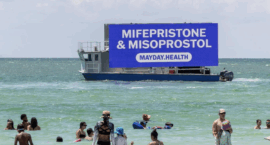
Billboards, Trucks, Gas Pumps, Newspapers and Even a Boat: Mayday Health Advertises How to Access Abortion Pills Across the South and Midwest

Boston-based Mayday Health’s in-your-face defiance of threats from red-state governors has ratcheted up in recent months. Mayday shares information on to access abortion pills in all 50 states, with the goal to “empower people to make their own informed decision about their own bodies.”

Taunting Ron DeSantis and Florida Republicans, Mayday is currently sailing a boat in the Gulf of Mexico along the beaches from St. Pete’s to Clearwater for the month of August advertising mifepristone and misoprostol.