Congress Went on Recess. Americans Got Higher Healthcare Bills.

Congressional discussions on extending the Affordable Care Act (ACA) tax credits, which are set to expire Dec. 31, remain deadlocked as Congress begins its winter recess. Now, millions will see their premiums increase as a result: Payments will more than double on average—some even quadrupling—for enrollees who were eligible for the tax credits.

Without the extension, more and more ACA marketplace enrollees will drop their increasingly costly health insurance plans. This comes at a time when the ACA is more popular than ever—recent polls show that across the political spectrum, three quarters of voters support extending the tax credits.

Could the administration’s latest attack on transgender young people be the administration’s way of deflecting attention from the disaster unfolding in real time for millions of families in need of healthcare?  

Santa Is a Woman

As Americans prep for the holidays and the time off from paid work that comes with them, I suspect many working moms are steeling ourselves for a season that feels anything but restful.  

The weight of society’s expectations of working moms on a normal day is crushing. As the mother of two young children, an attorney fighting for due process for immigrants in the second Trump administration and a clinical law professor, I know this firsthand.

My Daughter Was in the Mass Shooting at Brown, and I Wasn’t Trained for What to Do

The text, from a fellow ER doctor and former Brown University faculty member, arrived at 4:27 p.m. on Saturday: “Active shooter near Brown engineering building? Is Hannah ok?” Within seconds, I looked on my phone for my daughter’s location—she was on campus in Friedman Hall. I texted her. It was real. There was an active shooter. She was hiding in a bathroom with her four best friends. For the next 24 hours, I lived every parent’s nightmare while learning hard lessons about a reality even I was not trained for.

As an emergency medicine physician with over 20 years of experience, I’ve operated from positions of information and authority in mass casualties before. This weekend, I had neither. I was simply a mother trying to keep my daughter safe from 150 miles away, armed only with a phone and whatever guidance I could piece together. I want to share what I learned, because on Saturday, thousands of students were in lockdown texting their anxious parents, and I realized how unprepared we are for this side of the experience.

Project 2026 Declares Open War on Women’s Rights

When The Heritage Foundation released its new policy blueprint for 2026 this week—an extension of the now-infamous Project 2025—it did so with the calm confidence of an institution convinced no one will stop it. The document is shorter than last year’s 900-page “Mandate for Leadership,” but no less dangerous. It is, in fact, more candid.

Project 2026 lays out a government redesigned to control women’s bodies, erase LGBTQ+ lives, dismantle civil rights protections and roll back decades of hard-won progress. Wrapped in the language of “family,” “sovereignty” and “restoring America,” it is a direct attempt to impose a narrow, rigid ideology on an entire nation.

Make no mistake: This is a plan for forced motherhood, government-policed gender and the end of women’s equality as we know it.

But Project 2026 is not destiny. It is a warning—and one we must answer with the full force of a movement that has never accepted a future written for us by someone else.

Are We Ever Off Work, or Just Out of Office? The OOO Messages Exposing America’s Care Crisis

A new public awareness campaign, “Out of Office for Care,” launched this week invites employees to set their “OOO” automated email replies to accurately reflect the array of care responsibilities that pull them away from work, and then share those messages publicly.

People across industries—artists, founders, caregivers, cultural influencers, nurses, educators, nonprofit leaders, small business owners and parents—can give the country an unfiltered look at why they step away from work, and what it costs to do so without paid leave.

OOO replies range from clever to catastrophic. Some name the person they are caring for; others reveal the exhaustion of trying to do it all. All together, they show a country exerting caring in every direction and a policy landscape that hasn’t caught up.

Among those making the rounds:
—”I’m OOO because inexplicably school ends at 3 and work ends at 5 at best. … I can’t keep up, I need sleep, I’m getting a cold, everything is expensive and unnecessarily hard, and the holidays are coming.”
—”I’m OOO because my parents are getting older and I can’t manage their RX and 500 unread emails at once. In-home care is $60K and I have limited PTO. WiIl get back to you ASAP!”
—“Hi, sorry to miss you! I’m OOO because I just gave birth, but like 1 in 4 women in the U.S. I’ll be back at work in a couple weeks.”

Actually It’s Good That Fewer High Schoolers Want to Get Married

High schoolers, and especially high school girls, are less likely than ever to say that they want to get married someday, according to new research from Pew Research Center. While boys have stayed fairly stable in how many of them say they want to marry, girls have gone from overwhelmingly wanting marriage to being even less likely than boys to want to wed.

Conservative groups and writers have met this new survey with some panic. If 12th graders don’t want to get married, I guess the logic goes, then they won’t get married, and America’s declining rates of marriage and childbearing will continue and will eventually destroy society. To them, this new survey indicates a broader social shift away from marriage and childbearing, which is bad, because in their view, the nuclear family is the good and necessary backbone of any moral and functional culture. 

But actually, it’s great that far fewer high school girls are even thinking about marriage.

The teenage girls who are thinking about their weekends instead of their weddings? They’re doing something right. 

‘I’m Working Just to Survive’: A Single Mom on SNAP Cuts, Two Jobs and Big Dreams

Front & Center amplifies the voices of Black women navigating poverty—highlighting their struggles, resilience and dreams as they care for their families, build careers and challenge systems not built for their success. Now in its fourth year, Front & Center is a collaboration between Ms. and Springboard to Opportunities, a nonprofit based in Jackson, Miss., working alongside residents of federally subsidized housing as they pursue their goals.

Nicole is a single mother working two jobs. She was a part of the first round of Magnolia Mother’s Trust (MMT), where she received one year of guaranteed income. MMT has helped more than 500 mothers since it began in 2018.

“My ideal future is one where we aren’t living paycheck to paycheck—where I can pay all our bills, provide stability, and even take a trip on the weekends for fun, just to enjoy life together. I want more for Kylie and me.”

‘I Don’t Want to Live in Low-Income Housing Forever’: How Guaranteed Income Is Helping One Mom Dream Bigger

Front & Center amplifies the voices of Black women navigating poverty—highlighting their struggles, resilience and dreams as they care for their families, build careers and challenge systems not built for their success. Now in its fourth year, Front & Center is a collaboration between Ms. and Springboard to Opportunities, a nonprofit based in Jackson, Miss., working alongside residents of federally subsidized housing as they pursue their goals.

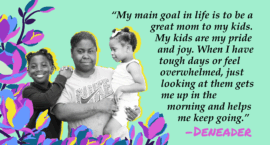
Deneader is a 37-year-old mother of three. She’s a participant in the Magnolia Mother’s Trust, receiving one year of guaranteed income as she searches for stable work and builds a better future for her family.

“I think a lot about going back to school, but my youngest needs me. Tamara is still little and having her at home takes up most of my focus.”

“I also want to get back on my feet fully and become a better person. I know the first step will be finding the right job—something stable, something that allows me to take care of my family. I don’t want to live in low-income housing forever. I know some people do it, but I want more for us.”