What the ‘Wicked’ Weight-Loss Discourse Gets Wrong

We can’t afford to look away from changing beauty norms in our society, and how they are fueling eating disorders. 

Jennifer Rollin, an eating disorder therapist based in Maryland, says, “What I hear from a lot of clients is that when they are trying to recover from their eating disorder in this society, it almost feels wrong, because ‘everyone around me is talking about Ozempic,’ and ‘all the celebrities are talking about their big amount of weight loss.’”

But while it can feel cathartic to criticize or distance ourselves from prominent women who seem to be conforming to dangerous beauty standards, that criticism is harmful and does not bring us any closer to addressing the problem.

Following Tragic D.C. Shooting, Afghan Allies Face a New Wave of Enforcement and Fear

The shooting in Washington, D.C., that left one National Guard member dead and another critically wounded on Nov. 26 quickly became a major focus of U.S. media. In the days since the shooting, the national conversation has focused almost entirely on the suspect’s identity as an Afghan refugee. Yet those who knew him describe a man who appeared to be struggling long before he drove across the country to Washington, D.C. One volunteer who worked closely with his family said he became increasingly withdrawn, isolated and overwhelmed by the challenges of resettlement. They noted that his behavior reflected profound distress, not radicalization or hostility toward the United States.

Despite these documented struggles, the current administration immediately cast the shooting as a failure of vetting by the Biden administration and threatened to punish an entire community for the crime of one individual. That framing ignores the basic fact that the suspect had been vetted repeatedly. It also ignores the testimony of those who interacted with him in the U.S. and saw no signs of ideological motivation.

Internal directives show ICE has begun targeting more than 1,800 Afghans with past deportation orders and is tracking arrests and removals in daily reports. Officials are also reassessing Afghan vetting programs created after the 2021 withdrawal, despite the fact that the suspect himself was granted asylum during the Trump administration after already receiving extensive screening.

The policies signal a retreat from those commitments and send a dangerous message to future partners: Support for the United States may not translate to safety once U.S. needs are met.

The tragedy in Washington stands as a devastating loss. It deserves a full investigation and a clear accounting of what shaped the suspect’s unraveling. But it must not be used to justify policies that abandon allies, ignore humanitarian obligations and dehumanize an entire community.

Police Officer Domestic Violence Is A Crisis. It’s Time for States to Take Action.

Domestic violence by police officers is a nationwide scourge. While the actual number of cases that happen every year is unknown, it’s likely in the tens of thousands. Police officers in almost every state have been charged with domestic violence since the start of 2025. Such figures demonstrate that police officer domestic violence is a structural failure, not the isolated misconduct of ‘a few bad apples.’

These numbers become even more sobering in light of police officer-abusers’ training and responsibilities, which makes them uniquely dangerous, and extremely undertrained: Less than 2 percent of police academy training time is spent on domestic violence response, while 17 percent is spent on weapons and defensive training.

Officer-abusers and their victims make clear that something is deeply wrong in our domestic violence support system. For now, we don’t understand the depth of that dysfunction, but we can be certain that more funding, better policy and less criminalization will help drive a better future.

Ms. Global: 300 Schoolchildren Kidnapped in Nigeria, Italian Parliament Recognizes Femicide and More

The U.S. ranks as the 19th most dangerous country for women, 11th in maternal mortality, 30th in closing the gender pay gap, 75th in women’s political representation, and painfully lacks paid family leave and equal access to health care. But Ms. has always understood: Feminist movements around the world hold answers to some of the U.S.’s most intractable problems. Ms. Global is taking note of feminists worldwide.

This week: News from Nigeria, Afghanistan, Japan and more.

A Feminist Historian’s Year-End Reading and Viewing Guide

As the year winds down, I find myself returning—as I always do—to the stories, performances and ideas that have shaped my teaching and thinking. Feminism’s past is never really past; it’s a living archive we carry with us, full of unresolved questions, missteps, breakthroughs and beautiful, complicated people. This year’s reading and viewing list reflects that sensibility.

Liberation forces its contemporary narrator—and its audience—to reckon with the impossible expectations we’ve placed on small groups of women in church basements.

Molly Jong-Fast’s memoir presses on the tender, maddening ties between feminist foremothers and the daughters who grew up in their shadow.

Sarah Weinman’s study of spousal rape laws exposes just how recently the law stopped treating wives’ bodies as open territory—while showing how fiercely survivors and advocates have had to push for change that should never have been controversial.

Sex, Power and Impunity: Epstein’s Legacy in Historical Perspective

The scandal that has preoccupied much of mainstream U.S. politics has, been, at one level, delightful: We have seen extremist Republicans—Reps. Marjorie Taylor Greene, Lauren Boebert, Thomas Massie and Nancy Mace—break with their party and its president in an effort to force into light the U.S. Department of Justice files on convicted sex trafficker and pedophile Jeffrey Epstein. 

The story is almost irresistible for critics of the current national administration, feminists among them: Will we finally get to items from Epstein like the CD labeled “girl pics nude book 4”? What might these materials reveal? And whose misbehavior might they reveal?  

Fire the starting gun on analyses from every liberal, left, critical corner. Claims abound of shifting coalitions, changing tides, pages turned, a president’s authority shredded. 

But there are still as many questions stirring in the Epstein pot as there are answers. Why did these particular Republicans break from the pack? Is this a contemporary Republican version of feminism? 

And beneath them all: What good does it actually do us—or Epstein’s particular victims, or the scads of other victims of sexual coercion, trafficking and other mistreatment—to raise the heat so high on this particular scandal?

Breaking the Silence: Zimbabwe Initiative Reaches Survivors of Violence

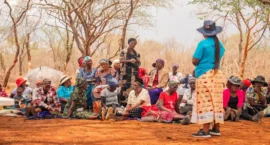
For years, Tjedza endured sexual violence at the hands of her father. Clara, an elderly woman, experienced abuse at the hands of her son. And for most of Tabeth’s married life, she bore abuse at the hands of her husband. 

These abuses—and many more like them—went unseen for far too long. Yet in rural Zimbabwe, services to support survivors of gender-based violence are often out of reach. Survivors often must travel long distances to seek help, and when they do, they risk facing stigma and blame from the very responders who are meant to protect them.  

But today, for survivors like Tjedza, Clara and Tabeth, the years of fear and silence are over. 

An initiative in Zimbabwe’s Bubi District, known as Women at the Center, is improving access to essential protection and support services—and improving the quality and delivery of these services as well. Now, when one survivor receives respectful care and protection, others are emboldened to speak out too.

“I only got the confidence to report after seeing how other survivors had received care and were in a much better place,” Tjedza shared.

“This program didn’t just save my life; it gave me back my dignity,” said Clara.

Inside the Global Network of Abortion Doulas Supporting Self-Managed Care

As barriers to clinic-based abortion care have increased in recent years, an increasing number of women are self-managing their abortions: finding and using abortion pills independently of the formal medical system. They are obtaining abortion pills through online abortion pill services, community networks sharing pills for free and websites selling pills.

To support self-managed abortion, feminists are creating a global network of online abortion doulas—trained companions who offer one-on-one support by phone, email and text to people using abortion pills. A leader in this effort is the organization Rouge Doulas, which runs the Rouge Abortion Doula School.

Six Ways Masculine Stereotypes Are Still Limiting Boys

Rigid norms of manhood—based in manly confidence and toughness, emotional stoicism, disdain for femininity and dog-eat-dog banter—are influential among boys and young men.

Between one quarter and one half of boys and young men endorse these norms. Over half feel pressure from others to live up to them, believing most people expect them always to be confident, strong and tough.

These are some of the findings from a new Australian survey of adolescents aged 14-18 years, conducted by The Men’s Project at Jesuit Social Services.

In a climate of heightened concern about boys and young men and violent masculinity, this study provides invaluable data on boys’ and young men’s own views. This includes the pressures they feel to live up to stereotypical masculine norms and the profound impact of those beliefs.