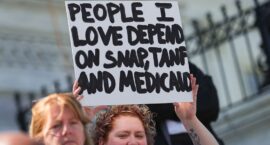
‘I’m Working Just to Survive’: A Single Mom on SNAP Cuts, Two Jobs and Big Dreams

Front & Center amplifies the voices of Black women navigating poverty—highlighting their struggles, resilience and dreams as they care for their families, build careers and challenge systems not built for their success. Now in its fourth year, Front & Center is a collaboration between Ms. and Springboard to Opportunities, a nonprofit based in Jackson, Miss., working alongside residents of federally subsidized housing as they pursue their goals.

Nicole is a single mother working two jobs. She was a part of the first round of Magnolia Mother’s Trust (MMT), where she received one year of guaranteed income. MMT has helped more than 500 mothers since it began in 2018.

“My ideal future is one where we aren’t living paycheck to paycheck—where I can pay all our bills, provide stability, and even take a trip on the weekends for fun, just to enjoy life together. I want more for Kylie and me.”


Playing Games With Hunger

Gail Todd lives with her husband and three daughters in the southeastern section of Washington, D.C., and works at a Walmart in suburban Maryland. Her husband is a shift manager at a fast-food restaurant. Food stamps—the common name for the vouchers or debit cards supplied by the Supplemental Nutrition Assistance Program, or SNAP—helped Todd when she struggled financially after her first daughter was born. She had to turn to them again four years ago because her job, combined with her husband’s wages, doesn’t pay enough to feed her family.

Before Walmart, Todd, pregnant now with her fourth child, worked for $8.35 an hour at McDonald’s. Walmart’s $10 hourly wage was better. In the beginning she worked roughly 40 hours a week, but since May her weekly hours have been reduced to between 16 and 28, earning her no more than $900 a month. The loss in income coincided with a cut to the family’s monthly food-stamps benefit from $339 down to $239—the lowest she’s ever received—because a temporary boost to the program in the stimulus bill was allowed to expire Nov. 1, 2013.

“The food stamps, they help, but it’s not enough because I can’t feed my family,” she says.

[From the Spring 2014 issue of Ms.]

‘The Rent Eats First’: Rationing Expired Food in the Wealthiest Country in the World

Throughout the United States, the millions of families that rely on Supplemental Nutrition Assistance Program (SNAP) benefits—which make up 12.3 percent of Americans—have spent at least 10 days without them. The uncertainties about whether they will return, and when, has left families desperate. For many, the crisis has reinforced what they’ve long felt: The nation’s social safety programs are failing to meet real, everyday needs—and across Iowa, Michigan and Pennsylvania, Americans are growing disillusioned with politicians who can’t protect their most basic ones.

For many disabled Americans, losing SNAP also means losing the nutritional needs that help keep them out of the floundering U.S. healthcare system. They shared with Ms. a glimpse into what the past 10 days without SNAP have looked like, and what millions of Americans who rely on these programs actually need.

“If I lose benefits, am I going to be able to remain going to school?”

“They’re thinking about next week. Will they have food? Will they be hungry?”

“The problem is, the rent always eats first, or the house payment is going to eat first. After that? Are you going to [get your] medicine? No, we [have to pay] our utilities…. then you [think], ‘Okay, I’ve only got enough for either food or my medicine.’”

When the Headline Gets It Wrong: Feminism Isn’t the Problem—Patriarchy Is

When I saw the headline “Did Women Ruin the Workplace? And if So, Can Conservative Feminism Fix It?” in The New York Times Opinion section, my heart sank. It felt like a headline torn from another era—a provocation that had no place in 2025.

False accusations remain extremely rare—estimated at between 2 percent and 8 percent of reports—while roughly two-thirds of sexual assaults are never reported at all. The crisis is sexual violence, not accountability.

Yet, for centuries, women have been labeled “emotional” or “petty” to justify their exclusion from leadership and public life. Hearing these stereotypes revived in 2025—in The New York Times, no less—is disheartening. At a time when reproductive rights are being stripped away and women’s autonomy is under attack, we don’t need pseudo-intellectual nostalgia for patriarchy disguised as debate. We need truth, solidarity and progress.

The message from the writers is clear: Women should know their place. But women already do—it’s everywhere decisions are made, everywhere power is exercised, everywhere the future is being built. We’re not staying in our lane. We made the road. And we’re not going anywhere.

A Hunger for Justice: Why SNAP Cuts Are a Feminist Public Health Issue

When policy proposals like The One Big Beautiful Bill Act and the Trump administration’s recent attempt to partially suspend food-stamp payments threaten the Supplemental Nutrition Assistance Program (SNAP), we must acknowledge that these decisions are not about fiscal responsibility. They are an ideological manifestation of historical racism and sexism that inevitably punishes Black and brown families and undermines the stability of our entire society.

In fact, SNAP recipients are 45 percent less likely to experience food insecurity, demonstrating that SNAP is one of the most effective anti-poverty programs we have in the U.S.

Trump Administration Forced to Fund SNAP Benefits—But Only Enough to Cover Half of November

The Trump administration will release funds to pay for half of November’s SNAP benefits, following two federal court rulings the Department of Agriculture (USDA) to release the money. Patrick Penn, who oversees the SNAP program at the USDA, warned of disruptions and delays, suggesting many SNAP recipients will still be without benefits for some time.

Keeping Score: No Kings Protest Turnout Makes History; SCOTUS Threatens Voting Rights; Gen Z Women Are Most Liberal in U.S.

In every issue of Ms., we track research on our progress in the fight for equality, catalogue can’t-miss quotes from feminist voices and keep tabs on the feminist movement’s many milestones. We’re Keeping Score online, too—in this biweekly roundup.

This week:
—No Kings Day marks the largest single-day protest in American history.
—The ongoing government shutdown could soon disrupt SNAP benefits, another unprecedented moment in U.S. history. “We have never seen our government turn on its people this way,” said Abby Leibman, president and CEO of MAZON.
—House Democrats rebuke Pete Hegseth’s hostility towards women in the military.
—Speaker Mike Johnson refuses to swear in newly elected Democrat, Rep. Adelita Grijalva.
—Return-to-office policies are pushing women out of the workforce.
—Remembering legendary trans activist Miss Major Griffin-Gracy.
—The Supreme Court heard arguments challenging the Voting Rights Act.

… and more.

The Trump Administration’s Latest Power Play: Starving Americans to Secure Democrats’ Submission

As the federal government lurches toward a second month of shutdown, SNAP is dominating the headlines. In a moment marked by fear, confusion and misinformation, the Trump administration and Republican leaders in Congress are offering plenty of inflammatory rhetoric—but little real problem-solving.

The Trump administration is playing politics with people’s basic needs by claiming there is no funding for November SNAP benefits. The truth is that the U.S. Department of Agriculture has complete control over the contingency fund for SNAP, and they can and must deploy it immediately.

A Game-Changing Approach: Providing Anonymous Hotel Check-Ins for Domestic and Sexual Violence Survivors

Safe Stays by ReloShare partners with hotels nationwide to protect survivors’ identities and expand access to secure housing.

“When guests check in, hotel staff often insist on seeing their identification and recording their full name. Because hotel staff members are not trained advocates, she said, they probably won’t be on high alert if an abuser calls or walks through the door,” said Ruth Glenn, the former chief executive and president of the National Coalition Against Domestic Violence. And “leaving is often the most dangerous time for survivors of abuse,” according to the National Domestic Violence Hotline.

Paige Allmendinger, Safe Stays by ReloShare’s chief product officer, told Ms., “First, we needed the ability for a guest to check in under a fake name, with no ID required at check-in. If the survivor’s real name isn’t tied to the reservation and an abuser calls the hotel searching for them, there won’t be any record that the survivor is in-house, giving the survivor a degree of protection at the very time they need it most.

“Second, we needed hotels to forego the usual requirement for a credit card from the guest or agency at check-in. Credit-card transactions can expose location putting survivors at risk. While social service organizations may have funding to pay for hotel stays, many have limited credit lines for upfront payment or can’t send staff in person to present a card at check-in.”

Millions Face Sharp Increases in ACA Premiums if Enhanced Tax Credits Expire

Affordable Care Act (ACA) enhanced premium tax credits—first introduced in 2021 and extended through 2025 by the Inflation Reduction Act—are set to expire at the end of this year. These tax credits have made Marketplace coverage far more affordable for millions of Americans, both by increasing financial assistance for low-income enrollees and by extending eligibility to many middle-income families for the first time. Since their introduction, enrollment in the ACA Marketplace has more than doubled—from about 11 million to over 24 million people.

If Congress allows the enhanced tax credits to expire, most Marketplace enrollees will face steep premium hikes. According to new analysis by KFF, the average enrollee’s annual premium payment would more than double—from $888 in 2025, to $1,904 in 2026. Some families would lose eligibility for any financial help at all.

A 60-year-old couple earning $85,000, for example, would see their premiums rise by over $22,600 next year—nearly a quarter of their income.

Without congressional action, millions could lose access to affordable coverage, threatening one of the ACA’s most significant achievements: making health insurance accessible to Americans across income levels.