Listen, Rate, Review and subscribe on:



In this Episode:
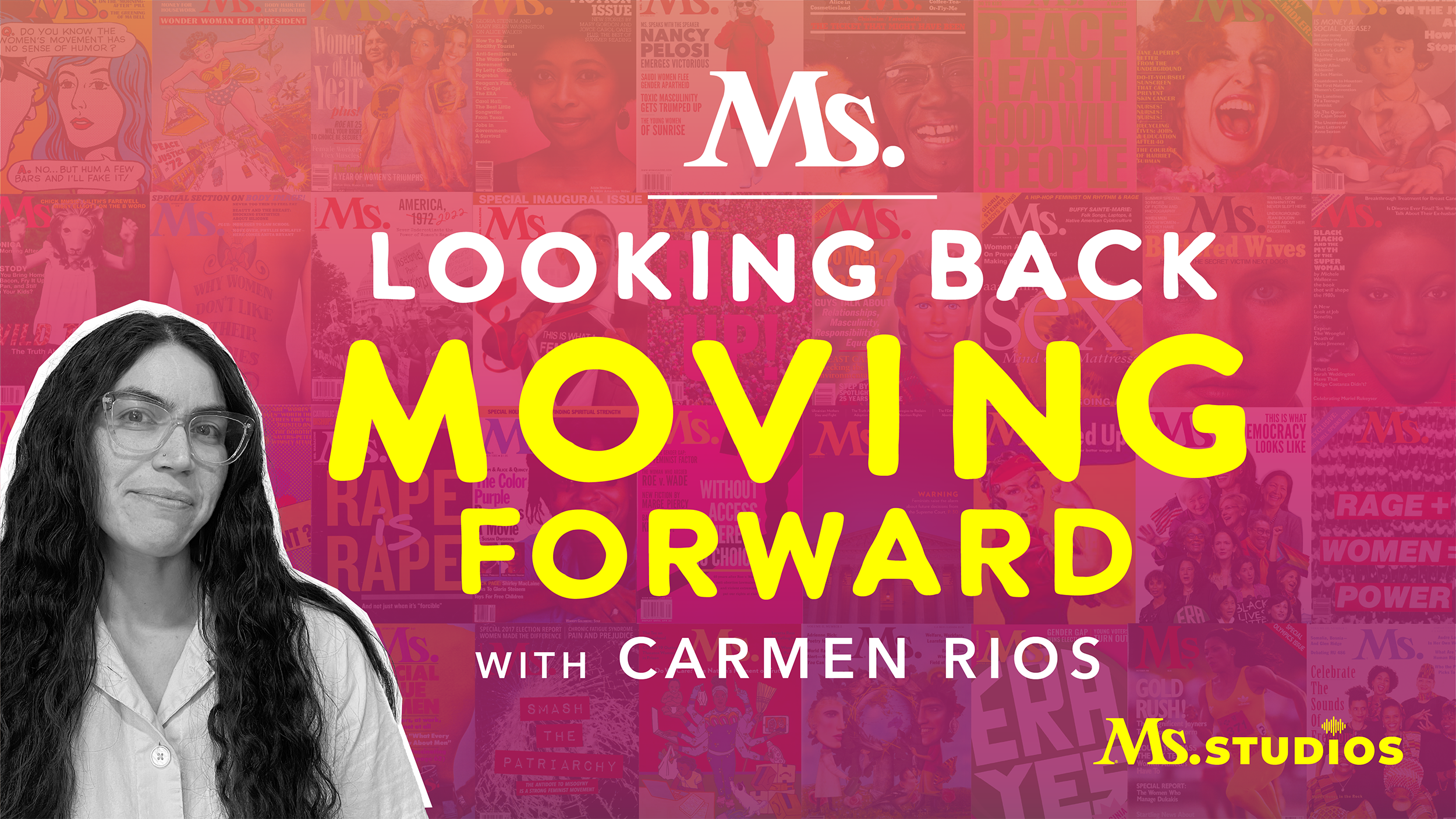
This bonus episode of Looking Back, Moving Forward features a conversation between Ms. consulting editor Carmen Rios; professor, author, and activist Loretta Ross; and professor and Ms. contributor Janell Hobson, moderated by Ms. Executive Editor Katherine Spillar, about how the past informs the future—and what our history tells us about our present moment.
Their conversation was recorded during a celebration in Los Angeles marking the launch of the Ms. Magazine archive on ProQuest, available now at libraries and on campuses across the country. Together, they reflected on the lessons we’ve learned from feminist history, the importance of feminist media platforms like Ms., and their visions for the future of feminism.
Meet the Voices
- Kathy Spillar, executive editor of Ms. and executive director of the Feminist Majority Foundation. Read her work in Ms.
- Loretta Ross, activist, professor, and author of multiple books on Calling In: How to Start Making Change with Those You’d Rather Cancel, co-author of Reproductive Justice: An Introduction and Undivided Rights: Women of Color Organize for Reproductive Justice, and editor of Radical Reproductive Justice: Foundations, Theory, Practices, and Critique. Follow her on Facebook and Instagram and read her work in Ms.
- Janell Hobson, Professor of Women’s, Gender and Sexuality Studies at the University at Albany, State University of New York; author of When God Lost Her Tongue, Venus in the Dark, and Body as Evidence; and co-chair of the Ms. Committee of Scholars. Follow her on Bluesky and read her work in Ms.
- And your host, Carmen Rios, feminist superstar and Ms. consulting editor. Follow her on Twitter, Instagram, Threads, and Bluesky and read her work in Ms.
Further Reading From the Ms. Archives
- “The Revolution Will Be Digitized,” by Lorissa Rinehart. Summer 2025.
More Links & Resources
- Learn more about the Ms. Magazine Archive on ProQuest and explore our favorite pieces from the collection.
- Explore bonus content from every episode of Looking Back, Moving Forward, including full interviews with every guest!
- Want to dig deeper? You can explore an interactive timeline of Ms. history.
Transcript
[THEME MUSIC FADE UP + OUT]
Carmen Rios: Hi, y’all! I’m back with another bonus episode of Looking Back, Moving Forward — the Ms. Studios podcast that traces the intertwined history of Ms. magazine and the feminist movement it has given voice to for over 50 years.
I’m your host, feminist superstar and Ms. consulting editor Carmen Rios.
This show is focused on connecting the dots between our movement’s history and its future—celebrating how far we’ve come, outlining where the fight for gender equality must go next, and charting the path forward toward a feminist future. This fall, I was honored to be part of a Ms. symposium conversation aimed at doing the same.
In a conversation moderated by Ms. executive editor Kathy Spillar, I joined activist, author, and professor Loretta Ross and professor Janell Hobson in exploration of how the past informs the future—and what our history tells us about our present moment—to mark the launch of the Ms. Magazine archive on ProQuest, available now at libraries and on campuses across the country. (If you can’t find it, ask your librarian!)
I’m sharing our full conversation here today — on the lessons we’ve learned from feminist history, the importance of feminist media, and what keeps us hopeful when it comes to the future of feminism.
Take a listen.
[Transition Music]
Kathy Spillar: Welcome, everyone who’s here in person and those who are joining us online. I want to welcome our panelists. As Karen said, this workshop is How the Past Informs the Future, which is a recurring theme at Ms., and 53 years, it should be. So, knowing, really, not only our past, but knowing, in detail, what was happening in so much more depth than you would get by going to other media accounts and trying to figure out what happened in the contemporary movement here in this country and frankly, around the globe.
I’m Kathy Spillar, and I’m Executive Editor of Ms. and the Executive Director of the Feminist Majority Foundation. We’ve been publishing Ms. since 2001. We’re actually now the longest publishers of this magazine, and we’re very proud of not only our work, but how it continues to connect to the broader activist movement, and that was our interest in making sure Ms. continued to live and thrive, was its connection to activism and to scholarship, and so, we’re thrilled that everyone is here. I will introduce everyone, although I really don’t need to go into any depth, because you all know most of the people here at this table with me.
So, to my far right, but really, not to my far right, by any stretch of the imagination, Loretta Ross, who you heard from last night. Activist, author, professor, professor at Smith College in the program for the Study of Women, Gender, and Sexuality.
To my near right, Janell Hobson. She is the co-chair of the Ms. Committee of Scholars, a frequent contributor to Ms., a Professor of Women’s Gender and Sexuality Studies, University at Albany, and to my left, Carmen Rios, who’s a consulting editor to Ms., and also, as you heard, the host of our most recent podcast through Ms. Studios. You can find it on the website or wherever your podcast source is. Called Looking Back, Moving Forward. Really a fabulous series. I highly recommend it. I was able to collaborate some with Carmen on it, and I just think it was an excellent pulling together of some of the key issues and lessons of the last 53 years.
So, again, a major focus of Ms. is to provide in-depth analysis of laws, of culture, of society as it impacts inequality, and to also put forward some strategies for change and connect to activists who are working for that change as we move towards equality. The key thing that Ms. provides, more than, frankly, I think than any other publication out there, is an understanding of the role of gender in the expansion of right-wing extremism and violence and the rise of authoritarianism here in the US and around the world. We feel this is one of our most pressing areas of inquiry and writing, both online and in the magazine, very critical given what’s happening here and in the world, and these are some of the toughest challenges that we’re going to face currently.
So, I want to get right into it and ask Loretta the first question, We’re in a period of horrendous backlash. Mainstream media really fails to deal with gender as part of rising authoritarianism and anti-democratic impulses in our political landscape, and wanting to throw it to you to talk about why including gender in this analysis of our current political crisis is so critically important and the problems with not including it.
Loretta Ross: I have to, frankly, say mainstream media does not include gender, not because they don’t know, but because they don’t care, okay? Let’s be clear. All we have done over the last hundred years to educate the public about the importance of gender issues has not gone unnoticed, but it is unprofitable to accurately analyze what is wrong with our society, and so, our project has to change, not just to tell our stories, but to change who listens to those stories so that, then, people are in seats of power who do care. I don’t believe that the assault on women and women’s rights can be extracted from the overall dysfunction of all societies. I mean, let’s look at how the current antifeminist movement began, as a strategy for those who wanted to distort democracy to knit together the antifeminists, the segregationists, the anti-gay people, the anti-immigrant people, the anti-democratic forces that, you know, never got punished for the Civil War. They put all of that together in a badly-named coalition called the Moral Majority.
What’s ironic is that we have to teach and use archives to teach, is that the vast majority of the Republicans who came out anti-choice in the ‘80s were, in fact, pro-choice in the ‘60s and ‘70s, until they switched their strategies, and a lot of people, without knowing that history that we can pull from archives, like Ms., will think that the Republican Party has always been against abortion, which it has not, or that the Democratic Party has always been for freedom and justice, which it has not, and so, it’s very important for us to understand the hydralike nature of the attack on women’s rights, because it’s never about just gender.
I’ve always said, if you don’t understand white supremacy, everything else will confuse you, because you really don’t understand how the attack on women’s rights is about compelling, coercing white women to have more babies, while practicing sterilization abuse and population control on everybody else, and so, I should stop and do a small commercial. Marlene Gerber Fried and I have just issued a new book called Abortion and Reproductive Justice, and I’m sorry it hasn’t come out in time to be displayed here, but our goal was to situate the struggle for abortion rights into this larger narrative around the fight against white supremacy, neoliberal capitalism, and the patriarchy.
And so, that’s my analysis. Is that, as we fight for women’s rights and women’s human rights, which is a phrase I prefer…because you have to have a vision of what you’re fighting for, not just what you’re fighting against. As we fight for women’s human rights, we always have to situate it in the larger struggle against the ravages of neoliberal capitalism, the permanence of white supremacy, the enduring nature of the patriarchy, and I hope we can get back to talking about Jackson’s work and how the effort to bring men into the movement has proceeded over decades. It’s not just a recent thing, too. I hope that answered your question.
Kathy Spillar: Yes, and we’ll come back to that very subject. We’ll come back to that very subject. I’m going to head to Carmen next to ask about how what Loretta was just talking about fit into this most recent podcast series that you produced, and talk a little bit about the podcast series and one or two things that really stood out at you.
Carmen Rios: Something that I was actually thinking about as Loretta was talking was about the most recent episode, the ERA episode. We spoke, in our interview for that episode, about Ms.’s role in unveiling the real opponents of women’s constitutional equality as well as just women’s rights across the board, and as we know, and as Loretta has touched on, how interconnected all of these other rights and justice issues are within that, and I was thinking about the article that we recently published online with Ms., Why Big Business is Trying to Defeat the ERA. It was published in, I believe, 1976.
Kathy Spillar: Yeah, I think so.
Carmen Rios: I found it in the ProQuest archive while I was doing research for the episode, and it was just an incredible thing to find, to see that this article just spelled out the ways in which what we saw as a culture war with Phyllis Schlafly and her STOP ERA movement was really just a funded operation by groups like the John Birch Society, these far-right groups that are interested in total economic destruction, you know, the absolute ravaging of culture for money, as well as stripping away everyone’s rights, and what stood out to me, as I was doing that research, was that our opponents have not changed.
And the mainstream media has yet to name them the way that we have, and have continued to for 50 plus years, and how tied in all of that is, and that comes up again and again in, you know, the episodes I did, the research I did. That when it came to women in politics, reproductive freedom, economic justice, of course, and even gender-based violence, so much of this is wrapped up in the people the mainstream media won’t name, because, like Loretta said, their wealth, their ties to this capitalist framework that demands, you know, that some are oppressed while other are multi-billionaires and trillionaires. It relies on that system to perpetuate itself, and so the mainstream media can’t name these people.
I think we’re seeing that in real time with the Epstein Files, right? We’re seeing the refusal to name the forces that are powerful, and that is something that is so incredibly important, and something that we know. When I was Managing Digital Editor of Ms. during the fallout from the 2016 election, we also just noticed the absolute inability or unwillingness of the mainstream media to admit that there are not two sides to whether or not everyone is a human being with human rights, that there are not two sides to so many different issues. But in order to make money and in order to sell, they need to have a conflict, and they need to have a debate, and something to sit around the table and talk about for 18 hours, and so, you know, it just all comes back to how vital it is to have a resource like Ms., an independently-funded community publication that’s willing to speak real truth to power and not just report on the fallout from these critical problems.
Kathy Spillar: We’ll come back to some of the people that you interviewed and talked to for the podcast series. I thought the strongest pull quote out of this article is the economic consequences of equality for women are enormous, and of course, the flip side of that is big businesses’ consequences, as well, and point well made, and I hope we don’t forget, and it really goes to what you were saying, too, Loretta. Don’t accept the popular wisdom or the conventional wisdom about why things are the way they are, and that has been a key job of Ms. Magazine from the beginning. Go beyond the curtain. Who is pulling the levers of what is happening? Don’t accept that it’s social wars, that it was Phyllis Shafly. I get so angry when she is featured in even popular series as having defeated the Equal Rights Amendment. She was the front. We can get into who defeated and why and what we’re going to do about it. That’s the exciting thing, is what are we going to do about it now?
Janell, part of what Ms. has done is always connect to the academic community, to scholars, and brought their research forward, and including what we are doing with our work to…I don’t want to use the word train, but help scholars learn to write for the popular media so that the research is not stuck in a journal that nobody reads, in all deference to ProQuest, but that it reaches mass audiences and that people can understand some of this vital research. You had a very popular series on Ms. about Harriet Tubman, and so, if you want to talk about that or any of the other pieces, you’re a regular contributor on culture, as much as anything else, which I think is very important.
Janell Hobson: I’m glad you brought that up. You know, listening to my fellow panelists, I’m going through all of these ideas, so I’m going to see how well I can connect everything, but I will say, it’s been such an honor to be able to write regularly for Ms., and even teaching, you know, articles, not just my own, of course, but all of the Ms. writers or even just teaching various pieces that I think is useful for my students.
One of the things I love about being able to link to a Ms. online article is that there are no pop-up ads, and I’m going to mention it, because when you talk about commercial-free, that is something important when you think about how you’re able to still bring a certain feminist analysis in your media, in your news, without having to be reliant on a kind of corporate model for that, and that is extremely important. It’s also important to go back to how I came into writing for Ms., because this happened back in 2010 when Ms. received a Ford Foundation grant, when the right people were in charge of Ford, I might add. I’m thinking of Irma McClaurin and the work she did to provide funding for Ms., for NWSA, for a number of those different institutions, to make sure that they had an opportunity to grow and expand, and Ms. took advantage of that by reaching out to scholars like myself. If you’re interested in writing for a broader audience, come work with us. Come train with us. Come do some, you know, media training and writing and whatnot, and it has been so profoundly important in the way I’ve been able to rewrite and write my work and to translate my work through a broader audience, which is what came out of whether I’m writing about Beyoncé or writing about Harriet Tubman. That I’m able to actually reach this broader audience, and it makes a huge difference, and I’m so glad we were able to do that in that small window of time that we had to try to grow, and that’s what the Feminist Majority Foundation said. We want to grow our own journalists, so let’s start with the actual feminist scholars in the academic institutions, but you know, bring you out of the ivory towers. Don’t get too comfortable over there, or just writing, because you need to get tenure, or you need to get promotion. That there is a real-world impact of the writing that you’re doing that’s more than just your little, you know, professional development.
And that was an important message, when you consider where we are right now in terms of the state of mainstream media and what a feminist media can do as intervention. So, I see the work that I’m doing as both co-chair of the Ms. Scholars Committee in terms of making those bridges between scholars as well as journalists and Ms. in particular, and being able to be a bridge, but to also be an intervention to actually provide an alternative, because that has become more and more important in the work that we’re doing.
So, now, to talk about the Harriet Tubman Bicentennial Project, that just came out of realizing that there was a bicentennial anniversary to celebrate, and realizing, you know, this is an opportunity to do a series, and I was so glad that Ms. was like, yeah, this will work. This fits right into our agenda. We actually worked on doing a whole series from Black History Month on, up to Women’s History Month, because, you know, being Black women, we get to combine two months together, and doing it with Harriet Tubman, which worked well, because, according to authenticating archives, there was evidence that showed that she may have been born in either February or March 1822. So, I said, well, we’ll claim the two months together, and so, we were able to do a series of different articles throughout February and March in 2022, highlighting Harriet Tubman, and one of the interesting things that I did, in terms of contributing, was I did an article about her descendants, those who claim to be descendants of Harriet Tubman. Not that I’m saying that they are not. Actually, let me back up, because there are some folks who are pretending that they are. They really are, but then there are those who really are actual descendants.
So, you know, one of the things you learn, as a journalist is, okay, fact check, and I did have to fact check on that, and so, I did find some authentic descendants of Harriet Tubman, those who have been very committed to keeping her memory alive, and one of the descendants, Jaclyn Bryant, who’s in her 80s, and her whole thing is I hope I live long enough to actually see her on our currency. I’m like, it’s going to take a while. I hope you can stay on it. But something she said was that she would love for us, as a society, as a nation, to be able to see the humanity of Harriet Tubman, and that, in order to do that, you’ll realize that she’s not this superhero, who had this super ability to just go in and rescue so many hundreds of people, which she did, but it’s like, how do you actually find the humanity of what motivated her, and what motivated Harriet Tubman was love, love for family, love for her people, and that was what kept her going back, because she freed herself, and then she’s like, okay. I’m in freedom, and I’m all alone. I need to go back for my people. And that’s what she did, and she freed up to 70 people during the Underground Railroad era. This is from the 1850s, before the Civil War.
It’s during the Cold War when, because of her heroic efforts, she was recruited to join the Union Army to help with the Cold War effort, and it was that particular work that she was able to then bring to the Cold War that led to that amazing moment in 1863, when she helped to liberate 750 enslaved people on the Combahee River in South Carolina, the largest, and she was the first woman to actually lead a military raid, which is why, you know, the military has suddenly given her all these awards. Well, not today’s…not today. Not now. As a matter of fact, I have a feeling the reason why we’re getting the pushback is because they were doing that work, right? So, there’s always the backlash, but it’s interesting that the reason why the military started recognizing her is because of descendants pushing to get her recognition. So, we also have to realize that there’s real work that people were doing behind that effort.
So, it has been very useful and important and very exciting to be able to write as a Ms. writer and like, you know, I’m writing for Ms. Magazine. I’d like to interview you about Harriet Tubman and being able to access, you know, descendants who can talk to me, you know, in that kind of level. Let me tell you about Aunt Harriet, and she’s Aunt Harriet to me. I don’t know about all these other people. Go find your own ancestors. It’s like, you mean we can’t claim? Okay, so, but you know, it’s really interesting when you do get that perspective.
One of the things I found fascinating is when we did that article with Ms., I had so many people respond, and said, wow, I have to tell you I’ve never thought of someone like Harriet Tubman having, like, real descendants. Now I have to actually think about her as a woman, and I’m like, wow, that’s interesting. So, what was she before? Oh, she was like Wonder Woman, like a superhero, and that’s what they meant. That you’re a superhero.
History is also about not just inspiring you about what people did in the past, but to also recognize their vulnerabilities. Recognize that they are human, to recognize that these are people who actually live real lives, which, by the way, the new administration is now trying to act like she never existed. So, there’s that. So, just so you know, and I’m not exaggerating, they actually started removing items at the Smithsonian’s National Museums of African American History & Culture, like her gospel hymns. Why is that subversive, you know?
Audience Member: We know why.
Janell Hobson: Well, yes, we know why, but they are starting to remove her certain items that are related to her in those exhibits at the Smithsonian, so it’s even more important that we keep history alive and to realize that they are, you know, deliberately doing it. I’ve been speaking to Kathy about eventually planning something for next year with the 250th anniversary, because we’re not letting this go. We have to keep rewriting history and reclaiming history, especially knowing that the forces out there are doing what they can to erase us.
Kathy Spillar: I’m going to come back to that, Janell, the idea of the America 250 series for next year, we need a real rewrite of our history, but Loretta, do you want to talk about some of the work the movement has done to communicate the value of feminism to men and their involvement in the movement, which is growing, but anything that you want to take off on that and why it’s so important?
Loretta Ross: Well, I had the privilege of being the third Executive Director of the first rape crisis center in the country, the D.C. Rape Crisis Center back in the ‘70s, and even at the beginning of the anti-rape movement, we knew we had to go beyond just helping the survivors. We had to stop rape, and to stop rape, we needed men to stop raping. So, moving out of that passive voice women were raped, into men are raping, and so, we understood that project from the outset, and so, in the early days, we had men who were committed to fighting rape and sexual violence and the rape culture, serving as our volunteers, doing the childcare when we had the conferences, trying to establish, you know, a presence for themselves. But they did it in a way that I thought was insufficient, because they always said, well, just bow to women and let the women lead, but they weren’t establishing a masculine analysis of ending violence. You know, that kind of thing, and then, by the ‘80s, we started seeing the development of Men and Masculinity conferences that were taking place, where men were actually coming together to talk about reframing the concept of masculinity so that they could remove violence against women and misogyny from the definition of what it meant to be a man.
In the ‘90s, I served on the board of Men Stopping Violence, for example, which was an Atlanta organization that was about coming up with successful strategies for stopping men committing violence and dealing with the perpetrators who had, and so, unfortunately, like many women’s institutions, those Men and Masculinity conferences weren’t getting any funding, either, to continue, because oppression is profitable, you know, and so, anybody who’s fighting against it is not going to be in the front of the line for getting major funding for continuing that work, but it was there I met people like Jackson Katz and others, who were beginning to theorize and conceptualize about repopulating the definition of masculinity without the violence, the white supremacy.
And you know, what we call, in our academic circles, the heteropatriarchy, though I never used it outside of the academy, because everybody else looks at you like, what? We used to say that extra special something women have to put up with, everybody understands that, right? So, this has been…but it’s not only around violence against women. When I was with the National Black Women’s Health Project, getting men to take their healthcare seriously is always a challenge, and they leave their partners to do all that emotional labor and all of that, and so, it is…like Black folks say, we’re fighting for the soul of white folks. We’re also fighting for the soul of men folks, you know, but we can’t fight for them. They have to fight for themselves, because we can’t save them. We’re busy saving ourselves and stuff, but I would also add one of the things that most challenge the reframing of the Men and Masculinity movement was homophobia. That they fundamentally believe that taking the patriarchy out of masculinity was going to be succumbing to the forces of homophobia and transphobia, and particularly in the gatherings that we would organize of Black men, it was always the number one question.
And let’s be clear, and maybe this is telling too much stuff, and then a lot of misogyny amongst the gay men, who didn’t also want to listen to the voices of women. You know, they might be gay, but that didn’t mean they weren’t patriarchal kind of things, and so, I’ve watched this for 50 years in terms of making that effort for men to recapture a sense of integrity and honesty and joy in being a man, without all those things that are leading them to the deaths of despair and the loneliness and things like that, but it is a very hard project for men. I mean, be honest, because for us, when we decide to claim feminism and claim self-empowerment and claim new definitions for ourselves, no one’s going to actually, within the other women, aren’t going to threaten to kill us for it. They might dislike us for it, but they’re not going to come out and actually kill us for it. It’s totally different for men. When they say that they’re recapturing or reconfiguring masculinity, it makes very insecure men want to kill them. So, we have to also recognize the differential price that you risk for standing up for human rights and justice if you’re a man. Sorry to give you that kind of historical walk.
Kathy Spillar: No, I think it’s very important. Very important, and the work of feminist men goes on. I really do encourage people to pick up this issue, if you don’t already have it. Loretta referred to deaths of despair. The death rate among men from suicide, from drugs, overdoses, from alcohol, very high, and the tragedy is, you know, that masculinity being tied up with violence comes back to kill them so often, and we saw that this week, clearly, but we’ve seen it in other contexts, as well. Carmen, you looked at violence and masculinities as part of the new podcast series. Anything that Loretta has said you want to take off on?
Carmen Rios: I’m also still thinking about what Janell was speaking of and you know,sort of with episode one, we spoke to Aimee Allison from She the People, and she spoke at length about the importance of rewriting the myths of America in order to sort of fix our democracy and assess what we’re seeing now, and that through line really does come through throughout the whole series.You know, to think about the interconnectedness of racism and sexism and homophobia and xenophobia in reproductive justice.
That came up in my interviews with Michele Goodwin and Renee Bracey Sherman, and then, for the violence episode, to really unpack the ways in which, you know, when Ms. was founded, there wasn’t even language around a lot of these issues that we now have so much conversation and dialogue about, even if I know we’re not seeing the kind of progress that we had hoped we would see in 50-plus years, but just the urgency of having that language, and like Loretta has said so many times today and yesterday, the language matters so that we can tell our stories.
A platform like the Ms. Archive, archives like them, matter because that history, those stories, remind us that these issues are not new and that we can come together and heal and work for progress around them, and I think it was fascinating to see…to be working on the issue around violence at the same time that the special issue came out and to be able to see, once again, that 50-plus years before men were in Ms. writing about feminism, about violence, about the idea that masculinity is tied to violence, and trying to put that message out there.
Like Loretta said, seeing how normalized that conversation has become was also really powerful, to know that I was writing this episode in a place where I came into the feminist movement with all that language and with male allies in that work, to see that progress was heartening and did give me hope.
Kathy Spillar: I want to come back to a theme that also has emerged, but first, Janell, I would love for you to talk about some of the ideas around America 250, a reframing of America 250. Are you willing to talk about that now? Yeah. Okay.
Janell Hobson: So, that means we’re moving forward. All right. So, yes, we started talking about what we can do for next year because of the…what is it? Semiquincentennial, right? Of the Declaration of Independence, and of course, hearing what the current administration has planned was like, yeah, we need to do a counternarrative, which, of course, it’s an opportunity to actually think through, you know, what is this idea of nationhood? What is this idea of America? And specifically how we want to actually articulate a more inclusive, more feminist democratic America, which means that if we need to imagine it for the future, we also have to remember and reimagine it in the past, because those two things are connected, the Looking Back, Moving Forward.
So, the idea is to actually think about a kind of series in which we can actually raise up the narrative of America’s founding feminists and who they are and how they operated within and without that particular master narrative that we have of the Founding Fathers. So, that might look like talking about Iroquois women, who gave us the Constitution, right? It might look like bringing up Phillis Wheatley as a Founding Mother. It might look like Sally Hemings as a Founding Mother. It might look like Ona Judge running away from George and Martha Washington to claim her own freedom. It might look like expanding on Abigail Adams’ Remember the Ladies, and to think beyond first ladies, as well, but to also include them in that conversation, to think about ways in which that history was also queered, the ways in which men have been supported feminists. I’m thinking of how the Declaration of Independence has always been this kind of signifying document that others have often used to, you know, respond to, So, whether we’re talking about Frederick Douglass or Elizabeth Cady Stanton coming up with the Declaration of Sentiments, there are opportunities to actually highlight these and some other histories that we should also keep in mind—that we’re not just going to take it back to this kind of Founding Fathers, which is what is the plan in terms of next year’s master narrative of America’s 250th anniversary.
In many ways, when I think of what is going on in this moment, I actually think about Nikole Hannah-Jones’ 1619 Project, because that really was the marking…that is the point when right-wing folks lost their ever-loving minds, because she dared to actually suggest that maybe 1619 and not 1776 really ought to be our origin story, all right? After that, what happened? Banning, you know? Vilifying critical race theory. All of those things came out of The 1619 Project. As a matter of fact, I remember even before Biden was elected president, one of the main executive orders we were dealing with in 2020 was coming from the White House that tried to ban anyone talking about race. So, you know, this was already in the works, and this did come out of pushing back against The 1619 Project, but it did give me an idea. It actually was a wonderful reminder, which is what also gave me the impetus to come up with the Harriet Tubman bicentennial project, is realizing that these narratives are so important. And it was also interesting watching that moment, because there was framing the politics of the moment with your own narrative, and then there’s also a reminder of how academics can sometimes be left out of the conversation, because there was so much pushback from actual historians who, basically, were mad that this journalist, you know, got to frame a conversation and felt that they were left out of it. There was a lot of hurt feelings that was going on, and it’s like, well, why were you riding the Ivory Tower? You should’ve been writing, you know, for the New York Times and Ms. Magazine, actually. So, it was also an invitation to, well, you know, academics, this is our opportunity. Let’s educate, but let’s do it in a way that other people can hear us. Not that we can’t use terms like heteropatriarchy as a matter of fact. One of my favorite stories is that, in 2010, when Ms. started the online platform around the same time Crunk Feminist Collective started their online platform, we were out there introducing a general population to various academic terms, like intersectionality. You know, when a pop star like Katy Perry can defend someone like Leslie Jones talking about, you know, misogynoir.
Audience Member: Thank you, Moya.
Janell Hobson: All right? Thank you, Moya, right? And that’s her writing that on Crunk Feminist Collective, but look how that traveled. So, that’s in the language when Amandla Stenberg is talking about intersectionality. It’s like, we are educating. Yes, and when Beyoncé stands in front of a feminist sign, you know, they’re responding, you know, to the language that we’re putting out there. So, it’s important for us to engage in the kind of general readership that the internet allowed. The internet does democratize many things. It’s also birthing all this other extreme nonsense, you know?
Once I actually took time to read about the person behind the whole Kirk thing and it’s like, what? You mean it’s that? Yes, I’m like, yet too many of our young people are totally stuck on social media, and that’s a problem, but other than that, there are also some positive ways that we could think about how we could use the internet. So, we also have to push back against the more extreme elements and to really help people to do the kind of critical thinking, because I like the idea of mass education, but to also realize that some folks are also doing mass dilution, and we have to think about how to fight that, as well.
Kathy Spillar: We are about out of time. I wanted to ask each of our panelists for some concluding remarks. What is it you want to leave with people today to be thinking about, and one of the things, Loretta, that you had mentioned earlier is the importance of Ms. intervening in the popular media’s reporting on so many things and how I wish we could come up with other ideas, you know, for how to totally define the conversation around some of these issues. I think we’re breaking through in many ways. We frequently see an article in the New York Times that we wrote, you know, four months ago.
Bonnie Thornton Dill, who many of you know, recently wrote and I said I think you really…we got to do an article on how Black women are getting fired more, and I looked it up, and indeed…because the New York Times had just done a big piece that many of you probably saw, and literally, four months prior to that, we had had a major piece online about this very subject, and I wish, occasionally, you know, the writers would say, as I found from Ms. Magazine, but every once in a while, they do, but it’s so rare, it makes you crazy. So, Loretta, do you want to kick us off on a final round of thoughts?
Loretta Ross: I think we should celebrate when we make a breakthrough, like with the New York Times’ post or whatever, but what pisses me off is that, even when we make a breakthrough, it’s a one-off. They won’t cover it with the routine repetitiveness of Hillary’s emails or what have you. So, it’s almost like a nod to doing the right thing, but not a commitment to keep the conversation going, and so, I noticed that. So, I’m going to reward them for making that breakthrough, but I’m also going to call them out, and I use that very intentionally for not doing a sustained attention to it the way that they do to the critics of feminism, to the enemies of human rights. They give them all a story a day for weeks, and we get that one breakthrough, and we have to celebrate that crumb.
So, that’s something that needs to change, but I actually wanted to go back to writing, because what people who know me know, I didn’t even graduate from college until I was 55, and so, I doubted that I had the chops to become a writer, because when you fail at college and you don’t get published and you’re a community activist, you see people like Janell. I say, oh, I’d like to be her one day, and it took me a long time to be persuaded that not only did I have ideas, but they were ideas worth writing down and that I had the capacity to write them. And I have to actually blame Kimberlé Crenshaw for this, you know? Because I went to California just to beg Kimberlé to write the first book on reproductive justice, and Kimberlé looked at me and said, Loretta, you got to write that, and I went, oh, shit. That’s not the answer I wanted to hear. I wanted the expert on intersectionality to write that book, not throw it back my way. Well, now I’m four books later on the topic. So, I can attribute that to Kimberlé saying a very strategic no, you do that, because I had that imposter thing, going I can’t write. I don’t have a degree. I can’t do this, and so, that’s what I want to leave people with. You have a voice, and however you present that voice is good and okay. Learning writing is a discipline, just like learning to play chess. The more you do it, the better you’ll get at it, but don’t assume that you have to be great at it to start, because as my writing coach told me, when I finally got smart enough to hire one, writers write. So, write every day, and the more you do it, the better you’ll get, but what I also love about Ms. Magazine is the low bar for interest. I’m not trying to say you don’t have high journalistic standards, but you don’t require people to have triple-dipped PhDs to publish within your pages and stuff, and I love that. So, thank you for the town and gown partnership that I’ve seen over your 53 years. It really works for women like me, who didn’t have advantages, who, like I said, didn’t trust our voices until much later in life.
Kathy Spillar: Thank you, Loretta. I had meant to ask you specifically about that. It’s a brilliant observation and something that Ms. is deeply committed to, and by the way, we currently are almost to the end of a series that we have done with the Groundswell Fund, which funds a lot of women of color reproductive justice organizers, activist groups, entities, and we invited them to step forward, leaders of these different grassroots groups around the country, and write about the work they’re doing and the importance of it, and in the fall issue, which is currently at the printers getting ready to be shipped out, we run some shorter excerpts of some of the key pieces, but it’s online. It’s at msmagazine.com. It’s part of our Women & Democracy series. It is, again, the purpose of this series is to center women and gender in democracy, and we felt that having the voice of activists become widely read is critically important, and the work that they’ve done, we’ve coached them. We’ve helped edit. We’ve really put in the effort, and they’re now all coming back and saying, well, we have other ideas for other stories we want to do. So, it’s created a whole new cohort for us, for writers, which we’re thrilled about. Just thrilled about. Janell, I’ll come to you next for concluding remarks.
Janell Hobson: It’s always a pleasure being able to share the same table, to actually talk about these ideas, and overall, I agree with what Loretta says. It’s interesting you’re, like, wanting to write like me. I’m like, I want to think like you, you know? So, we’re all, obviously, inspiring each other, and I think that the work that we’re doing is so critically important. You know, that motto, more than a magazine, it’s a movement, that really is true. It is about movement, movement building. It’s about also incorporating people, inviting other people.
I’m planning to invite my students in my research seminar next semester to work with me on, you know, founding feminists, because that’s what I do. I like to integrate the teaching with the writing, because there is that space, and I think that’s what makes…interesting, as we, in the field of women’s gender, sexuality studies are feeling, you know, the pressure and the fear of people trying to eliminate us, targeting us, and what not, and yet, at the same time, this is the first time, in the 25 years that I’ve been teaching at the University of Albany, that I actually have a majority Black women in a class that I am teaching this semester.
And the best part about it is it’s a course called Women in the Media, not Black Women in the Media, all right? It’s like, oh, I didn’t even have to put Black there, and I actually have a majority. So, it’s like, oh, all of a sudden, they’re there, and then, of course, I was also reminded that New York State actually, for the first time, implemented a policy where they were automatically accepting the top 10 percentile of all students across New York State, and just like that, the diversity actually exploded.
Obviously, you know, universities are trying to find other ways to get around the Supreme Court actually cracking down on Affirmative Action. So, that’s another way of doing it without actually specifying that you’re trying to diversify, but it has actually already improved the conversations that we’re having, and it was a reminder that our field started with students, you know, saying we want these courses. We want this program. We want feminism. We want magazines like Ms. So, it’s already a kind of grassroots ground-up, and that’s how we’ve always built, and I think we have to remember that when we’re being targeted, to go back to our roots and to think about, you know, how we make things happen. One of my colleagues lost her NIH grant, and you know, we had a whole conversation.
And it’s like, you know, it’s like what Audre Lorde said. The master’s tools will never dismantle the master’s house, and she’s like, what does that mean? I’m like, it means that we never started with a grant, you know? We didn’t start with a grant. You know, that women’s studies never started with grants. We did our research anyway. We built it anyway. Barbara Smith, who is in Albany where I am, they started Kitchen Table: Women of Color Press, no grant, because they were like, we’re going to create the space. We’re going to demand the space, and we’re going to create the space.
So, all of our fields in women’s studies is based on earlier feminists who created space without grants, and that doesn’t mean, hey, we shouldn’t fight to try to get those grants back or even to find alternative funders and whatnot, but it was a reminder that yeah, we were never supposed to depend on this, because that’s not how we started. That we do have to kind of like go back to our radical roots, because we’re not going to give up, you know, when folks are trying to target us, because that’s not how we started. We started from our own resources. So, that’s something else, and that’s what I like about Ms., is that when you see the commercial-free platform, the commercial-free magazines depending on subscribers and those who are supporting, it is about growing your own and finding your own resources, because we’re going to have to keep going back to that.
Carmen Rios: Something that I have thought about through the process with the podcast and was, really in my mind when we started the process of the podcast, was, you know, that our times are less unprecedented than we think, right? We know that our founding feminist foremothers and ancestors have dealt with far more perilous times, and like you said, they didn’t have the grants, right? They didn’t have the institutions. They found the way to make it happen anyway, and I think the process of putting together, looking back, moving forward has both…being able to see the history of Ms. and the ProQuest Archive and all of this is…you know, what’s that Gloria Steinem saying? The truth will you set you free, but first, it will piss you off. There’s this simultaneous reckoning with how deep these problems are, to know that 50-plus years later, we’re still talking about…
Like Angela Davis wrote in Ms., you know, the interconnectedness of capitalism and racism and sexism and violence and incarceration, we’re still talking about, you know, toxic masculinity, which Alan Alda was writing about in our first special on men, and we’re just still talking about economic injustice and women in the workplace and their unfair burden of domestic labor, which was the first issue of Ms., and so, it’s frustrating and deeply disheartening to know how these conversations have circled because of the disregard, you know, that so many have for these issues, but it also…
Every single episode, no matter how tough the challenges were that I had to recap in the narration coming down from this administration and Project 2025 and the far right, you know, every episode left me with a reminder that, because we have been here before, or we have been in familiar terrain before, and we have been fighting these forces for so long, and because of the stories in Ms. from women like you, Loretta and Janell, you know, from academics, from activists, and from everyday women, that offered me so much hope and inspiration.
And that was what I was hoping to pass on, and I think that’s what the importance of Ms. and feminist history and this archive really is, you know, is to know that not only are we not alone now, but we’ve never been alone in what we’re experiencing, and there’s a long lineage of people who have been fighting this fight, because they know that we deserve justice, and it allows us to sort of move forward, knowing that we have the visions that we need for the feminist future, and that means that we can find our way there, you know, as long as we’re willing to try our best to make it back to that home.
Kathy Spillar: And I will just say that because of Ms. and its coverage of all of these issues over the 53 years, more people today understand all of this than ever did when that first issue came out. You know, the very first issues were just explaining that there were problems and what those problems were. We’re now talking about the problems, but how the hell we’re going to solve them, and that is a difference that we should all be very grateful for. We’re 53 years ahead of where they were then.
Loretta Ross: But I just want to say, there’s still one thing that’s constant, because I keep getting asked, why are you a feminist? That has not changed, has it, and your best answer, I found, is simple. I’m a feminist because I want better men.
Kathy Spillar: It’s a good one. It’s a good one. We will end on that, except I want one little footnote to what Loretta just said. It’s been a deliberate strategy, obviously, by our opponents to constantly denigrate the term feminist and feminism, and you can see that, you know, in so many different ways, but I will say that despite that, despite that, the majority of women in this country self-identify as feminist. Self-identify, and an increasing percentage of men, and I think it’s now around 35% of men, will self-identify, and if you think, okay, well, they don’t know what they means, you ask, and you get the answers, and they know exactly what it means. We have a long way to go to reach that power level that feminists need to really change things, but the good news is, is despite the constant questioning, we’ve made great progress. Thank you.
[Transition Music]
Carmen Rios: Thank you so much for tuning in to this special bonus episode of LOOKING BACK, MOVING FORWARD: a podcast celebrating more than 50 years of Ms. and what’s yet to come as we carve out the second half of this feminist century.
If you liked what you heard today, be sure to check out the full show archive to dive into all five of our full-length episodes. You can find more from every installment, including my full interviews with our incredible guests and episode notes, at ms magazine dot com and ms magazine dot com slash podcast. You can also continue exploring the history of Ms. by ordering your copy of the collection 50 Years of Ms: The Best of the Pathfinding Magazine That Ignited a Revolution at bookstores and online at ms magazine dot com slash book—and of course, you can explore the entire digital collection of Ms. magazines, from 1972 to the present, at your public or university library through ProQuest! Ask your librarian to add the new Ms. Magazine Archive to their collections if you can’t find it.
That’s all for now, but be sure to stay in touch! You can follow Ms. on Facebook at msmagazine, at ms underscore magazine on Instagram and Threads and via msmagazine dot com on BlueSky, and you can find me at carmen fucking rios dot com and on social media everywhere at carmen rios, with three s’s—that’s c a r m e n r i o s s s.
Looking Back, Moving Forward is produced by Ms. Studios. Our executive producers are Michele Goodwin and Kathy Spillar. Our Supervising Producer, Writer, and Host is yours truly, Carmen Rios. Our episode producers are Roxy Szal and Oliver Haug. This episode was edited by Emersen Panigrahi. Art and design for this show are by Brandi Phipps.
Ms. is a non-profit, reader-funded magazine. Head to msmagazine dot com and hit JOIN to become a member or sustaining member today. You’ll get every issue of the magazine in print and in the Ms. app, access special member-only newsletters, discounted and early access to our community events, and special supporter gifts!
Our theme song is stock media provided by ProClips via Pond5.
Thanks for listening, readers.
[THEME MUSIC FADE OUT]