Listen, Rate, Review and subscribe on:



In this Episode:
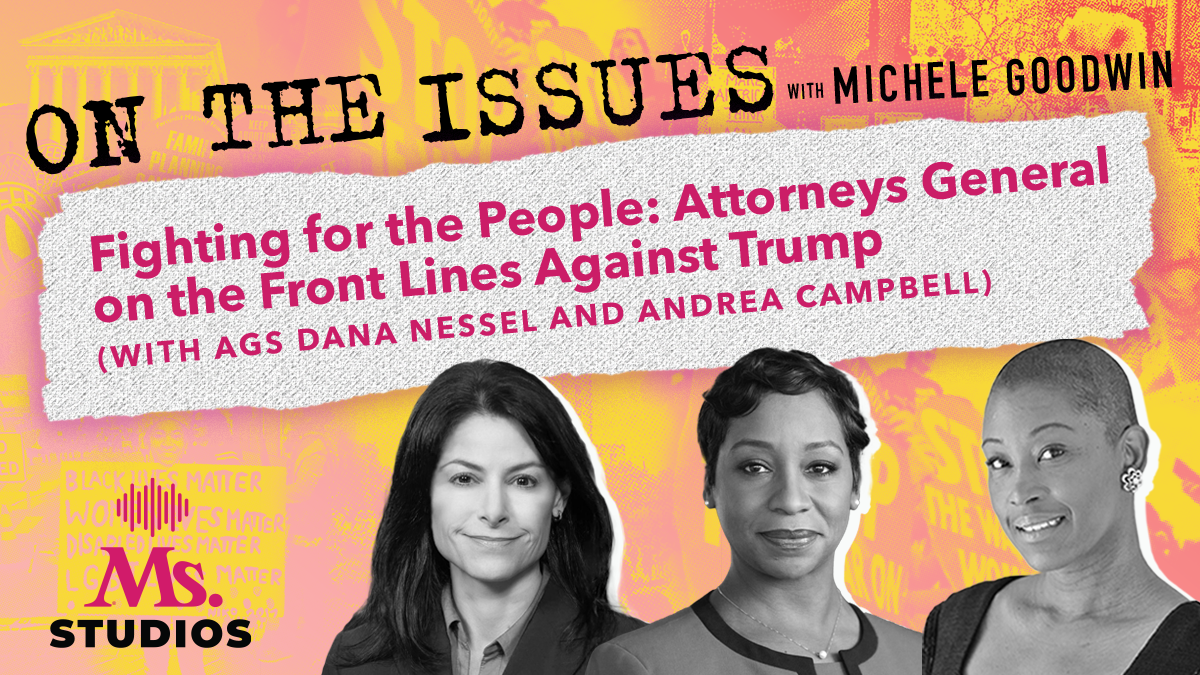
In the year since the Trump administration returned to office, there have been hundreds of executive orders, many of which district courts have ruled unconstitutional and illegal. As judges have noted, these actions have caused direct harm to Americans all across the country. And hard-hitting attorneys general have fought back. There are now over 450 lawsuits against the Trump administration, and in many of them district courts have ruled that the administration acted unconstitutionally. In this episode, recorded earlier this year, I’m joined by two Attorneys General who are leading this resistance: Massachusetts’s Andrea Campbell, and Michigan’s Dana Nessel.
Background reading:
- “Massachusetts Attorney General Andrea Campbell: A Reproductive Justice Champion” — Carrie Baker
- “Michigan Got Rid of Most Abortion Restrictions. Now AG Dana Nessel is Challenging the Final One.” — Ava Slocum
Transcript:
00:00:02 Michele Goodwin:
Welcome to On the Issues with Michele Goodwin at Ms. Magazine, a show where we report, rebel, and you know we tell it just like it is, and on this show, we center your concerns about rebuilding our nation and advancing the promise of equality. So, join me as we tackle the most compelling issues of our times, and on our show, history matters. We examine the past, as we think about the future.
In this episode, which was previously recorded, I am joined by two dynamic attorneys general, Andrea Joy Campbell, who is the Attorney General for the State of Massachusetts, and Dana Nessel, who’s been an Attorney General for the State of Michigan since 2019, and in this discussion, we talk about the very hard times that states have faced since the Trump administration has come back to office for its 2.0. I’m talking about the myriad executive orders, those executive orders that’ve caused direct harm to Americans all across the country and also to those people who are immigrants, people who are LGBTQ, and more.
We’ve seen the soup lines, the kitchen lines. We’ve heard the horror stories about people and their rent and mortgages. We’ve heard the stories about how people are losing their jobs. Three hundred thousand Black women out of the workforce and so much more. Now, out of those executive orders, there have been hard-hitting attorneys general who fought back. There are now over 450 lawsuits, of so many of them, district courts have said that the Trump administration has acted unlawfully, unconstitutionally.
And many of our listeners and many scholars and pundits and others have said that this has been an unethical administration, as well, given the travesty and harms that’ve taken place and also what’s afoot. People being snatched off streets with people in masks, people being separated from their children right after giving birth, mothers not able to be with their newborns. The list goes on, and it’s lengthy, and it’s shameful. In this pre-recorded episode, we talk about what this means in terms of the workforce, states attorneys general, and so, listeners, sit back, take a listen. I’m so happy that we have these guests on our show.
00:00:04 Michele Goodwin:
I’m so grateful that both of you have joined me for this episode. I really appreciate it. So, I want to get started with asking a broader question about what is this moment like, when there’ve been so many executive orders and you both have been standing up to that? And I’ll start with you, Andrea Campbell. Thank you for being on the show with me. Can you tell me a bit about how you and those in Massachusetts have been attempting to meet this moment of the Trump administration and the many executive orders?
00:00:42 Andrea Campbell:
Well, first of all, thank you for having me on. I’m delighted to be on with my colleague Dana, as well, because we are tag-teaming this, along with our Democratic AG colleagues all across the country, and I know she would probably say the same. Really proud to be a part of this coalition for different reasons.
One is we are all committed to service. We recognize that our job is about protecting the people, their rights, their freedoms, and doing it with a sense of urgency, and at the same time, protecting our state’s economy. We also do not take this work lightly. We are not only just public servants. We deal with integrity and a standard of excellence, and I’m proud of that, and I can’t stress that enough, because, as you know, when it gets really hard and challenging, you really have to turn to a team, and I’m really blessed to be a part of this one.
Specifically in Massachusetts, I think the thing that is the most heart-wrenching right now is the incessant attacks and unlawful attacks on our residents, on our immigrant residents, including children, on our public health system, the cut to our clinical trials, for example, for pediatric cancer, on our infrastructure, on our health and academic institutions, on DEI, and the list is long, and we don’t have any rationale as to why this vitriol and hatred is coming to our people. So, it’s hard to go out and explain that. So, what are we dealing with? Fear. Real, legitimate fear, and so, we are trying to use and maximize our legal tools to fight back.
And I’m proud that we’re doing that with a sense of urgency, understanding what’s at stake now and what’s to come, and reminding folks that we do this work, regardless of the letter that is by their name. We don’t care if you’re a Democrat, Republican, or Independent. It is about upholding the rule of law. It is about using our legal tools to fight to protect it, and most importantly, to fight to protect people, real people who are being harmed in real time, and then, of course, acknowledging the fear that is taking place not only…that exists here in Massachusetts, but of course, across this country. So, it’s a real fight, but I’m ready for it, and I’m excited to have a team to be a part of it.
00:02:56 Michele Goodwin:
Well, clearly, it seems that you are ready for it and meeting the moment. One of my producers, who helps me and the team in preparing for the show, shared that, as of July 21, that you filed 28 lawsuits against President Trump and his administration, and as you were noting, that litigation ranges in terms of matters of health, education, social service programs, and that you’ve also joined coalitions of other AGs, as well, in doing that work. Would you say that, a decade ago, that the attorney general in the seat that you now occupy would’ve ever, in the first six months of a presidential administration, have had, you know, nearly three dozen lawsuits filed against an administration?
00:03:56 Andrea Campbell:
No, and I’m frequently saying, because our current governor was the former AG, and I work closely with her, that Trump 2.0 is not Trump 1.0. If, for example, you are picking up a high school student who was on his way to practice, has no criminal record whatsoever, and detaining a 17-year-old student who’s about to graduate from high school and trying to offer some justification for that, it’s unacceptable, right? But the fear that is in our communities is real, and our inability to fight back with respect to every issue is also real. Our tools will hit a wall, especially in the context of ICE accountability.
This is very different, what we’re seeing, in addition to the blatant and consistent and persistent violations of the rule of law, the democratic values we all say we share in the Constitution here in Massachusetts and of course, at the federal level, but I think we are prepared to respond accordingly, but we also, at the same time, have to remind folks that we understand the pain and the suffering and that our tools will hit the walls. Even if we win a lawsuit, we’re not always winning, but we are in this fight with them, and everyone has to look themselves in the mirror in this moment in time and ask themselves, what are they going to do to fight back?
00:05:15 Michele Goodwin:
Well, on that note, you know, just quoting from you, that the lawsuits are working, and you’ve recently said that we’re protecting federal funding, our public health, our residents, and even birthright citizenship. I’m going to turn to your colleague, Attorney General Dana Nessel, who’s been on the show before, and so, here we are again, and when I think about Michigan and the work that’s going on there, as I was saying just before the show began, I think about the death threats that have been…that the governor, who’s a woman, has been targeted with. I think about just what that atmosphere is for a woman seeking to protect the state, anybody seeking to protect the state, but what that’s like in terms of the threat. So, I want to start there, which is how you’re doing. How are you doing in light of what has been the backdrop of defending the interests of the people of your state?
00:06:24 Dana Nessel:
Yeah, I think that I wouldn’t be honest with your audience if I said that, you know, there weren’t many times where new orders are issued by the executive, and there’s just a feeling of, like, I can’t believe we’re doing this. You know, I can’t believe we have a situation where our, you know, president and his administration are just so reckless and lawless, and that their orders and their actions are arbitrary and capricious and nonsensical, and candidly, don’t help anyone. There are so many times where I see orders and I say, this is harmful to literally every single person in my state, not just some people, and not just people who voted for Vice President Harris.
Literally everyone, and they’re done in a way that there’s simply no thought behind it whatsoever, and it’s almost a nihilistic viewpoint that this administration has, that they’re just going to blow up everything no matter who it harms, which is frequently, as I’ve indicated, so many people, but from the standpoint of the threats, I mean, this is something that I think all elected officials have had to deal with. Really, I would say it started, in earnest, around the time of the 2020 November election, and it honestly never stopped, and so, we have…
In my department, we have a Hate Crimes and Domestic Terrorism Unit that is constantly tackling the threats that come against public officials, not just Democrats. Many, many Republicans are also subjected to threats, and even people who are sort of, you know, low-level civil servants, just public servants, and I think, unfortunately, it all starts at the top. When you have somebody who is the president, who is so careless in the language that he uses and traffics in this very dangerous rhetoric, it has a way of seeping into every other part of life, and it really, truly has. So, unfortunately, that’s been a big part of our work, too, is investigating those cases and prosecuting those cases and trying to keep people safe.
00:08:47 Michele Goodwin:
So, one of the issues that you both were involved in is the question of birthright citizenship. Americans have heard a lot about it, the executive order that was to limit birthright citizenship. I’m wondering if you can unpack that a bit for our listening audience, and then, there was the case before the Supreme Court, settled on procedural grounds, but one that still remains quite the threat, and so, I’ll start again with you, AG Nessel, if you could tell us a bit about that, because you were responding…both of you were responding to what that meant in your states.
00:09:27 Dana Nessel:
Yeah, I mean, this was one of the very first orders that came from the president after he was sworn into office for the second time, and I will say, it was one that we were prepared for, from the standpoint that, you know, President Trump and his administration, through Project 2025, have made it abundantly clear this was his strategy, and you know, but also, I mean, one of the most unconstitutional orders or edicts ever to come, I would say, from any president of the United States. It so flagrantly violates the 14th Amendment, and I am the very first judge to rule on it, and one of the cases that was filed…there were two groups that the Democratic AGs were divided into.
But one of the cases that, I believe, is out of Washington district court was a Reagan appointee who said that, in over 40 years on the bench, he had never, in his entire career, seen such a flagrant violation of the United States’ Constitution, and so, you know, we have been successful. The Democratic AGs who have fought this battle, we have been largely successful so far in ensuring that this very illegal order never takes effect in any of our states, but you know, we’ve certainly had concerning rulings from the United States Supreme Court, who should have, in my opinion, very quickly deemed this order to be unconstitutional and then been done with it, but yet, this remains…cases that are continuing to be litigated.
00:11:17 Michele Goodwin:
Andrea Campbell, if you could then pick up on that, what’s the thrust behind, do you think, this executive order with regard to birthright citizenship, and explain it a bit more to our audience, just what’s at stake?
00:11:33 Andrea Campbell:
I do agree with AG Nessel, that I do wish the Supreme Court took up the substance of the very issue and deemed that the 14th Amendment is still intact, that it’s still constitutional, and that the president’s executive order to eradicate birthright citizenship in the 14th Amendment was unlawful. So, hopefully, that will come from them at some point, but yes, to your point, taking a step back, you know, birthright citizenship said that if you were born on the soil of this country, you are a citizen.
And we know it comes out of a collective fight, not just of Black folk, but of a rainbow coalition, in many ways, of people who fought for the freedoms for us, frankly, to be on this Zoom together without one of us being arrested, right? Fought against slavery and that oppression and the systems that would oppress our people and said, okay, well, what are we going to do with these Black folks post the victory there? And after that collective fight, the 14th Amendment came about that said, right, those Black folks who were recently freed are not only citizens, but they’re entitled to the rights and the privileges afforded other citizens in this country.
So, lately, I think folks have been talking about it in the context of immigration, of course, and the attack, that this is on newborn and unborn babies. That is cruel and horrific, to say the least, and that is so true, and it’s very much a part of the argument in our case. The second, though, it is also attack on Black folks in this history that I think is equally important. I’m the first Black AG in Massachusetts. I could not run for office, I could not vote without the 14th Amendment. So, it is critical to my existence as well as my ability to serve in this incredible role, and then, lastly, it is about the rule of law.
I tell folks, regardless of how you feel about the 14th Amendment, if we allow the president to eradicate, with a Sharpie and a stroke of a pen, the 14th Amendment of our Constitution, which he does not have the right to do, he can do that with any amendment. So, pick the one you like, the first, the second, any one you like. All of them are under threat if we allow this to proceed. For all these reasons, we mobilized quickly with respect to this first executive order out of the gate from the administration to hold him, as the president and of course, his administration accountable for this blatant violation of the rule of law and the values and the precedent that this all stands for.
00:14:05 Michele Goodwin:
Yeah, if you don’t mind me…oh, go ahead. Yeah.
00:14:08 Dana Nessel:
I think that something needs to be said about this, and that’s my father became a citizen through birthright citizenship. Had it not been for birthright citizenship, you know, he wouldn’t be a citizen, and I guess, you know, I would then not be a citizen as a result, as well, but I went to the southwest area of Michigan, and I had a meeting with a number of folks from various different immigrant communities, right? Haitians and Venezuelans and you know, Mexicans, and the list goes on and on, and I said to them…
You know, I told my story, and I said, how do we better tell the story of the fact that, you know, we are a nation of immigrants and so many of us are only American citizens via the 14th Amendment? You know, how do we tell the story, because are we failing to do that appropriately or in a way that is convincing to people? And what they said to me, and I’ve had a lot of time to think about this, is that they said, this isn’t about, you know, birthright citizenship, per se. The way that the Trump administration has formulated this, it’s really to prevent Black and Brown people from obtaining citizenship in the United States, and that, you know, the stories that have been told, it’s not that they’ve failed to tell their story.
It’s that people just don’t care. People are only interested in the stories of white Europeans, like myself, I guess, and I guess I came to see that that was really true. If you look at who the Trump administration has focused on in terms of the revocation of temporary status of people who have been here for, you know, decades, it is only people who are Black and Brown and people who are from those countries. It’s certainly not from White Afrikaners from South Africa. So, I think we have to call it what it is. This isn’t being meted out in a way that is equally distributed to all people around the globe. It is really focused on certain populations of people, and it’s those populations that have a certain skin color.
00:16:26 Michele Goodwin:
And it drives stereotypes, right? I mean, because what it does, is it drives the stereotype that the only people who’ve extended beyond the time of their visas or are here without documentation happen to be Black and Brown, and that, of course, is not true. It’s absolutely not true.
So, it ignores people who are here in the United States from Ireland, from Scotland, from Germany, from France, from all throughout, you know, Europe, from Australia, from New Zealand, from South Africa, right? Who may not…who may have extended beyond their visa, who may be homeowners and contributors to society, but the backdrop, in terms of the kind of narrative quality of this, is one that really does paint the kind of picture, AG Nessel, that you’re talking about, where most Americans are being sort of prompted to believe that the folks that they need to be worried about, in this regard, are Black and Brown. I want to pick up on that thread, because that leads us to how this is taking place, right?
So, even though there’s been a case before the United States Supreme Court, and the Supreme Court has weighed in procedurally, and we’ll talk a little bit about that, what has taken shape on the streets of America has been something that I’ve not seen in my lifetime, and we look around the same age. So, we’ve probably all not really seen…which is people being snatched off the streets with people who are masked, who are not identifying themselves, necessarily, and in fact, what I’m talking about is ICE, and there have been the people pretending to be ICE who’ve kidnapped people in that same kind of way.
So, you both have been involved now with turning your attention towards the ways in which the enforcement of this administration’s policies have been, and to your point, AG Nessel, you’ve been quoted as saying you’re seeing ICE agents who are in plain clothes, with, oftentimes, no identifying insignia on them at all, fully masked, and they’re performing arrests, detentions, and they’re throwing people into unmarked vehicles. So, tell us what you are doing about that, and then I’d like to hear from you, too, AG Campbell. How are you responding to this moment?
00:18:57 Dana Nessel:
Well, I’m proud of the fact that the Democratic AGs have written letters in support of federal legislation that is pending in both the United States House of Representatives as well as in the United States Senate that would require, except for in very specific, limited circumstances, that ICE officers have to, firstly, have identifying insignia so you even know what agency they’re affiliated with, if any, and secondly, that they be unmasked, and I will tell you this. You know, I have been a longtime prosecutor. I started my career as an assistant prosecuting attorney in Wayne County, which is where Detroit is located.
And so, I’ve spent the bulk of my year as a prosecutor. I’ve never, ever seen law enforcement operate this way. Not the locals, not the county sheriffs, not the state police, and not federal law enforcement, and this is a terrifying moment, but it’s also dangerous, not just for the communities that ICE is serving. It’s dangerous for law enforcement, because you have this situation where, you know, people, rightfully, don’t know, you know, are these people who are trying to kidnap them? Are these people who are committing an illegal act? For a state like Michigan, which is a stand-your-ground state, can you defend yourself with lethal force against someone who is trying to perpetrate this harm upon you?
You know, and in addition to that, it actually contradicts our own state laws regarding law enforcement. So, whether it’s resisting and obstructing an arrest, you’re allowed to resist an unlawful arrest, whether it’s fleeing and eluding laws. You don’t have to pull over for an unmarked vehicle in Michigan. We think it’s unsafe for people to pull over when there’s just flashing lights and you don’t know, is this law enforcement or somebody pretending to be law enforcement? So, it is really a safety hazard to law enforcement and to other forms of law enforcement, too, not just to ICE, because it begs the question, well, who is and who isn’t law enforcement?
Because when you see people who are operating, again, in plain clothes, unmarked vehicles, fully masked, no identifying insignia, now everyone is confused, and so, it puts everybody’s life in danger, and it makes it harder for law enforcement to do their jobs and to do them well. So, you know, I’m proud of the fact that we all came together to support Congress in their effort to change the law. I’m not really under any illusions that the president would sign such legislation, even if it was passed in both chambers, but I think it’s really serious, and it needs to be addressed, and anybody who really cares about the safety of law enforcement officials knows how important this legislation is.
00:22:00 Michele Goodwin:
So, we have the birthright citizen case that came up before the United States Supreme Court, and AG Campbell, I’d love to hear you speak to this. So, the backdrop of the case really is this challenge to the 14th Amendment, as you talked about, but the court dispensed the case on procedural grounds, which, the theory was that judges, district court judges, may not issue orders that have an effect across the entire nation, which, of course, is really quite complicated. You know, it’s something that the court could have spoken to during the Biden administration. It didn’t. You are quoted as saying, while today’s Supreme Court decision is disappointing and introduces additional procedural hurdles, we look forward to demonstrating why nationwide relief, in this case, is necessary, as the court has invited us to do. Could you explain just a little bit more of that for our listeners who are trying to figure out what does this all mean?
00:22:57 Andrea Campbell:
Absolutely, and I think it’s clear from my quote I wanted to really push back, to be candid, on the victory lap that the Trump administration was taking, with respect to this particular case. It was procedural. We would have liked the Supreme Court to weigh in on the merits. I think, based on the arguments, that wasn’t going to probably be the case, based on what we heard in the actual back and forth between the justices, and what they essentially told us is that we have to go back to the district court and frankly, ask for that relief again, which we have done, and that they have real concerns about nationwide relief, and I get that.
Even the Democratic AGs have been on record saying that we do not think it’s appropriate relief in every single case. In the birthright case, it was abundantly clear that this is appropriate relief. We often have folks born here in Massachusetts, because of our healthcare infrastructure here and in the number of healthcare providers we have here, institutions, who then are born here and then go back to New Hampshire or states right across the border. How then can you be born in Massachusetts, maybe be a citizenship, then go to New Hampshire and not be a citizenship…be a citizen there?
So, just the…it just wouldn’t make any sense, and so, we’re going to keep pushing for the relief to be nationwide, but most importantly, to continue to lift up the birthright citizenship case as just that, something that is indicative of the larger issues we’ve been discussing. That it’s not just about this administration looking to dismantle the rule of law and the Constitution. You can’t have a functioning society or economy without one. Good luck, but it is about the targeting of Black and Brown people, as AG Nessel described, and we’re seeing that in the ICE activity in our communities, as she also spoke to, and that is not any different here in Massachusetts.
It is egregious. It is horrific. They’re targeting youth. They’re targeting people with active applications for asylum and other types of relief. They’re targeting people who came here lawfully, including a student whose case got a lot of attention at Tufts University. She came here lawfully and was detained for months, and so, we’re not only standing up to push for what’s right. We’re also in court in immigration cases to defend TPS and other statuses, to also defend and stand up for due process, and also to recognize the bigger issue that’s at play here, which is them promoting this narrative as if they are doing this for public safety, but to say that is total BS.
It is fear mongering, and it will make our communities less safe, as it already has. People will not come forward to talk about crime they’re seeing. It will also absolutely disrupt and undermine our cultural institutions, our economy, and the last I checked, we need more people for jobs, not less, and our immigrants here in Massachusetts are working, and if they’re perpetuating crime, we, as AGs, already hold them accountable without promoting fear at the same time for unjust policies. So, we’ll keep fighting the fight, but it’s all interconnected.
00:26:06 Michele Goodwin:
It so is. So, I want to turn to my last couple of questions before I let you go. This time flies by way too quickly, and I could spend a lot more time with you, and I would love to have both of you back. You both are in states that have elected two women, and before I go on, let me just say this. These targeting of Black and Brown people, I kind of see that as being canaries in the coal mine, right?
Because once people become used to ICE agents not having to identify themselves, having any kind of insignia, you know, of who they are, being masked and all of that, then what does that mean for the college student who might be a white woman on campus and someone rolls up and ICE is the only thing that’s on their, you know, back? Is she supposed to respond to the demands that are made, get in this car because I’m ICE? I mean, you’re setting up this kind of scene in our culture that, yes, the folks who are first affected by it are Black and Brown, but ultimately, normalizing a kind of behavior where everyone should be concerned about being at risk.
So, I want to turn to this question about what it means to then hold these positions in a blue state versus a purple state. So, I want to start with you, AG Nessel. Okay, what is it like then doing this work in a purple state? You have said, on one hand, our executive office holders are all progressive Democratic women, which is amazing, in and of itself. On the other hand, you’ve said the legislature has been gerrymandered. Tell us a bit about doing this work where you are.
00:27:49 Dana Nessel:
Yeah, well, I’ve referred to, you know, the electorate, at times, to be a little schizophrenic in my state, unsure of exactly what it is that they want, and I say that because, of course, you know, I ran on a platform of suing the Trump administration during his first term. That’s when I first came into office, and so, it’s odd, of course, that, like, I was elected twice in this state, but so was Donald Trump twice. So, I don’t know. It seems odd to say we want someone who is going to promote illegal policies, and we want someone else to sue every time there’s an illegal policy, and there is standing to do so.
I mean, obviously, that doesn’t make sense, but what I would say is this. I truly, truly believe that if people in my state, people who voted for Trump, people who still identify as Republicans, if they really understood each of our lawsuits, I think that they would support the vast majority of them, and let me say this. Our lawsuits have now saved the state of Michigan over…I mean, this is a conservative figure. Over 1.6 billion dollars, and that’s money that our state residents and our businesses paid to the federal government in taxes that the Trump administration then tried to illegally withhold from our state, money that was congressionally approved to come back to our state in the way of much needed programming.
So, you know, in our state, here we have a 1.1-billion-dollar shortfall in revenue that is projected, based on things like, you know, a downturn in the economy and the tariffs that have been very injurious, in particular, to the auto manufacturers and their suppliers. That really hits Michigan in a big way, and so, we have much less money coming into our state treasury, but here, our department is saving the state so much money.
And I’ve actually had, off-the-record, a couple of Republican legislators say, thank god for your lawsuits, because we don’t know what we would do if we didn’t have that money coming back to us. So, I think there is the recognition by some that this fulfills a really important role, and at the end of the day, again, this was money that was legally, congressionally, constitutionally appropriated to our state after we’ve already paid for that. That’s our money that we’re getting back to our state. So, there’s the understanding that this is important, and I would say this, in addition.
Because of the procedural ruling in the birthright citizenship case, you have a situation where the court has, essentially, said that, in many different instances, if you’re not participating in that lawsuit, you will, as a state, not be granted the relief provided by a preliminary injunction or a TRO by the court. So, for the states that are not participating, meaning the states that are represented by a Republican attorney general, oftentimes, the Trump administration will have to just do away with whatever the policy was, because we’ll win in court, and then it will only impact the states with a Republican AG and not our states, our respective states.
00:31:12 Michele Goodwin:
That’s a very good point.
00:31:13 Dana Nessel:
I think there’s a _____ 00:31:13 that we are doing really important work for our states in terms of bringing these lawsuits, but that these lawsuits are gravely injurious, really, to all of the states.
00:31:25 Michele Goodwin:
That’s right. That’s right, and so, then I’m wondering, then, we’ve gone from purple to then blue. So, AG Campbell, what then is it like then taking on the Trump administration, fighting for the folks in your state, and doing it from a space that is recognized as being bold and blue?
00:31:44 Andrea Campbell:
Bold and blue, I love that. Blue is my favorite color. Bold and blue. So, one of the things…and I think this picks up on a point that you made earlier about the college student, who may happen to be white, walking down the street who’s stopped by law enforcement or ICE or anybody, and that these issues we’re talking about would affect her, too, right? The lack of due process if she was just taken off the street or pulled over and not even explained to, well, why are you pulling me over and expected to go with some stranger somewhere?
And so, I think what we’ve done our best, at least, or attempting to, through storytelling, is that the issues that are coming out are coming to the top for us to deal with, and the unlawful actions of this administration affect everybody, and yet, what they’re attempting to do is divide us, right? They actually want us to refer to our states as the red state, the purple state, the blue state, and what I find, as I crisscross the commonwealth, is that most of the communities that feel left out, left behind, that I prioritize fighting for, because maybe as a kid, I felt left out and left behind, is they are poor.
They are rural communities. They are not Boston, right? They’re not the eastern part of the state, necessarily, and they are maybe more red there or more purple there, and so, what I have done, instead, is to say, we’re focused on doing a job that requires government to respond to your needs. Affordability is a number one issue. So, we’re holding the Trump administration accountable, because it is threatening billions of dollars that come to Massachusetts, over 20 billion dollars, and that’s not a red, blue, Republican, Democrat issue. That’s an economic issue. That’s an affordability issue. We can’t help you with respect to the number one issue you’re talking about if we don’t hold this administration accountable like we do everybody else.
And so, what I’m finding is that, in this moment in time, it’s really important that we actually get out there in the community to talk to real people, and to AG Nessel’s point, to get them to understand what we’re doing is to help people to hold government accountable, most importantly, to deliver for real people. Just like I was in a community earlier today talking about our FEMA brick lawsuit, where we just got a preliminary injunction granted today, a real infrastructure project in a community, Manchester-by-the-Sea, that also, if flooding happens, will cost people their lives.
It’s also an economic issue because of where it’s situated in that community in terms of their business district. So, it covers so many different topics that everyone cares about, and I think we have to do our best to really push back on these narratives, including the divisive narrative that folks want to create to suggest that we are somehow different or not in this, and to really make this about everyone and what’s really at stake. It’s not just the rule of law or our Constitution. It is lives. It is economic prosperity. It’s children and the next generation to come.
00:34:48 Michele Goodwin:
All right, really quickly, because we’re running out of time…I am so grateful that you gave me the time, that you’re giving me this time. All right. What’s the fight ahead for reproductive rights in your state?
00:35:01 Andrea Campbell:
I can start. Where to begin? So, one thing, I do think we are blessed here in Massachusetts because we have won the Shield law, which, we passed the first one. Other states followed, but we actually just…the legislature just passed Shield 2.0. So, we’ve had to update that in terms of privacy provisions, continue to protect our providers, those providing access to gender-affirming care, you name it. I established a reproductive justice unit in the office, as well, not only to continue to push legislative solutions here in Massachusetts…
So, regardless of what the federal government does, this is a safe space for people to access reproductive healthcare, but at the same time, to ensure that we have litigation and other tools available to us to support other states, which we’ve done as a coalition even before this administration. Access to mifepristone and other ways in which people can access abortion care, access to reproductive healthcare generally, but then, also, making sure we’re talking about it from an intersectional lens.
Reproductive healthcare, at least for us in Massachusetts, is about, also, maternal health gaps. It is about gender-affirming care. It is about the quality of care. It is about the cost of healthcare. So, when we say that word reproductive healthcare, it’s about human rights and healthcare generally, and again, it’s Democratic AGs stepping up in our respective states and then, as a coalition, to fight back to protect our folks from what we’re seeing on the ground, in terms of other state activity that is egregious and horrific, to say the least.
00:36:30 Michele Goodwin:
AG Nessel, if you could just give us some insight about what’s happening in Michigan?
00:36:35 Dana Nessel:
Yeah, well, we have divided government here, so we can’t pass some of the same types of laws that AG Campbell spoke about, but we did have a voter initiative pass with flying colors in 2022 because we had one of the old 1931 abortion bans on the book still, and when Dobbs overturned Roe v. Wade in 2022, myself and our governor took quick action to ensure that the old law never went into effect until the voters had their say.
And then we, basically, incorporated Roe into our Michigan Constitution to provide protections not just for abortion, but for birth control, for the ability of people to manage a miscarriage, for fertility treatments. Really, the list goes on and on, and so, what I’ve been doing, as state attorney general, is, when challenges come, obviously, we vigorously defend that. Sometimes there are challenges coming from sort of pro-choice stakeholders, who are now challenging some of the old TRAP laws that are on the books, and in those cases, you know, I erect a conflict wall in my office.
And while the department does still defend those laws, I personally, in my parents’ patriotic capacity as attorney general, have taken the opposite approach in trying to have those TRAP laws stricken down, and we’ve been, actually, very successful just recently in having some of those laws, you know, be held to be unconstitutional under our new laws, but that being said, I will just say very quickly, even though, you know, we were told by the United States Supreme Court that Dobbs was supposed to be a state’s rights-related ruling, we know that that’s not really the agenda of the federal government.
And so, you have many, many maneuvers being made by the federal government to try to take states like ours, where we do have reproductive freedom, and to say, well, even if, technically, the law is that you have the ability to seek, you know, reproductive healthcare, we’re going to make it so hard for you to do so, that, in effect, it’s just the law’s just, you know, a paper document and nothing more, and they’re doing that in a number of different ways, but you know, the Democratic AGs have been fighting back vigorously against those efforts, and we’re going to continue to do that.
00:39:04 Michele Goodwin:
All right, final question, and then we’ll take it on out of here. Which is, what’s the silver lining? I mean, we’ve talked about any number of issues in terms of the atmosphere of now. The disparities, the stereotypes, the stigmas of now, the ways in which you’re fighting back, the kind of fear-mongering that is being cultivated. So, with all of that, what is a silver lining? What do you see as sort of gives a space of hope for those who are listening and who are trying to figure out how to withstand such that we’re able to build a better democracy? I’ll start with you, AG Nessel.
00:39:43 Dana Nessel:
I guess what I would say that is encouraging is that we are actually winning most of these lawsuits, at least in the preliminary phases. I mean, we are getting, you know, restraining orders or preliminary injunctions in the vast majority of these cases. Yeah, every once in a while, something will go up to the Supreme Court, and we’ll get a ruling that…not on the merits, but a ruling that, you know, we’re not happy about, because it undermines, you know, our case, but for the vast majority of these cases, we have been successful.
And at the same time, as we’re doing that, Donald Trump and his administration have become deeply unpopular, and his popularity in states like mine, that, again, voted for him, have really diminished significantly. So, I think there is the understanding that, you know, our lawsuits are just and righteous and popular, and that the maneuvers by the executive, by Donald Trump, and by his administration are becoming deeply unpopular, and so, those are the kinds of things that give me a little bit of hope, and I do know this. The more that the administration enacts these very, you know, illegal orders and acts, you know, the less likely it’s going to be that they’re going to be upheld by the courts, in part, because they’re doing it so frequently that, frankly, they don’t have the capacity.
I think the DOJ really doesn’t have the capacity to keep up, not just with the Democratic AGs who’ve been fighting back, but the many, many other groups out there, some 300 cases or more, I think, that have been filed, and you know, for the most part, many of our institutions are withstanding this tidal wave of illegal acts. I don’t know if that’ll continue to be the case, but so far, I think that our numbers are pretty good in terms of these challenges to these illegal acts in court.
00:41:51 Michele Goodwin:
And AG Campbell, silver lining before I let you go.
00:41:55 Andrea Campbell:
I would echo AG Nessel, in that we are winning these lawsuits, and if folks don’t know who their AG is in their respective state, wherever they are, get to know your AG, because, right now, that particular elected official is on the front lines of either defending your rights in your pocketbooks or not, and so, I’m proud of this coalition that wins. At the same time, we recognize, even though we may win a case on NIH funding to protect clinical trials, if a clinical trial has been disrupted for someone battling pediatric cancer, it can be game over for them.
So, there are many folks who are still, by certain metrics, right, losing, maybe even losing their lives, and so, I understand there is maybe a sense of hopelessness and fear. So, what sustains my hope is not only the work and the purpose-driven work that I get to do every day, it’s a deep sense of faith that I name and stand in every day. It’s remembering my own personal story and how it’s miraculous I’m even here, and I think people, in this moment in time, should reflect on their own story where they went through something and made it through, and now you don’t have to make it through by yourself. Find yourself a Democratic AG, and then, well, there you go, right? And then, lastly, I think, in addition to our own personal stories and narratives, this would be a good time to reflect on history, and in my case, right…I think AG Nessel mentioned this, too.
We all have a historical context where people fought and died with lesser, in many ways, and sacrifice, knowing they would never see the light or the outcome of what they were fighting for. That absolutely gives me hope and a sense of inspiration to fight the fight today and to do it knowing that there is a group of coalition folks out there, including you in this podcast and this platform, and folks who are civically engaged in getting people to vote more. All of that gives me hope, and hopefully will give others the same sense of inspiration and hope, too.
00:43:52 Michele Goodwin:
I want to thank both of you, Attorney General Andrea Joy Campbell and Attorney General Dana Nessel, for joining us for our Ms. Magazine platform at Ms. Studios. Thank you so much.
00:44:04 Andrea Campbell:
Thank you.
Dr. Michele Goodwin:
Guests and listeners, that’s it for today’s episode of On the Issues with Michele Goodwin, and I want to thank my guests for joining us, and being part of this critical and insightful conversation.
And to our listeners, I thank you for tuning in for the full story. We hope you will join us again for our next episode, where we will be reporting, rebelling, and telling it just like it is, as usual. It will be an episode you will not want to miss. And for more information on what we discussed today, head to MsMagazine.com, and be sure to subscribe.
And if you believe, as we do, that women’s voices matter, that equality for all persons cannot be delayed, and that rebuilding America being unbought and unbossed, and reclaiming our time, are important, then be sure to rate, review, and subscribe to On The Issues with Michele Goodwin and Apple Podcast, Spotify, iHeartRadio, Google Podcast, Stitchers, wherever it is that you listen to your podcast. We are ad-free, and reader supported. Help us reach new listeners and bring the hard-hitting content you’ve come to expect by rating, reviewing, and subscribing. Let us know what you think about our show, and please support independent feminist media.
Look for us at MsMagazine.com, for new content, and special episode updates. And if you want to reach us to recommend guests for our show, or topics that you want to hear about, then write to us at OnTheIssues@MsMagazine.com.
This has been your host, Michele Goodwin, reporting, rebelling, and telling it just like it is. On the Issues with Michele Goodwin is a Ms. Magazine and Ms. Studios production. Michele Goodwin is the executive producer of Ms. Studios. Our producers for this episode are Roxy Szal, Oliver Haug, Mariah Lindsay, and Allison Whalen. The creative vision behind our work includes art and design by Brandi Phipps, editing by Natalie Hadland, and music by Chris J Lee. Our intern is Emersen Panigrahi.
About this Podcast
On The Issues With Michele Goodwin at Ms. magazine is a show where we report, rebel and tell it like it is. On this show, we center your concerns about rebuilding our nation and advancing the promise of equality. Join Michele Goodwin as she and guests tackle the most compelling issues of our times.