

Trump’s Silence on World AIDS Day Revives a New Lavender Scare

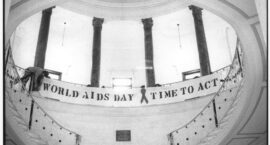
Last month, the State Department warned employees not to commemorate World AIDS Day through official work accounts, including social media, nor should they use government funds to mark Tuesday, Dec. 2, as World AIDS Day. The day came and went in a quiet, cold Washington, D.C., without the president marking what it represented—the more than 700,000 Americans who died from HIV/AIDS-related causes in the United States since 1981. 

If his intentions were unclear, Trump’s budget proposed ending all CDC HIV prevention programs this past June, and Congress continues to negotiate next year’s budget, proposing massive cuts to HIV programs. 

For many young people who never lost friends or family, there may be the misconception that the HIV/AIDS crisis of the 1980s was localized and small, but nearly 300,000 men who have sex with men have died from AIDS-related complications, with over 6,000 deaths in 2019 alone. To put this in perspective, this would be as if over half of Wyoming’s population disappeared, or if everyone in Pittsburgh, Penn., vanished overnight. 

Even Madonna criticized Trump’s move, posting on Instagram, “It’s one thing to order federal agents to refrain from commemorating this day, but to ask the general public to pretend it never happened is ridiculous, it’s absurd, it’s unthinkable. I bet he’s never watched his best friend die of AIDS, held their hand, and watched the blood drain from their face as they took their last breath at the age of 23.” 
A Century After the Eugenics Movement, the U.S. Is Again Barring Disabled Immigrants

This month, Secretary of State Marco Rubio instructed visa officers to consider obesity and other chronic health conditions, such as heart disease, cancer and diabetes, as justification to deny people visas to the United States.

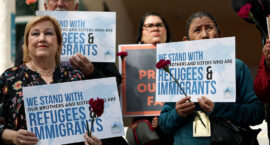
Many were outraged and shocked, observing the Trump administration’s new expansion of the “public charge” rule—directing visa officers to deny entry to people with disabilities, chronic illnesses or age-related conditions—as a modern revival of eugenic immigration policy designed to exclude, control and institutionalize disabled and marginalized people.

When Trump first took office in 2016, the Trump administration broadened the definition of public charge to include people who receive SNAP benefits, medicaid, housing assistance, childcare subsidies and more. This new rule was published in 2019 and went into effect in 2020 and early 2021; President Biden ended the use of this public charge rule definition in March 2021, returning it to the older but still restrictive version. Following Trump’s new rule, visa denials based on the “public charge” rule exploded during Trump’s first residency, rising from just over 1,000 denials in 2016 to over 20,000 in 2019, and it had disastrous effects.

As the Migration Policy Institute (MPI) found, broadening this public charge rule led many people to reduce or stop using benefits or services for themselves.

The Return of the Tradwife Gospel

When Erika Kirk took the stage at her husband’s memorial, dressed in white and preaching about virtue, guardianship and motherhood as women’s highest calling, it was not just a moment of personal grief. It was also a sermon drawn directly from the playbook of the 19th-century Cult of Domesticity, which elevated piety, purity, domesticity and submission as the cornerstones of “true womanhood.” While Kirk framed these ideals as a source of women’s strength, history shows that they have long functioned as tools of confinement and control.

The irony, of course, is that Kirk is now CEO of Turning Point USA—a position she could never hold without the very feminist progress she disavows. Tradwife rhetoric may promise dignity and purpose, but as the Cult of Domesticity and later social purity movements revealed, these ideals have always come at women’s expense. They strip away autonomy, enshrine patriarchal power and ultimately sacrifice women—even those who embrace the gospel themselves.

A Trump Cabinet Member Endorsed a Pastor Who Wants the 19th Amendment Repealed, and the Danger Is Growing

Once a fringe warning, the threat to women’s right to vote is now out in the open—and in the halls of power.

Defense Secretary Pete Hegseth reposted a video on Aug. 7 with the endorsement “All of Christ for All of Life,” in which a far-right conservative pastor, Doug Wilson, co-founder of the Communion of Reformed Evangelical Churches (CREC), argued that women should not have the right to vote.

As Wilson told the Associated Press, “He was, in effect, reposting it and saying, ‘Amen,’ at some level.”

But a deeper dive into CREC reveals troubling gender politics where women cannot hold church leadership positions and married women are expected to submit to their husbands.

Legalizing Conversion Therapy Sets a Dangerous Precedent for Medical Violence

Iowa and South Carolina’s attorney generals are leading a coalition composed of representatives of 11 states seeking to overturn Michigan’s ban on conversion therapy for minors. This past Friday, the coalition filed an amicus brief in the 6th U.S. Circuit Court of Appeals requesting a reversal of a decision issued in January—a decision denying a request to reverse Michigan’s conversion therapy ban. 

Conversion therapy originated from medical violence against women who did not conform to gender-based norms, arguably the same reason that Christian conversion therapy practitioners today target LGBTQ+ people who do not conform to heteronormative, cisgender norms. It sets a dangerous precedent for what other kinds of medical violence can be leveraged to reinforce far-right gender normative ideals.

Trump Attacks Queer Communities Using Nazi Symbolism

Earlier this week, President Trump shared an article on his Truth Social platform celebrating his elimination of trans and queer people from military advertising. The opinion piece published by reporter Jeremy Hunt of The Washington Times, featured a crossed out upside down pink triangle. The inverted pink triangle was a symbol used by Nazis to identify LGBTQ+ prisoners in Nazi concentration camps. In response, LGBTQ+ Americans and allies are expressing fear surrounding the post—marking the third time that someone within or associated with the Trump administration has used Nazi symbolism.