
Women make the holidays happen, even as policymakers undermine the programs meant to support families—including SNAP and Affordable Care Act subsidies to make healthcare more affordable.


More Than A Magazine, A Movement

Hunger and food insecurity reflect political and economic systems that deny people—particularly women, children and marginalized communities—consistent access to safe, nutritious food.
Women make the holidays happen, even as policymakers undermine the programs meant to support families—including SNAP and Affordable Care Act subsidies to make healthcare more affordable.

This month, Secretary of State Marco Rubio instructed visa officers to consider obesity and other chronic health conditions, such as heart disease, cancer and diabetes, as justification to deny people visas to the United States.
Many were outraged and shocked, observing the Trump administration’s new expansion of the “public charge” rule—directing visa officers to deny entry to people with disabilities, chronic illnesses or age-related conditions—as a modern revival of eugenic immigration policy designed to exclude, control and institutionalize disabled and marginalized people.
When Trump first took office in 2016, the Trump administration broadened the definition of public charge to include people who receive SNAP benefits, medicaid, housing assistance, childcare subsidies and more. This new rule was published in 2019 and went into effect in 2020 and early 2021; President Biden ended the use of this public charge rule definition in March 2021, returning it to the older but still restrictive version. Following Trump’s new rule, visa denials based on the “public charge” rule exploded during Trump’s first residency, rising from just over 1,000 denials in 2016 to over 20,000 in 2019, and it had disastrous effects.
As the Migration Policy Institute (MPI) found, broadening this public charge rule led many people to reduce or stop using benefits or services for themselves.

In every issue of Ms., we track research on our progress in the fight for equality, catalogue can’t-miss quotes from feminist voices and keep tabs on the feminist movement’s many milestones. We’re Keeping Score online, too—in this biweekly roundup.
This week:
—Democratic candidates won elections across the country.
—At Crooked Con last week, Rep. Pramila Jayapal (D-Wash.) laid out her priorities for when Democrats regain power in Congress: “We’ve got to fix the Voting Rights Act, we have to deal with the money in politics, we have to deal with the Supreme Court and we need immigration reform.”
—ICE targeted childcare workers and is accused of inhumane detention conditions.
—Nancy Pelosi announced her retirement in 2027.
—Trump’s approval ratings continue to fall, a year out from the 2026 midterms.
—Many popular lubricants aren’t safe for vaginal health.
… and more.

Gail Todd lives with her husband and three daughters in the southeastern section of Washington, D.C., and works at a Walmart in suburban Maryland. Her husband is a shift manager at a fast-food restaurant. Food stamps—the common name for the vouchers or debit cards supplied by the Supplemental Nutrition Assistance Program, or SNAP—helped Todd when she struggled financially after her first daughter was born. She had to turn to them again four years ago because her job, combined with her husband’s wages, doesn’t pay enough to feed her family.
Before Walmart, Todd, pregnant now with her fourth child, worked for $8.35 an hour at McDonald’s. Walmart’s $10 hourly wage was better. In the beginning she worked roughly 40 hours a week, but since May her weekly hours have been reduced to between 16 and 28, earning her no more than $900 a month. The loss in income coincided with a cut to the family’s monthly food-stamps benefit from $339 down to $239—the lowest she’s ever received—because a temporary boost to the program in the stimulus bill was allowed to expire Nov. 1, 2013.
“The food stamps, they help, but it’s not enough because I can’t feed my family,” she says.
[From the Spring 2014 issue of Ms.]
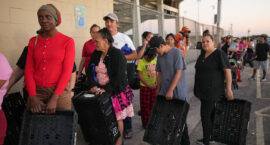
Throughout the United States, the millions of families that rely on Supplemental Nutrition Assistance Program (SNAP) benefits—which make up 12.3 percent of Americans—have spent at least 10 days without them. The uncertainties about whether they will return, and when, has left families desperate. For many, the crisis has reinforced what they’ve long felt: The nation’s social safety programs are failing to meet real, everyday needs—and across Iowa, Michigan and Pennsylvania, Americans are growing disillusioned with politicians who can’t protect their most basic ones.
For many disabled Americans, losing SNAP also means losing the nutritional needs that help keep them out of the floundering U.S. healthcare system. They shared with Ms. a glimpse into what the past 10 days without SNAP have looked like, and what millions of Americans who rely on these programs actually need.
“If I lose benefits, am I going to be able to remain going to school?”
“They’re thinking about next week. Will they have food? Will they be hungry?”
“The problem is, the rent always eats first, or the house payment is going to eat first. After that? Are you going to [get your] medicine? No, we [have to pay] our utilities…. then you [think], ‘Okay, I’ve only got enough for either food or my medicine.’”
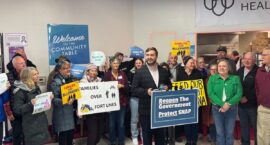
As federal SNAP funding stalls amid the shutdown, families, advocates and food banks are stepping up to keep people fed—but they can’t fill all the gaps.
“When we support programs like SNAP—we’re not just feeding families, we’re strengthening the entire community—every child who goes to bed with a full stomach, every parent who can focus on work instead of hunger, every landlord who can count on rent being paid—all of that adds up to a healthier, more resilient community,” said Semone Thomas, a Wisconsin SNAP advocate. “Because in the end, food security is not charity, it’s community.”
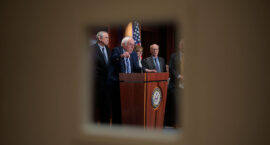
The Trump administration will release funds to pay for half of November’s SNAP benefits, following two federal court rulings the Department of Agriculture (USDA) to release the money. Patrick Penn, who oversees the SNAP program at the USDA, warned of disruptions and delays, suggesting many SNAP recipients will still be without benefits for some time.
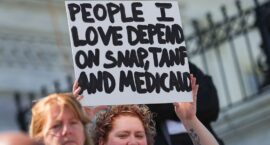
As the federal government lurches toward a second month of shutdown, SNAP is dominating the headlines. In a moment marked by fear, confusion and misinformation, the Trump administration and Republican leaders in Congress are offering plenty of inflammatory rhetoric—but little real problem-solving.
The Trump administration is playing politics with people’s basic needs by claiming there is no funding for November SNAP benefits. The truth is that the U.S. Department of Agriculture has complete control over the contingency fund for SNAP, and they can and must deploy it immediately.
When Crystal FitzSimons became president of the 55-year-old, Washington, D.C.-based Food Research and Action Center (FRAC) in May, she anticipated attacks on federal food and nutrition programs. But she calls what has unfolded unprecedented, and makes clear that unless Congress changes course and passes the Restoring Food Security for American Families and Farmers Act of 2025, millions of U.S. residents will lose some or all of the benefits they’re receiving through the Supplemental Nutrition Assistance Program, better known as SNAP.
Other pending changes that FitzSimons is expecting will take the shape of denying SNAP to the few immigrants who were previously eligible for benefits, such as asylum seekers, refugees and international survivors of domestic violence.
“We are working at the state and federal levels and are collecting stories of different people who will be directly impacted by the cuts—the grandmother who relies on SNAP and helps watch her grandchildren while her daughter is at work; disabled people who use SNAP to support their independence; and older adults who are no longer able to work. We share their stories because we know that the real experiences of real people are critical in helping lawmakers and others understand who benefits from SNAP.”
“Every dollar spent on SNAP generates up to $1.80 in economic activity at the community level during economic downturns.”

The Trump administration is calling its new budget “the most pro-family legislation ever crafted.” But for women like Bre’Jaynae Joiner, a single mother of two in Oakland, the cuts to Medicaid and SNAP threaten her family’s very survival.
Over the next decade, more than 11 million Americans—mostly women and children—are expected to lose health coverage, while deep food assistance cuts and work requirements will push even more families into crisis. Advocates call the bill a massive transfer of wealth to the rich at the expense of the poor, a policy that will shutter rural hospitals, deny essential care and worsen maternal mortality.
As Sen. Raphael Warnock puts it plainly: “If you cut $900 billion out of Medicaid, people are going to die.”