
In a year marked by democratic backsliding, cultural reckoning and organized resistance, these feminists reshaped power, through law, leadership, art and collective courage.


More Than A Magazine, A Movement

In a year marked by democratic backsliding, cultural reckoning and organized resistance, these feminists reshaped power, through law, leadership, art and collective courage.
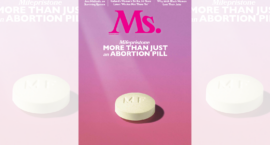
Mifepristone has shown potential to treat a striking range of diseases and conditions, some life-threatening: fibroids, breast cancer, depression, endometriosis, Gulf War illness and maybe even other autoimmune diseases, such as chronic fatigue syndrome and multiple sclerosis. Research also suggests that mifepristone may help prevent some forms of breast cancer and can serve as an effective weekly contraceptive without the side effects of hormonal birth control.
Yet despite the drug’s promise, its development has been repeatedly stymied by abortion opponents who fear wider availability would weaken their attempts to suppress abortion access.
The result? Women are left in needless pain and subject to invasive and unnecessary surgical procedures like hysterectomies.

In a quiet regulatory maneuver with seismic consequences, the U.S. Department of Education—under the direction of Republican members of Congress—has proposed reclassifying all graduate nursing degrees as “non-professional.” What sounds like an obscure bureaucratic shift is, in reality, a direct attack on the women who make up nearly the entire nursing workforce and who hold together America’s fraying healthcare system.

This has been a year of noise—misinformation, silencing, the old machinery of misogyny trying to drown out the truth. But still, the stories and the truth rose. They rose because you supported our Ms. community, because you shared them, and because you believed that women’s realities deserve a place at the center of public life and discussion.

The feminist revolution has taken center stage. Liberation, written by Bess Wohl and directed by Whitney White, officially opened on Broadway on Oct. 28, 2025, at the James Earl Jones Theatre, following a critically acclaimed Off-Broadway run earlier this year.
In an interview with Vogue, Wohl said she was inspired by her mother’s work as an editor at Ms.: “The arc of history is so much longer than we realize. Already in 1970 women were feeling frustrated, like, ‘When is this gonna happen?’ … And I think that that urgency really powers so much of the story of the play.”

Robert Redford, who died Sept. 16 at 89, was more than a Hollywood legend—he was also a man unafraid to stand with women.
In October 1975, Redford appeared—back turned, jeans and T-shirt on—with a rolled-up copy of Ms. tucked into his pocket for our “Special Issue on Men.” The image, art-directed by Bea Feitler, became one of the magazine’s most iconic covers, making a simple but bold statement: Women’s rights are a men’s issue too.
That appearance wasn’t a one-off. Redford consistently used his platform to support social justice, environmental causes, LGBTQ+ rights, and women’s voices in film—including through his Sundance Institute, which opened doors for countless underrepresented filmmakers. He welcomed the #MeToo and Time’s Up movements as a long-overdue tipping point, insisting that men’s role was to listen.

This fall marks 20 years since Hurricane Katrina devastated New Orleans and the Gulf Coast, leaving more than 1,800 people dead and hundreds of thousands displaced. Katrina was not just a natural disaster—it was a political, legal and public health catastrophe that exposed deep inequities in the United States. Women, low-income communities and communities of color were hit hardest, and the failures of government response left lasting scars that continue to shape policy and memory today.
To reflect on these legacies, Georgetown University will host a three-day symposium, “Memory, Medicine and Law: Reflecting on the 20th Anniversary of Hurricane Katrina,” from Sept. 11-13, 2025, at its Capitol Campus and adjoining Law Center, located at 125 E Street NW in Washington, D.C.
The symposium is free and open to the public, but registration is required.

Tuesday, Aug. 26, marks 104 years since the 19th Amendment was certified, recognizing women’s constitutional right to vote. But anniversaries like Women’s Equality Day are not just about looking back. They remind us of unfinished business.
The proposed SAVE Act threatens to make voting harder for students, married women, low-income voters and communities of color. Dark money is flooding state races aimed at rolling back abortion access, LGBTQ+ protections and civil rights. And without congressional recognition of the ERA, gender equality remains absent from the Constitution.
But wins are possible.

The work of advocating for abortion rights has always been dangerous. But under the second Trump administration, which has enabled antiabortion lawmakers and vigilantes through policies and rhetoric, that danger has escalated dramatically, as state Rep. Melissa Hortman’s murder proves.
In our Fall issue, we delve into the motivations behind the shootings, and talk to the people who are trying to prevent further violence.
Here’s what else you’ll find in the Fall issue:
—a deep dive into how the Trump administration’s immigration policies are impacting families across the country—and advocates’ visions for a more just future.
—a visit to Syria’s “village of women,” which offers Kurdish women a refuge—one they’ll fight to protect.
—investigating how the Medicaid and SNAP cuts in the Republican budget bill will impact women and children.

Nearly $10 million worth of U.S.-funded contraceptives—purchased to support women in some of the most desperate places on Earth—are currently sitting in a Belgian warehouse, slated for destruction. The supplies include long-acting contraceptives such as implants and IUDs, as well as birth control pills, many of which remain sealed, viable and do not expire until 2031.
According to advocates, there are qualified organizations—including the United Nations Population Fund (UNFPA) and MSI Reproductive Choices—prepared to accept and distribute the supplies at no additional cost to the U.S. government. But Secretary of State Marco Rubio, appointed earlier this year, has not authorized their release.
In response, Sens. Jeanne Shaheen (D-N.H.) and Brian Schatz (D-Hawaii) have introduced legislation to stop the destruction. The Saving Lives and Taxpayer Dollars Act would require the contraceptives to be released for their intended humanitarian use and prohibit incineration of still-viable medical supplies.
Advocates are urging members of the public to call or email their senators and representatives to demand they pressure the State Department to release the contraceptives, not destroy them.