


What the Backlash Against Women’s Leadership Tells Us About Young Men

At this year’s Reykjavík Global Forum in November, where 500 global leaders from public and private sectors convened in Iceland, the mood around gender equality was both urgent and reflective. Progress that once felt inevitable now looks fragile. The Reykjavík Index for Leadership reveals concerning declines in how women are perceived for leadership roles across major economies, while conversations about young men and boys have become more heated, polarized and emotionally charged.

While at the forum, I spoke with Richard Reeves, an author and researcher focused on boys and men, and Michelle Harrison, the founding force behind the Reykjavík Index for Leadership, about what’s really going on—and what comes next. Their insights help clarify the current backlash, the urgency of centering young people, and why gender equality must remain a shared project—one that includes all of us.


Women’s and Girls’ Wrestling Is Ready for Its Modern Era

Women’s and girls’ wrestling has grown considerably in the U.S. since the late ’80s. After the sport’s debut at the 2004 Olympics in Athens, more and more girls began joining high school wrestling teams as more high schools began making teams for girls.

Although the sport carries a long history, women’s wrestling is now more popular than it’s ever been. The sport seeks to create community after being ignored for many years, and will be featured at the 2028 Olympic Games in Los Angeles. It will be in that moment in Los Angeles, under the Olympic flame, that women’s and girls’ wrestling will close the chapter of its trailblazing journey and launch into a modern era.

A Global Telehealth First: Women Help Women Begins Producing Abortion Pill Combipack

The feminist telehealth provider Women Help Women is redesigning how abortion pills are packaged to reflect what users actually need: a combination pack that includes one mifepristone tablet and eight misoprostol tablets for use up to 12 weeks of pregnancy.

“It’s a huge revolution of who actually gets to decide when, how and with the support of whom they can have an abortion and until when,” said Women Help Women coexecutive director Kinga Jelinska. “It centers the needs of users rather than institutions or markets. The underlying notion is that abortion can be friendly, and abortion can be easy.” 

Self-managed abortion is disruptive. We were told that abortion is a difficult decision; that it has to be difficult to access, and that only doctors control it. Self-managed abortion subverts that,” said Lucía Berro Pizzarossa, fellow coexecutive founder.

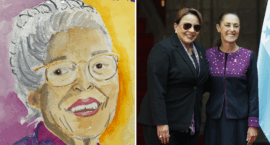
Seventy Years After Rosa Parks’ Arrest: How We Commit to Carrying the Work Forward

Weekend Reading for Women’s Representation is a compilation of stories about women’s representation in politics, sports and entertainment, judicial offices and the private sector—with a little gardening mixed in!

This week:
—The 2025 elections prove that voters across the country want women as their leaders.
—Democratic leaders are exploring ranked-choice voting for the 2028 presidential primaries.
—In a Tennesee special election, Democratic nominee Aftyn Behn surpassed electoral expectations for her congressional district.
—Fort Collins, Colo., elected Emily Francis as mayor in its first use of ranked-choice voting.
—College student Any Lucía López Belloza was deported in Massachusetts on her way home to Texas for Thanksgiving.

… and more.

Calling Foul: Breaking Down WNBA Pay and Why It Matters

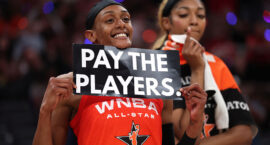
There’s a long history of women in sport fighting for equal pay, and what’s happening with the WNBA today is less of a mirror of the current gender pay gap and more of a throwback to a time when women’s efforts were even more deeply devalued. The WNBA is a visible legacy of Title IX, and an indication of how far there is left to go. 

These are women at a pinnacle of professional achievement, who are still beholden to structural barriers. This is not a sports issue. It is a feminist issue.

This FDA Decision Could Transform Menopause Care

On Monday, Nov. 10, the U.S. Department of Health and Human Services announced that the Food and Drug Administration would eliminate the “boxed labeling” requirement for estrogen products.

The “black box warning,” as it’s commonly called, is part of the fallout from a press conference that occurred more than 20 years ago, announcing the findings of the Women’s Health Initiative (WHI). It’s also been the subject of a half-century-long push and pull with the federal government.

Make no mistake, this has been a longstanding demand—it’s neither new nor MAHA-driven. Doctors and scientists have made the case for its removal since the start to no avail, arguing the data from the WHI—the largest, most expensive, and only randomized placebo-controlled study of post-menopausal women—never supported putting it there in the first place.

The FDA’s reversal of the labeling requirement is a major win for evidence-based medicine. Now it’s up to us to responsibly inform women of their choices.

FDA Rewrites the Story on Estrogen: A Win for Women

Estrogen, the hormone long cast as a public health threat, has been unfairly maligned.

The FDA has finally announced it will remove the incorrect “boxed warning” from vaginal estrogen products and issue corrected labeling for other estrogen therapies—a much needed course correction for one of modern medicine’s most damaging missteps.

The Witch Was Never the Villain. She Was the Beginning of Women’s Power.

Weekend Reading for Women’s Representation is a compilation of stories about women’s representation in politics, sports and entertainment, judicial offices and the private sector—with a little gardening mixed in!

This week:
—Long before Halloween became a night of costumes and candy, it was Samhain: a Celtic festival marking the end of harvest and the beginning of winter’s half-dark. Communities gathered to honor what had ended, prepare for what was to come, and find renewal in letting go. At the heart of those gatherings were women. When patriarchal religions spread across Europe, that spiritual authority became a threat.
—When my children were young, during the Halloween season, I remember thinking how natural it is for young children, especially young girls, to believe they can transform … to step boldly into whoever they want to be.
—As we approach another Election Week, women once again stand at the threshold between what is and what could be: Women could sweep governor elections in New Jersey and Virginia. And Women are posed for gains in city elections across the country.
—New York Attorney General Tish Janes is targeted by the DOJ.
—Ireland elects Independent Catherine Connolly as its third woman president.

… and more.

From Iceland’s ‘Women’s Day Off’ to No Kings, Progress Begins When Women Stand Together

Weekend Reading for Women’s Representation is a compilation of stories about women’s representation in politics, sports and entertainment, judicial offices and the private sector—with a little gardening mixed in!

This week:
—Fifty years ago, the women of Iceland changed the course of their nation … not through an election or a revolution, but through one simple, collective act: They stopped. On Oct. 24, 1975, 90 percent of Icelandic women refused to work, cook or care for children for a single day. That strike, known as the Women’s Day Off, became a watershed moment for equality, but it didn’t emerge overnight.
—Women hold the majority in the Bolivia legislature.
—Japan confirms Sanae Takaichi as its first woman prime minister.

… and more.

Russia Was Once a Revolutionary Feminist Motherland

Russia’s hostility to feminism today stems not from its foreignness, but from memory. A century ago, it was Russian women who lit the first sparks of revolution. On International Women’s Day in 1917, factory workers filled the streets of Petrograd demanding bread, peace and equality—an uprising that toppled the Romanovs and pulled the world into modernity. Under the Bolsheviks, women won the right to vote, divorce became accessible and abortion was legalized. For a brief, radical moment, the Soviet experiment made women’s liberation a pillar of the state.

Julia Ioffe’s book, Motherland: A Feminist History of Modern Russia, from Revolution to Autocracy, reminds us that today’s Russia rejects feminism precisely because it once knew what it could do: ignite revolutions, upend hierarchies and reimagine power itself.