


Midwife-led, community-rooted birth care offers a visionary path toward equity, dignity and better outcomes for all families.
This essay is part of an ongoing Gender & Democracy series, presented in partnership with Groundswell Fund and Groundswell Action Fund, highlighting the work of Groundswell partners advancing inclusive democracy. You’ll find stories, reflections and accomplishments—told in their own words—by grassroots leaders, women of color, Indigenous women, and trans and gender-expansive people supported by Groundswell. By amplifying these voices—their solutions, communities, challenges and victories—our shared goal is to show how intersectional organizing strengthens democracy.
Across the country, birth centers led by Black, Indigenous and people of color are rising to meet the needs of families nationwide. Despite mounting pressures from hospital closures, wavering philanthropic support, Medicaid cuts and a shortage of resources—at times like these—we must keep our feet firmly on the ground, address immediate harms with care and resolve, and keep our eyes on the horizon.
As a Black mother, a birth center co-founder, and a national leader in birth justice, I invite you to lead with me in choosing vision over fear.
In my 20 years in public health … I have learned change happens in proportion to our courage—and that the first act of courage is honoring your vision.
Alice Walker writes, “The most common way people give up their power is by thinking they don’t have any.” It is this self-defeating pattern in the face of authoritarianism that the current U.S. federal government is counting on. And sadly, a pattern to which some of our most powerful institutions have succumbed. Fear and chaos are tried and true tools of oppression. Vision and courage, however, are exponentially stronger.
In my 20 years in public health, and five years of building birth centers, I have learned that change happens in proportion to our courage—and that the first act of courage is honoring your vision. Echoing the words of poet Lucille Clifton, “Any stone can sing,” I offer that each and every one of us can lead. Willingness, choice and courage distinguish leaders. Visionary leaders are willing to see before others see, and choose to share fearlessly—even if we are trembling inside. Courageous leaders risk what others cannot or will not, and bring out courage in others.
With audacity that comes from unwavering faith, I invite you to envision transforming birth culture in the U.S. Hospital closures, especially in rural and communities of color, highlight systemic issues in healthcare financing, infrastructure and equity. In very few places has a closure been mitigated by the creation of another birth care option.
In the face of crumbling systems, Grace Lee Boggs told us that “now is the time to grow our souls.” Now is also the time to grow our courage. We have decades of maternal health research, public health strategy history, midwifery wisdom and a not-to-do list from a failed system to draw upon. We also have the opportunity to dream big. In her book, When No Thing Works, Norma Wong writes that times of conflict and collapse create the conditions for the evolution that resets who we need to be.
America’s birth care system can be reset, but not by fearfully resisting its collapse or playing in its rubble. Birth care in the U.S. will be reset with vision, courage and a leap strategy. Wong defines leap strategy as “casting back from a story of the thriving future, and building the just-enough infrastructure to support a critical mass of intrepids” towards creating that future. Leap strategy moves with the understanding that not all the answers have to be in hand to begin, and no one leader or organization should leap alone.
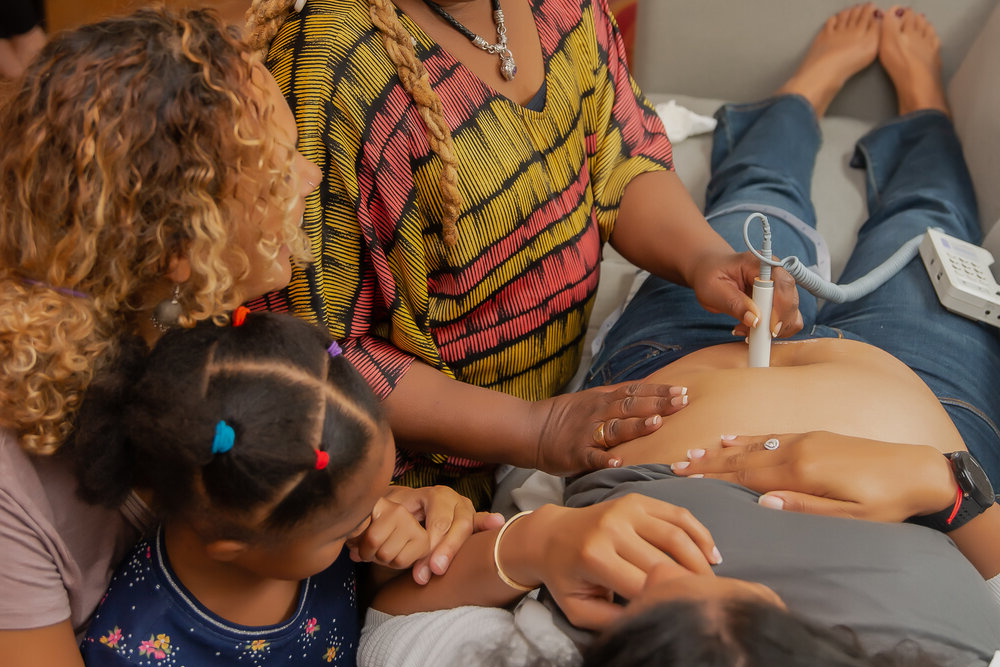
Let us set aside fear—fear of change, fear of visibility, fear of failure—and imagine it is possible to shift away from today’s medicalized birth culture, which is physician-centric, hospital-anchored and rooted in hierarchies (of human value and provider credentials).
Recognize that midwifery care, sustained with community birth infrastructure, is an essential solution to a failing birth care system. Research shows that being cared for by midwives—healthcare professionals who provide expert reproductive health care during pregnancy, birth, postpartum and beyond—improves birth outcomes, enhances the care experience, lowers costs and reduces inequities. Yet, in the U.S., less than 15 percent of birthing people have access to midwifery care.
The U.S. has been doing birth backwards for decades, providing highly medicalized, costly care despite poor outcomes, and ignoring data that estimates at least 60 percent of U.S. pregnancies are low-risk and could be safely supported by midwives in a community setting. Ignoring the fact that in countries with better birth outcomes than the U.S., like France, the United Kingdom, the Netherlands and Japan, 75 percent of pregnancies are supported by midwives.
Birth care in the U.S. will be reset with vision, courage and a leap strategy. … Imagine it is possible to shift away from today’s medicalized birth culture, which is physician-centric, hospital-anchored and rooted in hierarchies.
Let us envision a birth culture informed by this knowledge, a birth culture that is family-centered and midwife-led with physician collaboration, rooted in the inherent dignity of every person, and that respects both midwife and physician credentials. This vision requires fundamental shifts in healthcare infrastructure. Finance, facilities, workforce, policies and regulations, health systems integration, and the hearts and minds of millions must shift to bring beloved birth into being.
Beloved Birth 50 by 50 is the bold and audacious goal that by 2050, 50 percent of babies in the U.S. will come into the world with the care of midwives. It is an open-source, unifying north star for collective action toward a culture of birth where all people give birth safely in dignity and love. National Geographic recently spotlighted the centrality of midwifery in maternal health around the globe, providing a major, mainstream platform for advancing this work.
Our lives, and those of our children and grandchildren, depend on the courage and vision we embody today. Together, we can create a roadmap to a future where birth care is safe, abundant, respectful and loving.