


It’s Been a Hell of a Year for Feminists

Since Trump’s inauguration in January, we’ve seen a barrage of attacks on the rights of women, immigrants and undocumented people, people of color and LGBTQ+ people. The cruelty that the administration has shown has been astounding to witness.

But the resistance to this cruelty has been just as astounding. Millions taking to the streets, again and again. Neighbors stepping in and preventing ICE from kidnapping neighbors they may not even know. Democracy defenders taking to the courts, fighting the onslaught of unconstitutional executive actions. Courageous networks of doctors, nurses, midwives and regular people distributing abortion pills into red states and ensuring women have access to safe abortion no matter where they live. And of course, the major feminist victories in November’s elections—in which women made a decisive difference for our democracy. 

Congress Went on Recess. Americans Got Higher Healthcare Bills.

Congressional discussions on extending the Affordable Care Act (ACA) tax credits, which are set to expire Dec. 31, remain deadlocked as Congress begins its winter recess. Now, millions will see their premiums increase as a result: Payments will more than double on average—some even quadrupling—for enrollees who were eligible for the tax credits.

Without the extension, more and more ACA marketplace enrollees will drop their increasingly costly health insurance plans. This comes at a time when the ACA is more popular than ever—recent polls show that across the political spectrum, three quarters of voters support extending the tax credits.

Could the administration’s latest attack on transgender young people be the administration’s way of deflecting attention from the disaster unfolding in real time for millions of families in need of healthcare?  

What the ‘Wicked’ Weight-Loss Discourse Gets Wrong

We can’t afford to look away from changing beauty norms in our society, and how they are fueling eating disorders. 

Jennifer Rollin, an eating disorder therapist based in Maryland, says, “What I hear from a lot of clients is that when they are trying to recover from their eating disorder in this society, it almost feels wrong, because ‘everyone around me is talking about Ozempic,’ and ‘all the celebrities are talking about their big amount of weight loss.’”

But while it can feel cathartic to criticize or distance ourselves from prominent women who seem to be conforming to dangerous beauty standards, that criticism is harmful and does not bring us any closer to addressing the problem.

Police Officer Domestic Violence Is A Crisis. It’s Time for States to Take Action.

Domestic violence by police officers is a nationwide scourge. While the actual number of cases that happen every year is unknown, it’s likely in the tens of thousands. Police officers in almost every state have been charged with domestic violence since the start of 2025. Such figures demonstrate that police officer domestic violence is a structural failure, not the isolated misconduct of ‘a few bad apples.’

These numbers become even more sobering in light of police officer-abusers’ training and responsibilities, which makes them uniquely dangerous, and extremely undertrained: Less than 2 percent of police academy training time is spent on domestic violence response, while 17 percent is spent on weapons and defensive training.

Officer-abusers and their victims make clear that something is deeply wrong in our domestic violence support system. For now, we don’t understand the depth of that dysfunction, but we can be certain that more funding, better policy and less criminalization will help drive a better future.

International Telehealth Provider ‘Abortion Pills in Private’ Ready to Ramp Up if FDA Restricts Mifepristone

As Trump’s FDA threatens to block U.S.-based medical providers from offering telehealth abortion, one international telehealth provider—Abortion Pills in Private—has vowed to continue providing mifepristone and misoprostol to U.S.-based patients, no matter what.

Their commitment is clear: “We will continue to send mifepristone, even if the FDA takes it off the market inside the U.S.. … We want to make this service easy, the best experience that it can be, with dignity. You can just go online, and it’s easy, and there’s no judgment. If you need this, we are here for you. Here are your pills. Here’s the support service that you need. You can do this from home. Whatever the reason is, we want to have that service there for you to be able to do that, no matter where you live.”

Their service and determination grew directly out of the post-Roe crisis. People find Abortion Pills in Private through the Plan C website. Since March 2024, they have served almost 3,500 patients in the U.S., most of them living in the hardest-hit states—those with abortion bans and severe restrictions. “They are from all over, but they are very much from banned states. Texas is always number one. Then Florida, Georgia. Even Ohio and Pennsylvania. There are some blue states too.”

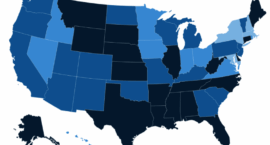
Where ACA Premiums Could Spike Most in 2026 if Congress Lets Enhanced Tax Credits Expire

The Affordable Care Act (ACA) offers premium tax credits to help make health insurance more affordable. Under original Affordable Care Act provisions, an income cap for premium tax credits was set at 400 percent of the federal poverty level. Above that threshold, federal financial assistance was not available, creating a “subsidy cliff.”

Enhanced premium tax credits expire at the end of this year. Enrollees currently receiving premium tax credits at any level of income will see their federal assistance decrease or disappear if enhanced premium tax credits expire, with an average increase of 114 percent to what enrollees pay in premiums net of tax credits.

The impact will be greatest for those whose unsubsidized premiums are highest: older Marketplace enrollees and those living in higher-premium locales.

Trump’s Silence on World AIDS Day Revives a New Lavender Scare

Last month, the State Department warned employees not to commemorate World AIDS Day through official work accounts, including social media, nor should they use government funds to mark Tuesday, Dec. 2, as World AIDS Day. The day came and went in a quiet, cold Washington, D.C., without the president marking what it represented—the more than 700,000 Americans who died from HIV/AIDS-related causes in the United States since 1981. 

If his intentions were unclear, Trump’s budget proposed ending all CDC HIV prevention programs this past June, and Congress continues to negotiate next year’s budget, proposing massive cuts to HIV programs. 

For many young people who never lost friends or family, there may be the misconception that the HIV/AIDS crisis of the 1980s was localized and small, but nearly 300,000 men who have sex with men have died from AIDS-related complications, with over 6,000 deaths in 2019 alone. To put this in perspective, this would be as if over half of Wyoming’s population disappeared, or if everyone in Pittsburgh, Penn., vanished overnight. 

Even Madonna criticized Trump’s move, posting on Instagram, “It’s one thing to order federal agents to refrain from commemorating this day, but to ask the general public to pretend it never happened is ridiculous, it’s absurd, it’s unthinkable. I bet he’s never watched his best friend die of AIDS, held their hand, and watched the blood drain from their face as they took their last breath at the age of 23.” 

A Century After the Eugenics Movement, the U.S. Is Again Barring Disabled Immigrants

This month, Secretary of State Marco Rubio instructed visa officers to consider obesity and other chronic health conditions, such as heart disease, cancer and diabetes, as justification to deny people visas to the United States.

Many were outraged and shocked, observing the Trump administration’s new expansion of the “public charge” rule—directing visa officers to deny entry to people with disabilities, chronic illnesses or age-related conditions—as a modern revival of eugenic immigration policy designed to exclude, control and institutionalize disabled and marginalized people.

When Trump first took office in 2016, the Trump administration broadened the definition of public charge to include people who receive SNAP benefits, medicaid, housing assistance, childcare subsidies and more. This new rule was published in 2019 and went into effect in 2020 and early 2021; President Biden ended the use of this public charge rule definition in March 2021, returning it to the older but still restrictive version. Following Trump’s new rule, visa denials based on the “public charge” rule exploded during Trump’s first residency, rising from just over 1,000 denials in 2016 to over 20,000 in 2019, and it had disastrous effects.

As the Migration Policy Institute (MPI) found, broadening this public charge rule led many people to reduce or stop using benefits or services for themselves.

Dobbs Has Triggered Widespread Discrimination in Non-Reproductive Healthcare

In the years since Roe was overturned, physicians across a wide range of medical specialties have described how abortion bans are undermining their ability to follow evidence-based standards of care. Dermatologists, oncologists, neurologists, cardiologists and others told Physicians for Human Rights (PHR) that they are regularly forced to alter treatment plans, delay urgent care or avoid prescribing the most effective medications simply because those treatments could harm a pregnancy. These constraints are creating a chilling effect that reaches far beyond reproductive health and into the everyday practice of medicine.

As PHR’s Michele Heisler and Payal Shah explained, abortion bans are also fueling discriminatory care. Reproductive-age women are routinely denied the best available treatments, while men with the same conditions face no such barriers. Even within the group of reproductive-age women, clinicians are making decisions based on subjective judgments about a patient’s “contraceptive reliability”—a practice that opens the door to bias and disproportionately harms marginalized patients.

This two-tiered system of care is not hypothetical: It is already shaping medical decision-making in ban states, with dangerous consequences for patients’ health and lives.

Her Pregnancy Wasn’t Viable. Wisconsin’s Laws Still Made Her Fight for an Abortion.

Abortion may be legal in Wisconsin, but the hurdles still involved forced mom Gracie Ladd, 33, to flee the state anyway.

“He recommended terminating the pregnancy because I was so low on amniotic fluid that Connor would most likely pass away before birth, which would put me at serious risk for infection. … I was aware Wisconsin had an abortion ban, but I was shocked to learn only two hospitals would do D&Es for someone 20 weeks pregnant.

“There was so much nonsense just for a woman to get essential care. …

“I received a huge amount of support from many people, even those I didn’t expect. That opened a door for me to use this experience to help other moms. … When Roe v. Wade fell, I wondered, ‘How do I help?’ But I felt insignificant, like my voice wouldn’t matter. But after this happened with Connor, it gave me a way to get involved and a reason to speak out about how abortion is healthcare.”