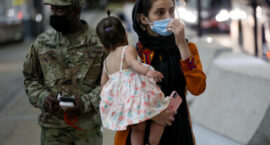
How the Trump Administration Used a National Guard Tragedy to Accelerate Its Anti-Immigrant Agenda

Months before the lives of West Virginia National Guard Specialist Sarah Berkstrom and Afghan asylee Rahmanullah Lakanwal collided, the Trump administration planned to bring immigration to a halt from countries like Afghanistan, Somalia, and other nations that supposedly threaten American values. When Lakanwal was charged with first-degree murder in Berkstrom’s Nov. 26 death, the administration seized on this tragedy to redouble its rhetoric against Afghans and others and to usher in the next round of immigration restrictions.

As Spojmie Nasiri, an Afghan American immigration attorney points out, “They are using the tragedy to enact the agenda that they already had.”

Following Tragic D.C. Shooting, Afghan Allies Face a New Wave of Enforcement and Fear

The shooting in Washington, D.C., that left one National Guard member dead and another critically wounded on Nov. 26 quickly became a major focus of U.S. media. In the days since the shooting, the national conversation has focused almost entirely on the suspect’s identity as an Afghan refugee. Yet those who knew him describe a man who appeared to be struggling long before he drove across the country to Washington, D.C. One volunteer who worked closely with his family said he became increasingly withdrawn, isolated and overwhelmed by the challenges of resettlement. They noted that his behavior reflected profound distress, not radicalization or hostility toward the United States.

Despite these documented struggles, the current administration immediately cast the shooting as a failure of vetting by the Biden administration and threatened to punish an entire community for the crime of one individual. That framing ignores the basic fact that the suspect had been vetted repeatedly. It also ignores the testimony of those who interacted with him in the U.S. and saw no signs of ideological motivation.

Internal directives show ICE has begun targeting more than 1,800 Afghans with past deportation orders and is tracking arrests and removals in daily reports. Officials are also reassessing Afghan vetting programs created after the 2021 withdrawal, despite the fact that the suspect himself was granted asylum during the Trump administration after already receiving extensive screening.

The policies signal a retreat from those commitments and send a dangerous message to future partners: Support for the United States may not translate to safety once U.S. needs are met.

The tragedy in Washington stands as a devastating loss. It deserves a full investigation and a clear accounting of what shaped the suspect’s unraveling. But it must not be used to justify policies that abandon allies, ignore humanitarian obligations and dehumanize an entire community.


Ms. Global: 300 Schoolchildren Kidnapped in Nigeria, Italian Parliament Recognizes Femicide and More

The U.S. ranks as the 19th most dangerous country for women, 11th in maternal mortality, 30th in closing the gender pay gap, 75th in women’s political representation, and painfully lacks paid family leave and equal access to health care. But Ms. has always understood: Feminist movements around the world hold answers to some of the U.S.’s most intractable problems. Ms. Global is taking note of feminists worldwide.

This week: News from Nigeria, Afghanistan, Japan and more.

Yearning to Breathe Free [Part 1 of 3]

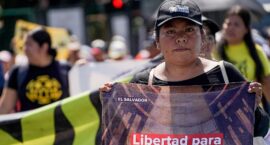
In the matter of K-E-S-G-, a Salvadoran woman stalked and threatened by gang members was denied asylum by the U.S. Board of Immigration Appeals on July 18, even though her persecution stemmed from her gender in a country that treats women as property. Advocates warn that this ruling could make it much harder for women fleeing violence to prove gender-based claims and may embolden immigration judges to discount their stories.

“This isn’t the first time the Trump administration has singled out women seeking asylum, and we know where this path leads,” said Neela Chakravartula of the Center for Gender & Refugee Studies. “More judges denying protection to women who qualify for it. More refugees being deported to danger.”

The decision highlights the ongoing struggle to recognize gender as a protected basis for asylum. Afghan and Salvadoran women, among others, may now face even steeper barriers to protection—a chilling effect that experts say could deter survivors from seeking safety in the U.S.

Hegseth’s Call to ‘Toughness’ Sparks Concerns About Military Sexual Violence

Secretary of Defense Pete Hegseth recently vowed to enforce “tough” new rules of engagement for the U.S. military, declaring there would be “no more walking on eggshells.” Critics say his rhetoric risks normalizing aggression and sexual violence both within the ranks and in combat.

Hegseth, a member of a Christian nationalist church that promotes patriarchy, also called for past infractions by so-called “tough” leaders to be expunged. Sexual assault in the military remains pervasive: the Department of Defense reported 8,195 cases in 2024, and estimates suggest nearly a quarter of active-duty women experience sexual assault during their service.

Historically, rape has been used as a weapon of war, from ancient Israel to World War II, and it continues today in conflicts abroad and at home. Experts warn that leadership matters—policies and rhetoric that prioritize violent masculinity put survivors at serious risk.

Ms. Global: Indigenous Women’s Rights Violated in Greenland, Earthquakes in Afghanistan and Indonesia Affect Women and Children, and More

The U.S. ranks as the 19th most dangerous country for women, 11th in maternal mortality, 30th in closing the gender pay gap, 75th in women’s political representation, and painfully lacks paid family leave and equal access to health care. But Ms. has always understood: Feminist movements around the world hold answers to some of the U.S.’s most intractable problems. Ms. Global is taking note of feminists worldwide.

This week: news from Indonesia, Greenland, Gaza, and more.

The Beijing Conference Was a Victory for Women’s Movements. It’s Time to Believe in Them Again.

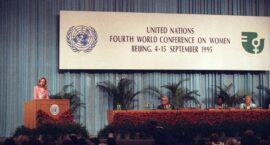
Thirty years ago this month, 45,000 women from around the world converged in Beijing and neighboring Huairou for the historic United Nations Fourth World Conference on Women. In today’s hyperconnected world, it’s easy to miss how groundbreaking the mere fact of this gathering was: The largest number of women at that point in history assembled to lobby the world’s governments for their rights. As Gertrude Mongella, the legendary Tanzanian leader who served as Secretary General of the conference, told the crowd: “The time has come for women to receive their rightful place in all societies and be recognized once and for all, that they are no more guests on this planet. This planet belongs to them too.” 

For funders, governments and individuals—including those gathered at the U.N. General Assembly this week—the message is clear. If you don’t already support and fund women’s movements, start. If you already fund them, stand by your investments, which pay dividends for all the issues you care about. And if you’re marking the Beijing anniversary, know that any progress made since then was no accident. 

‘I Am Alive, but I Am Not Living’: Four Years After the Taliban’s Return, Afghan Women Judges Go Deeper Underground

When the Taliban regained control of Afghanistan in August 2021, one of their earliest, most devastating acts was to remove all women judges from their positions. These courageous women, educated in their own country and possessing many years of experience adjudicating complex and sensitive cases, were abruptly stripped of their roles and authority.

Although the global spotlight has dimmed, the danger remains real and immediate. These judges, still known and targeted by the Taliban, face grave risks. The international community must not let them fall through the cracks.

Dreams Deferred: The Oppression of Women Judges Under Taliban Rule

On a cold Sunday morning in January 2021, Qadria Yasini, a judge on the Supreme Court of Afghanistan in Kabul, set out for work with her colleague, Zakia Herawi. As they rode in the back seat of a government-provided car, they were gunned down in broad daylight by three assassins, who then fled on foot and by motorcycle. When Yasini’s possessions were returned to her family, a Mother’s Day greeting from her two teenage sons was found in her handbag, riddled by bullets.

This heartbreaking story opens British journalist Karen Bartlett’s deeply reported, troubling new book: Escape From Kabul: The Afghan Women Judges Who Fled the Taliban and Those They Left Behind.

But Bartlett’s narrative also provides an inspiring tale of resilience.

With New DOJ Ruling, Women Fleeing Gender-Related Persecution Will Have an Even Harder Time Winning Asylum

In Matter of K-E-S-G-, an asylum case decided by the Board of Immigration Appeals on July 18, Department of Justice officials declared that an abused Salvadoran woman could not obtain asylum based only on the argument that her persecution was based on her gender, in a country that views women as property. The decision is the latest in a 30-year battle over the legitimacy of gender-based asylum claims and closely tracks the first of the Trump administration’s efforts to roll back decisions and policies that recognized the unique role that gender plays in many asylum cases, particularly those involving domestic abuse, sexual violence or trafficking.  

It was already difficult to obtain asylum in the United States. You must demonstrate that you have been or will be persecuted, based on a protected category, and that your own government will not or cannot help you. You must show that your persecutor intended to harm you based on the protected category. You must show that you can’t simply move to another part of your country, and you must provide evidence that your life is in danger if you return home.

“What I desire most is for all women who are fleeing abuse in their country to have their asylum cases heard and to be safe here. The situation right now is dire. The struggle continues. But they have to keep fighting.”