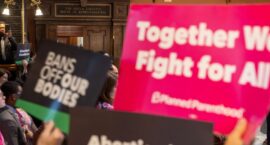
A Very Bad Year for Women’s Health

When I started writing for The Contrarian, a funny-not-funny inside joke was whether there would be enough fodder for a weekly democracy column that overtly centers gender. I think you already know the punchline. Suffice it to say, I did not miss a single Wednesday in all of 2025.

For my final entry of the year, we thought it worthwhile to offer a snapshot—a year’s worth of reporting on the depth of damage this administration has wreaked on women’s health, with real-time Contrarian reporting noted.

Congress Went on Recess. Americans Got Higher Healthcare Bills.

Congressional discussions on extending the Affordable Care Act (ACA) tax credits, which are set to expire Dec. 31, remain deadlocked as Congress begins its winter recess. Now, millions will see their premiums increase as a result: Payments will more than double on average—some even quadrupling—for enrollees who were eligible for the tax credits.

Without the extension, more and more ACA marketplace enrollees will drop their increasingly costly health insurance plans. This comes at a time when the ACA is more popular than ever—recent polls show that across the political spectrum, three quarters of voters support extending the tax credits.

Could the administration’s latest attack on transgender young people be the administration’s way of deflecting attention from the disaster unfolding in real time for millions of families in need of healthcare?  

The Supreme Court Case That Could Shield Unregulated Pregnancy Clinics From Oversight

On Dec. 2, the U.S. Supreme Court heard oral arguments in First Choice Women’s Resource Centers v. Platkin, an unregulated pregnancy clinic’s constitutional challenge to the New Jersey attorney general’s subpoena for information about its operations, including donor records. 

Despite being awash in revenue, and serial reports of fraud, waste and illegal use of taxpayer funds, these antiabortion clinics are positioning to realize a long-term goal: to “replace” Planned Parenthood and Title X programs and secure federal taxpayer funds to advance an agenda that promotes childbirth and undermines evidence-based healthcare. 

As right-wing politicians decimate the reproductive health delivery system for low-income and uninsured Americans, the UPC industry is ramping up the narrative that their unregulated pregnancy clinics are the answer to the maternal healthcare deserts their policies have created. 

Most media observers are predicting the Court will rule for the crisis pregnancy center, First Choice. If it does, unregulated pregnancy clinics nationwide will be further emboldened to resist any state oversight, including of their medical services. A bold, innovative, multi-front action by reproductive justice advocates, public health professionals and pro-choice officials is the only way we ensure they can’t succeed. 

Texas and Florida Sue FDA in New Bid to Block Abortion Pill Access

Texas launched a lawsuit against the U.S. Food and Drug Administration last week over the agency’s approval of mifepristone, marking the state’s latest effort to crack down on access to abortion pills.

Joined by Florida, Texas Attorney General Ken Paxton filed the case on Dec. 9 in federal court in Wichita Falls. The two states argued in a 120-page complaint that the FDA did not properly evaluate mifepristone’s safety and effectiveness when approving the drug in 2000 and its subsequent generic versions. They also challenged the agency’s moves that expanded access to the pills, including the ability to dispense them by mail.

Abortion access advocates have blasted the lawsuit.

“If they succeed in restricting access to mifepristone, abortion access will be devastated across the country, even in states where abortion remains legal,” Shellie Hayes-McMahon, executive director of Planned Parenthood Advocates of Texas. “This lawsuit is not about safety or healthcare; it is about control. And nothing short of full control over our bodies will satisfy them.”

International Telehealth Provider ‘Abortion Pills in Private’ Ready to Ramp Up if FDA Restricts Mifepristone

As Trump’s FDA threatens to block U.S.-based medical providers from offering telehealth abortion, one international telehealth provider—Abortion Pills in Private—has vowed to continue providing mifepristone and misoprostol to U.S.-based patients, no matter what.

Their commitment is clear: “We will continue to send mifepristone, even if the FDA takes it off the market inside the U.S.. … We want to make this service easy, the best experience that it can be, with dignity. You can just go online, and it’s easy, and there’s no judgment. If you need this, we are here for you. Here are your pills. Here’s the support service that you need. You can do this from home. Whatever the reason is, we want to have that service there for you to be able to do that, no matter where you live.”

Their service and determination grew directly out of the post-Roe crisis. People find Abortion Pills in Private through the Plan C website. Since March 2024, they have served almost 3,500 patients in the U.S., most of them living in the hardest-hit states—those with abortion bans and severe restrictions. “They are from all over, but they are very much from banned states. Texas is always number one. Then Florida, Georgia. Even Ohio and Pennsylvania. There are some blue states too.”

A Bill Criminalizing Abortion Failed in the South Carolina Senate, But S.C. Prosecutors Have Long Treated Pregnancy as a Crime

We have to talk about South Carolina.

Last week, what could have become the most punitive abortion law in the U.S., SB 323, failed in the South Carolina Senate. The bill proposed banning abortion in almost all circumstances, criminalizing people who sought abortion care, and removed any exceptions for rape, incest or fetal anomaly currently written into the state’s already strict six-week ban.

The defeat of SB 323 is a victory that was won by dedicated and fierce advocates from across the state and across the country. But South Carolina has been actively engaged in policing the bodies of pregnant women, and in criminalizing pregnancy, for decades.

The prosecutorial “hold my beer” approach to criminalizing abortion shows us not only just broken the criminal legal system is, but also, just how little regard they have for the humanity of people with the capacity for pregnancy. 

Novel ‘Truth Is’ Shows What It Really Takes for a Teen to Get an Abortion in 2025

Truth Is is a pro-choice novel in every sense of the phrase. Truth’s choice to move forward with an abortion is made early on in the novel and the majority of the book focuses on her life and her choices after her decision.

I hope that years from now, a student picks up this book and reads about the challenges that the book’s main character Truth faces and goes, “Is that really how it was back then?”

For adults who engage with Truth’s story, I want us to consider the limitations we sometimes unknowingly put on young people. I want us to consider the heights young people could reach if they were granted opportunities and community support, the way Truth ultimately does in the novel.

Kim Davis Failed This Time, But Her Advocates Are Still American Power Players

The Supreme Court this week declined to revisit Kim Davis’ appeal that attempted to overturn its landmark precedent recognizing same-sex marriage as a legal right nationwide.

Davis may now fade into the distance—but how did the former Kentucky county clerk become the face of America’s anti-gay marriage movement?

In short, Davis had help from some of the biggest Christian legal groups and most influential figures in the U.S., who are still actively trying to roll back LGBTQ rights on home soil and—in many cases—internationally. Now more than ever, we need to remain vigilant about Davis and these groups and monitor their efforts.

RFK Jr. Ignores 100+ Studies to Push Abortion Pill Ban—This Is the Mifepristone Explainer You Need

Apprehensive OB-GYNs across the country are alerting Americans that Health & Human Services Secretary Robert F. Kennedy Jr. may withdraw abortion pill mifepristone from the market.

The threat follows the publication of a discredited study on mifepristone by a Project 2025 “think tank.” Medical organizations, including the American College of Obstetricians and Gynecologists, have called the report “seriously flawed” and accused it of manipulating data. So why would RFK Jr. believe it?

Kennedy “is not a scientist and is entirely political. It’s hard to watch someone with such an important role in this country, who is in charge of some of the most vulnerable people in this country, have a complete lack of respect for the things we hold dear,” said Dr. Kristin Lyerly, a Wisconsin OB-GYN who also practices across the state border in rural Minnesota.

Marjorie Dannenfelser, president of Susan B. Anthony Pro-Life America, plans to pour millions of dollars into House and Senate races in the 2026 midterms, in hopes of securing a “trifecta of pro-life administration, House and Senate.”

That’s a complete reversal from what voters have said they want: Since Roe was reversed in 2022, voters in every state with an abortion protection measure on its ballot have overwhelmingly passed it, enshrining the right to abortion into their state constitution—even in deep red states like Kansas, Kentucky and Ohio. 

‘Mife No Matter What’: Community Abortion Providers Pledge to Continue Sharing Free Abortion Pills, Even if FDA Imposes Restrictions

Since 2022, community providers have built a nationwide network discretely mailing free abortion pills to those in ban or restricted states.

People can find community providers through several platforms that research and share information about abortion pill access, including Plan C, I Need An A and Red State Access. On these sites, visitors can search for options by their state or territory. Once the client reaches out, community providers typically respond within 24 hours and mail the pills within 48 hours. The medication typically arrives within seven days, and are shipped in an unmarked, discrete package.

More than 100 people are involved in community provision across the United States. One provider told Ms. why she stepped in to become a community provider: “I saw a great need and I could do it,” noting she is single with no children and is white, making her less vulnerable to police surveillance. “I love helping people. It’s rewarding.”

A recent client wrote back to her community provider with a message of gratitude: “I would like to extend my gratitude and appreciation. What you guys are doing is saving lives and giving us a choice when we don’t have the means of money or the resources. Thank you so much. I received the package and it worked as intended. Thank you for being here for me and millions of other girls that are in need.”