

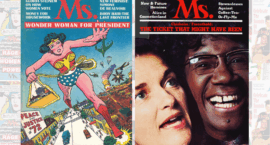
‘We’re 53 Years Ahead of Where They Were Then’: Looking Back at 50+ Years of Ms.—and Looking Forward to a Feminist Future

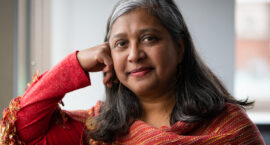
In a new bonus episode of Looking Back, Moving Forward, Ms. executive editor Kathy Spillar, consulting editor Carmen Rios, Ms. Committee of Scholars co-chair Janell Jobson, and legendary author, activist and professor Loretta Ross explore how the stories of our past can continue to inspire us—and give us hope in the fight forward.

“I don’t believe that the assault on women and women’s rights can be extracted from the overall dysfunction of all societies.”

“We have to keep rewriting history and reclaiming history, especially knowing that the forces out there are doing what they can to erase us.”

“There’s a long lineage of people who have been fighting this fight, because they know that we deserve justice.”

bell hooks Taught Us to Imagine Freedom. Universities Are Forcing Us to Fight for It.

On the day bell hooks became an ancestor, four years ago today, my beloved friend, comrade and co-conspirator Black feminist sociologist Shawn McGuffey and I were consoling one another over text when he wrote, “We should do something.” “Say less,” I replied.

We had institutional support from Northeastern University at a time when universities and other institutions were publicly and ceremoniously committing to funding DEI related initiatives in the tidal wave of so-called racial reckoning that occurred in the aftermath of George Floyd’s death. The first symposium took place two months later on a cold and clear February morning in 2022. This annual gathering became an important tradition that we looked forward to each year.

This week, we mark four years since the woman born Gloria Jean Watkins, a Black feminist writer, academic, professor and activist became an ancestor. But in 2026, there will be no bell hooks symposium at my university. Due to university wide fiscal austerity, we will not mark the anniversary this year in any official way. It is a tremendous loss, for our students and for our community locally, nationally and internationally.

As I grappled with my own grief over this loss, I had to also reflect deeply about what it means to be a Black feminist scholar in the academy today.

Trey Reed’s Death—and Its Swift Labeling as Suicide—Demands the Scrutiny Ida B. Wells Called For

Trey Reed, a young Black student, was found hanging from a tree on his college campus of Delta State University in Mississippi on Sept. 15, 2025. Trey Reed was a computer science major from Grenada, Miss., and a first-generation student, described as ambitious and eager to create a positive future for himself and his family.

Mississippi police and the Bolivar County coroner’s office have labeled the death a suicide. But Reed’s family members and other advocates, including Reps. Bennie Thompson (D-Miss.) and Ayanna Pressley (D-Mass.), activist and former NFL quarterback Colin Kaepernick, attorneys Ben Crump and Vanessa J. Jones (both of whom are representing the family), are calling for further investigation. 

Cases like Reed’s awaken questions rooted in legacies of racial violence in the South. “While the details of this case are still emerging, we cannot ignore Mississippi’s painful history of lynching and racial violence against African Americans,” said Thompson in the days following Reed’s death. That history is not distant: Mississippi recorded more lynchings than any other state, and the echoes of those crimes persist in how the deaths of Black people are investigated and discussed. The reflex to dismiss possible racial motives—or to declare a death a suicide before all evidence is known—reflects a deeper national unwillingness to confront the full scope of anti-Black violence.

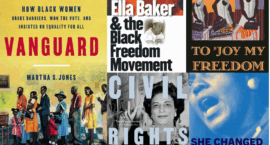
Five Best Books on Black Women’s Political Leadership

While writing my new book about the contributions Black women have made in the global struggle for human rights, I was humbled to see, over and over, how many of these women did not come from rich families, or hold positions of great power, or even have all that much education. But they did the hard and dangerous work required, day in and day out, because they believed in equal rights for everyone, around the world.

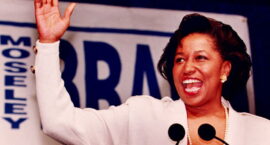
‘I’m Not Going to Tolerate Being Treated as a Second-Class Citizen’: Carol Moseley Braun Isn’t Giving Up on the Fight for Constitutional Equality

“The expectation of equality is the most important cultural thing that we can achieve, and we have to keep holding up that light.”

Carol Moseley Braun became the first Black woman elected to the Senate after her involvement in the movement to ratify the Equal Rights Amendment. In the fifth and final episode of Looking Back, Moving Forward, more than 40 years later, she asked a simple question: “Why haven’t we gotten this right yet?” 

Listen to the latest episode of Looking Back, Moving Forward, “The Feminist Fight For The Equal Rights Amendment Is Far From Over—and More Urgent Than Ever (with Pat Spearman, Ellie Smeal, Carol Moseley Braun, Kathy Spillar, and Ting Ting Cheng)” on Spotify, Apple Podcasts or wherever you get your podcasts.

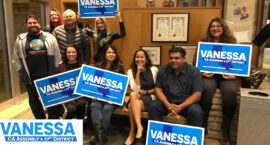
“When and Where Do We Get to This Place Called ‘Fair?’” What Political Scientist and Survivor Vanessa Tyson Wants the Feminist Future to Look Like

The professor, advocate and veteran of multiple political campaigns reflected in the latest episode of Looking Back, Moving Forward on her journeys to both survivor advocacy and politics—and the ways in which our political structures reinforce the injustices survivors face writ large across the country.

Listen to the latest episode of Looking Back, Moving Forward, “How Feminists are Breaking the Cycle of Gender-Based Violence and Harassment (with Ellen Sweet, Jane Caputi, Vanessa Tyson, Victoria Nourse, and Debra Katz)” on Spotify, Apple Podcasts or wherever you get your podcasts.

The 19th Amendment, Explained

It took more than a century of fighting by generations of activists to achieve suffrage for all American women.

The 19th Amendment to the U.S. Constitution reads, “The right of citizens of the United States to vote shall not be denied or abridged by the United States or by any State on account of sex.” The amendment granting women the right to vote was enacted at the start of the Roaring Twenties, decades after a prolonged and meandering fight for enfranchisement. 

The 19th Amendment codified women’s suffrage nationwide, but long before its ratification, unmarried women who owned property in New Jersey could and did cast ballots between 1776 and 1807. Beginning in 1869, women in Western territories won the right to vote. And in the decade leading up to the 19th Amendment’s passage, 23 states granted women full or partial voting rights through a series of successful campaigns.

‘In Whose Interests Are We Fighting?’ What Historian Premilla Nadasen Learned About Economic Justice from the Domestic Workers’ Rights Movement

Nadasen, who teaches history at Barnard College, offered lessons from the domestic workers’ movement for the current moment in the latest episode of Looking Back, Moving Forward. “We, as feminists today, like domestic workers in the 1970s and in the early 2000s,” she told me, “need to think outside the box.”

Listen to the latest episode of Looking Back, Moving Forward, “Women Can’t Afford to Wait for a Feminist Economic Future (with Premilla Nadasen, Rakeen Mabud and Lenore Palladino, Aisha Nyandoro, Gaylynn Burroughs, and Dolores Huerta)” on Spotify, Apple Podcasts or wherever you get your podcasts.

The Great American Jeans Debate: Racializing Beauty and Democratizing ‘Good Genes’ in Commercial Media

“Sydney Sweeney has great jeans.” Get it?

The issue is, we all get it and cannot avoid the ad’s uncomfortable truths about how women’s bodies convey different symbols and meanings. As a symbol of beauty, Sweeney certainly fits the bill as an attractive, voluptuous young woman who has capitalized on her looks. However, when the camera emphasizes Sweeney’s blue eyes just after panning across her body as she gives a quasi-scientific lesson on how “genes” get passed down, beauty is no longer just about whether a young woman is attractive enough to serve as an ad campaign’s spokesperson. It’s about which type of woman gets to define beauty and promoting scientific fixation on “good genes,” a holdover from the era of eugenics (which literally means “good genes”). 

The best “all-American jeans” advertisement should capture this sense of aspirational dreaming. And Ralph Lauren “Oak Bluffs” ads do just that. These campaigns depict the collegiate, bougie aesthetic of Black middle-class life—represented by those African Americans attending HBCUs and vacationing in Oak Bluffs at Martha’s Vineyard during the summertime—and resonates more positively for a wider audience than American Eagle’s exclusionary “great genes” messaging.