


What the Backlash Against Women’s Leadership Tells Us About Young Men

At this year’s Reykjavík Global Forum in November, where 500 global leaders from public and private sectors convened in Iceland, the mood around gender equality was both urgent and reflective. Progress that once felt inevitable now looks fragile. The Reykjavík Index for Leadership reveals concerning declines in how women are perceived for leadership roles across major economies, while conversations about young men and boys have become more heated, polarized and emotionally charged.

While at the forum, I spoke with Richard Reeves, an author and researcher focused on boys and men, and Michelle Harrison, the founding force behind the Reykjavík Index for Leadership, about what’s really going on—and what comes next. Their insights help clarify the current backlash, the urgency of centering young people, and why gender equality must remain a shared project—one that includes all of us.


Two Mass Shootings, Two Countries—and Two Very Different Responses

On Dec. 14, 2025, two tragedies unfolded on opposite sides of the world—each marked by gun violence and grief, yet met with starkly different national responses.

On the first night of Hanukkah, a gathering on Bondi Beach in Sydney, turned into horror when a father and son opened fire during a “Hanukkah by the Sea” celebration, killing 15 people and wounding 40 in what Australian authorities called an antisemitic terrorist attack. 

The day before in Providence, R.I., a shooter opened fire at Brown University during finals, killing two students and wounding nine.

These shootings—one at a beloved public beach, the other on an Ivy League campus—expose not only shared grief but radically different understandings of responsibility.

Making the Invisible Visible: How Misogyny Is Driving Rising Political Violence

We have seen a rise in political assassinations and assassination attempts, along with violent extremist attacks that have ticked upward for years. Mass casualty plots in the U.S. have increased by over 2,000 percent since the 1990s, leading to the deaths or grievous injury of thousands of people in shootings at schools, grocery stores, theaters, parades, concerts, houses of worship and more.

In the search for explanations, the public and policy discourse is most often swept up in heated debates about far-left or far-right ideologies.

But the data shows that the biggest and clearest predictor of mass shootings, across ideologies, sits somewhere else: in rising gendered grievances, patriarchal backlash, and the perpetrators’ histories of gender-based violence and misogyny.

Six Ways Masculine Stereotypes Are Still Limiting Boys

Rigid norms of manhood—based in manly confidence and toughness, emotional stoicism, disdain for femininity and dog-eat-dog banter—are influential among boys and young men.

Between one quarter and one half of boys and young men endorse these norms. Over half feel pressure from others to live up to them, believing most people expect them always to be confident, strong and tough.

These are some of the findings from a new Australian survey of adolescents aged 14-18 years, conducted by The Men’s Project at Jesuit Social Services.

In a climate of heightened concern about boys and young men and violent masculinity, this study provides invaluable data on boys’ and young men’s own views. This includes the pressures they feel to live up to stereotypical masculine norms and the profound impact of those beliefs.

Virginia Giuffre’s Posthumous Memoir Is an Indictment of the Men and Institutions That Enabled Her Abuse

I thought I was mentally prepared to read Virginia Roberts Giuffre’s posthumous book, Nobody’s Girl. I was wrong. If reading the book was gut-wrenching, I can’t imagine what it was like for her and other girls and women who experience the horrors of being trafficked.

In the final paragraph of the book, and perhaps in some of the final sentences she ever wrote, Giuffre tells that she will have achieved her goal with Nobody’s Girl if “just one person” is moved to create “a world in which predators are punished, not protected; victims are treated with compassion, not shamed; and powerful people face the same consequences as everybody else.”

Although she never lived to see this day, her book, her courage and her rage compel us to fight for this goal in the name of all victims and survivors of sex trafficking. 

Actually It’s Good That Fewer High Schoolers Want to Get Married

High schoolers, and especially high school girls, are less likely than ever to say that they want to get married someday, according to new research from Pew Research Center. While boys have stayed fairly stable in how many of them say they want to marry, girls have gone from overwhelmingly wanting marriage to being even less likely than boys to want to wed.

Conservative groups and writers have met this new survey with some panic. If 12th graders don’t want to get married, I guess the logic goes, then they won’t get married, and America’s declining rates of marriage and childbearing will continue and will eventually destroy society. To them, this new survey indicates a broader social shift away from marriage and childbearing, which is bad, because in their view, the nuclear family is the good and necessary backbone of any moral and functional culture. 

But actually, it’s great that far fewer high school girls are even thinking about marriage.

The teenage girls who are thinking about their weekends instead of their weddings? They’re doing something right. 

When the Headline Gets It Wrong: Feminism Isn’t the Problem—Patriarchy Is

When I saw the headline “Did Women Ruin the Workplace? And if So, Can Conservative Feminism Fix It?” in The New York Times Opinion section, my heart sank. It felt like a headline torn from another era—a provocation that had no place in 2025.

False accusations remain extremely rare—estimated at between 2 percent and 8 percent of reports—while roughly two-thirds of sexual assaults are never reported at all. The crisis is sexual violence, not accountability.

Yet, for centuries, women have been labeled “emotional” or “petty” to justify their exclusion from leadership and public life. Hearing these stereotypes revived in 2025—in The New York Times, no less—is disheartening. At a time when reproductive rights are being stripped away and women’s autonomy is under attack, we don’t need pseudo-intellectual nostalgia for patriarchy disguised as debate. We need truth, solidarity and progress.

The message from the writers is clear: Women should know their place. But women already do—it’s everywhere decisions are made, everywhere power is exercised, everywhere the future is being built. We’re not staying in our lane. We made the road. And we’re not going anywhere.

Russia Was Once a Revolutionary Feminist Motherland

Russia’s hostility to feminism today stems not from its foreignness, but from memory. A century ago, it was Russian women who lit the first sparks of revolution. On International Women’s Day in 1917, factory workers filled the streets of Petrograd demanding bread, peace and equality—an uprising that toppled the Romanovs and pulled the world into modernity. Under the Bolsheviks, women won the right to vote, divorce became accessible and abortion was legalized. For a brief, radical moment, the Soviet experiment made women’s liberation a pillar of the state.

Julia Ioffe’s book, Motherland: A Feminist History of Modern Russia, from Revolution to Autocracy, reminds us that today’s Russia rejects feminism precisely because it once knew what it could do: ignite revolutions, upend hierarchies and reimagine power itself.

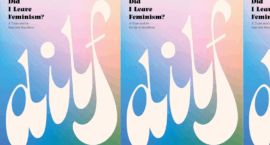
‘DILF (Did I Leave Feminism?)’ Is a New Transmasculine Manifesto

An excerpt from Jude Ellison S. Doyle’s new book, DILF (Did I Leave Feminism?), out Oct. 21:

Transmasculine people are one of feminism’s biggest blind spots. No one knows quite what to do with us, so it’s easier to pretend we’re not there. Books on “male feminism” or “feminist men” mostly teach men how to be allies to women’s struggle—the idea that there might be men who actually experience pregnancy, or abortion, or being cat-called or sexually harassed or pay-gapped or any of the other things we traditionally call “women’s issues” is not accounted for. Books on trans feminism understandably stress the importance of feminism for trans women—which is important, what with them being women and all—but do tend to reinforce the assumption that feminism is just for girls.