


Texas and Florida Sue FDA in New Bid to Block Abortion Pill Access

Texas launched a lawsuit against the U.S. Food and Drug Administration last week over the agency’s approval of mifepristone, marking the state’s latest effort to crack down on access to abortion pills.

Joined by Florida, Texas Attorney General Ken Paxton filed the case on Dec. 9 in federal court in Wichita Falls. The two states argued in a 120-page complaint that the FDA did not properly evaluate mifepristone’s safety and effectiveness when approving the drug in 2000 and its subsequent generic versions. They also challenged the agency’s moves that expanded access to the pills, including the ability to dispense them by mail.

Abortion access advocates have blasted the lawsuit.

“If they succeed in restricting access to mifepristone, abortion access will be devastated across the country, even in states where abortion remains legal,” Shellie Hayes-McMahon, executive director of Planned Parenthood Advocates of Texas. “This lawsuit is not about safety or healthcare; it is about control. And nothing short of full control over our bodies will satisfy them.”


Following Tragic D.C. Shooting, Afghan Allies Face a New Wave of Enforcement and Fear

The shooting in Washington, D.C., that left one National Guard member dead and another critically wounded on Nov. 26 quickly became a major focus of U.S. media. In the days since the shooting, the national conversation has focused almost entirely on the suspect’s identity as an Afghan refugee. Yet those who knew him describe a man who appeared to be struggling long before he drove across the country to Washington, D.C. One volunteer who worked closely with his family said he became increasingly withdrawn, isolated and overwhelmed by the challenges of resettlement. They noted that his behavior reflected profound distress, not radicalization or hostility toward the United States.

Despite these documented struggles, the current administration immediately cast the shooting as a failure of vetting by the Biden administration and threatened to punish an entire community for the crime of one individual. That framing ignores the basic fact that the suspect had been vetted repeatedly. It also ignores the testimony of those who interacted with him in the U.S. and saw no signs of ideological motivation.

Internal directives show ICE has begun targeting more than 1,800 Afghans with past deportation orders and is tracking arrests and removals in daily reports. Officials are also reassessing Afghan vetting programs created after the 2021 withdrawal, despite the fact that the suspect himself was granted asylum during the Trump administration after already receiving extensive screening.

The policies signal a retreat from those commitments and send a dangerous message to future partners: Support for the United States may not translate to safety once U.S. needs are met.

The tragedy in Washington stands as a devastating loss. It deserves a full investigation and a clear accounting of what shaped the suspect’s unraveling. But it must not be used to justify policies that abandon allies, ignore humanitarian obligations and dehumanize an entire community.

We Can No Longer Tinker With the Machinery of Death: New ACLU Report Exposes Fatal Flaws in Capital Punishment

On the first day of his second term President Donald J. Trump issued an executive order entitled Restoring The Death Penalty And Protecting Public Safety. In doing so he chose to ignore the mounting and irrefutable evidence, recently highlighted in a new report from the American Civil Liberties Union (ACLU), that the death penalty is riddled with human error and poses the undeniable risk of executing innocent people.

At least 150 countries have abolished the death penalty, by law or by practice. Resisting the humanitarian trend around the world, the United States remains part of a gruesome club, along with China, Iran, Saudi Arabia and Iraq.

A Century After the Eugenics Movement, the U.S. Is Again Barring Disabled Immigrants

This month, Secretary of State Marco Rubio instructed visa officers to consider obesity and other chronic health conditions, such as heart disease, cancer and diabetes, as justification to deny people visas to the United States.

Many were outraged and shocked, observing the Trump administration’s new expansion of the “public charge” rule—directing visa officers to deny entry to people with disabilities, chronic illnesses or age-related conditions—as a modern revival of eugenic immigration policy designed to exclude, control and institutionalize disabled and marginalized people.

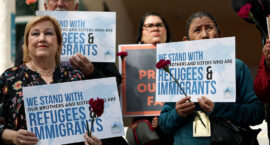
When Trump first took office in 2016, the Trump administration broadened the definition of public charge to include people who receive SNAP benefits, medicaid, housing assistance, childcare subsidies and more. This new rule was published in 2019 and went into effect in 2020 and early 2021; President Biden ended the use of this public charge rule definition in March 2021, returning it to the older but still restrictive version. Following Trump’s new rule, visa denials based on the “public charge” rule exploded during Trump’s first residency, rising from just over 1,000 denials in 2016 to over 20,000 in 2019, and it had disastrous effects.

As the Migration Policy Institute (MPI) found, broadening this public charge rule led many people to reduce or stop using benefits or services for themselves.

Russia Was Once a Revolutionary Feminist Motherland

Russia’s hostility to feminism today stems not from its foreignness, but from memory. A century ago, it was Russian women who lit the first sparks of revolution. On International Women’s Day in 1917, factory workers filled the streets of Petrograd demanding bread, peace and equality—an uprising that toppled the Romanovs and pulled the world into modernity. Under the Bolsheviks, women won the right to vote, divorce became accessible and abortion was legalized. For a brief, radical moment, the Soviet experiment made women’s liberation a pillar of the state.

Julia Ioffe’s book, Motherland: A Feminist History of Modern Russia, from Revolution to Autocracy, reminds us that today’s Russia rejects feminism precisely because it once knew what it could do: ignite revolutions, upend hierarchies and reimagine power itself.

From Berlin to Beijing to U.S. Congress, Women’s Courage to Convene Propels Us Forward

Weekend Reading for Women’s Representation is a compilation of stories about women’s representation in politics, sports and entertainment, judicial offices and the private sector—with a little gardening mixed in!

This week:
—We mark 60 years since former President Lyndon Johnson advanced equal opportunity in employment.
—When women come together, share our strength, and lift one another up, the impossible becomes possible. 
—In a landslide victory, Adelita Grigalva becomes Arizona’s first Latina to Congress.
—Of the four Republican House members signing the petition about the actions and allies of sexual predator Jeffrey Epstein, three are women.
—A record number of U.S. legislators won’t run for reelection next year.
—Hillary Clinton “sees a dangerous moment for women’s rights and democracy.”
—Akshi Chawla, who writes the #WomenLead Substack and is a valuable resource on international women’s representation, on the great question: “How do I get started?”
—The Marshall Islands, a rapidly vanishing Oceania nation, is led by the region’s first-ever woman president, Hilda Heine.
—Who was the first American woman to have an airport named in her honor?

… and more.

Community Is as Important to the Fight for Democracy as Everything Else

It has been a hell of a week for gridlock in my hometown, New York City, as global leaders convene for the 80th United Nations General Assembly—where on Monday, President Donald Trump delivered an hour-long rant calling climate change a hoax and claiming to have personally ended seven wars in his first seven months in office.

It wasn’t all grievance and gloom. Monday also marked the 30th anniversary of the historic United Nations Fourth World Conference on Women in Beijing, where 189 nations adopted an ambitious “Platform for Action” to acknowledge and advance women’s rights. It was there that future Secretary of State Hillary Rodham Clinton famously pronounced “women’s rights are human rights.” For more about the anniversary, read this extraordinary report, released this week and co-authored by Contrarian contributor Jennifer Klein, “Beijing+30: A Roadmap for Women’s Rights for the Next Thirty Years.” It details the myriad ways regression on women’s freedom is also an early sign of weakened democracy and outlines critical priorities to advance women’s rights in the immediate future.

Over a Million Women Are at Risk of a Pay Cut Under a New Trump Rule

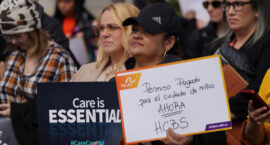
The Trump administration’s Department of Labor recently proposed a new rule that would directly take earnings away from the more than 1.5 million home care workers in the United States, more than 80 percent women, and their families.

Between 2019 and 2040, the population of adults ages 65 and older is expected to balloon from 54 million people to nearly 81 million people, comprising an estimated 22 percent of the U.S. population. That means that the direct care workforce is projected to grow at a faster rate than any other occupation over the next decade.

From Alligator Alcatraz to National Guard Patrols: What Is the Cost of the Trump Administration’s Cruelty?

Reserve forces of the U.S. Army, 800 National Guardsmen, and for some reason, 120 FBI agents, are being newly assigned by El Presidente to patrol our national capital—citing crime as his motive, though it’s dropped by a third in recent (Biden) years. He’s already done this in Los Angeles for the last 60 days and predicts other cities are on his list: Baltimore, Chicago, Oakland, New York City—all places that just happen to vote blue.

Early on, the Pentagon testified it would spend about $134 million for the LA deployment, which sounds like a low-ball figure to anyone who’s recently shopped for groceries to feed 5,000 hungry young men three meals a day. And now, California’s governor is asking for the total cost to taxpayers of this “unlawful” deployment—because whether it’s political theater or not, we’re the ones footing the bill.

Will the SCORE Act Sideline Women Athletes? Title IX Advocates Push for NIL Protections

Members of the Democratic Women’s Caucus are pushing Congress for explicit Title IX protections for women student-athletes in a proposed national law related to name, image and likeness (NIL)—and long-time gender equity advocates hope they succeed.  

Four years into student-athletes being able to capitalize on their NIL, 32 states have enacted their own laws. Now, there is a proposed bill before Congress, the Student Compensation and Opportunity Through Rights and Endorsements (SCORE) Act, which is designed to establish a national framework for collegiate athlete compensation, particularly as it pertains to NIL.

Something the SCORE Act doesn’t take into consideration is Title IX and gender equity. Earlier this year, the Department of Education Office of Civil Rights rescinded guidance put in place by the Biden administration, noting it was “overly burdensome” and effectively stating that Title IX, an educational statute that prohibits discrimination based on gender at any institution receiving federal funds, is inapplicable to NIL.