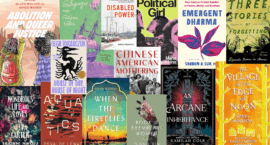
Each month, Ms. provides readers with a list of new books being published by writers from historically excluded groups.
December’s 14 titles are great for gifting or curling up with on a cold winter’s night. Wishing you all a lovely holiday season!


More Than A Magazine, A Movement

Each month, Ms. provides readers with a list of new books being published by writers from historically excluded groups.
December’s 14 titles are great for gifting or curling up with on a cold winter’s night. Wishing you all a lovely holiday season!

In every issue of Ms., we track research on our progress in the fight for equality, catalogue can’t-miss quotes from feminist voices and keep tabs on the feminist movement’s many milestones. We’re Keeping Score online, too—in this biweekly roundup.
This week:
—137 women and girls are killed by intimate partners or family members every day.
—Congress votes overhwlemingly to force the Justice Department to release their Epstein files.
—Donald Trump snaps at women journalists: “Quiet, piggy” and “you are an obnoxious—a terrible, actually a terrible reporter.”
—Violence against trans women remains high.
—DACA recipients are being targeted and detained under the Trump administration.
—Higher-income college students often receive more financial support than they need, while low-income students struggle.
—Tierra Walker died from preeclampsia in Texas after being repeatedly denied an abortion.
—Viola Ford Fletcher died at age 111. She was the oldest living survivor of the 1921 Tulsa Race Massacre.
—North Dakota’s total abortion ban was reinstated after the state’s Supreme Court reversed a temporary injunction from a lower court. There are now 13 states with total bans.
… and more.

As the year winds down, I find myself returning—as I always do—to the stories, performances and ideas that have shaped my teaching and thinking. Feminism’s past is never really past; it’s a living archive we carry with us, full of unresolved questions, missteps, breakthroughs and beautiful, complicated people. This year’s reading and viewing list reflects that sensibility.
Liberation forces its contemporary narrator—and its audience—to reckon with the impossible expectations we’ve placed on small groups of women in church basements.
Molly Jong-Fast’s memoir presses on the tender, maddening ties between feminist foremothers and the daughters who grew up in their shadow.
Sarah Weinman’s study of spousal rape laws exposes just how recently the law stopped treating wives’ bodies as open territory—while showing how fiercely survivors and advocates have had to push for change that should never have been controversial.

We have seen a rise in political assassinations and assassination attempts, along with violent extremist attacks that have ticked upward for years. Mass casualty plots in the U.S. have increased by over 2,000 percent since the 1990s, leading to the deaths or grievous injury of thousands of people in shootings at schools, grocery stores, theaters, parades, concerts, houses of worship and more.
In the search for explanations, the public and policy discourse is most often swept up in heated debates about far-left or far-right ideologies.
But the data shows that the biggest and clearest predictor of mass shootings, across ideologies, sits somewhere else: in rising gendered grievances, patriarchal backlash, and the perpetrators’ histories of gender-based violence and misogyny.
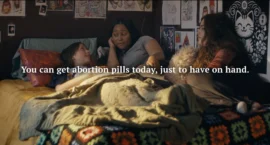
The grassroots abortion-stigma-busting juggernaut Shout Your Abortion has released two new powerful public service announcements urging people across the U.S. to order abortion pills in advance to have on hand, in case they have an unwanted pregnancy.
Made by Detroit-based filmmaker Na Forest Lim, the short films follow two women—a teenager named Dani and a single mother in her 30s named Poppy—who find out they are pregnant and use abortion pills at home, supported by friends and family.
Both of the main characters have easy access to abortion pills: Dani’s friend arrives with pills in her backpack, and Poppy keeps a pack tucked away in her top dresser drawer.
Building on that vision of easy access, the Dani PSA shows what it looks like when abortion pills are already part of teenagers’ lives and a pregnancy never has the chance to become a crisis.
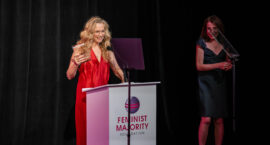
At the Feminist Majority Foundation (publisher of Ms.) Global Women’s Rights Awards on Nov. 18 in Los Angeles, FMF honored the team behind the Broadway smash hit Liberation: playwright Bess Wohl, director Whitney White and Lisa Cronin Wohl, an OG Ms. writer from the 1970s.
“Theater is made up of dialogue. Autocracy is a monologue. Theater is about community: We watch a play together. Autocracy seeks to isolate us. Theater is about curiosity: A good play asks a question. Autocracy is not interested in questions, only in control.
“So, thank you, because in honoring this play, you honor the role of dialogue, community and questions in creating social change.”
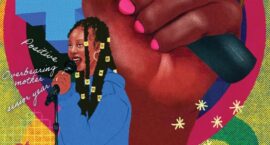
Truth Is is a pro-choice novel in every sense of the phrase. Truth’s choice to move forward with an abortion is made early on in the novel and the majority of the book focuses on her life and her choices after her decision.
I hope that years from now, a student picks up this book and reads about the challenges that the book’s main character Truth faces and goes, “Is that really how it was back then?”
For adults who engage with Truth’s story, I want us to consider the limitations we sometimes unknowingly put on young people. I want us to consider the heights young people could reach if they were granted opportunities and community support, the way Truth ultimately does in the novel.

There is a cold wind that blows every time Donald Trump opens his mouth to belittle a woman who dares to ask him a question. Last week, that wind swept through Air Force One when Bloomberg reporter Catherine Lucey pressed him on the Epstein files. A reasonable question in a democracy: If there’s nothing incriminating, why fight so hard to keep the documents sealed? Trump wheeled toward her, finger stabbing the air, and snarled, “Quiet! Quiet, piggy.”
Lucey returned two days later—undaunted. Her courage was met with more schoolyard taunts: “You are the worst … I don’t know why they even have you.”
That is the tell of a man losing control: a loud desperation masquerading as swagger. The sound of someone terrified that truth might be closing in.
And we will keep telling the truth about Trump, about Epstein, about the women and children harmed, exploited, dismissed, erased. We owe it to the victims who never got to ask their own questions.
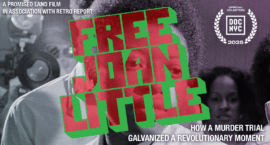
A new documentary short chronicles Little’s groundbreaking case—and her historic victory as the first U.S. woman acquitted for using deadly force to resist sexual assault.
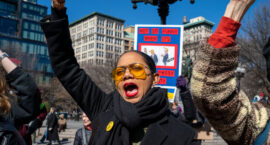
When I saw the headline “Did Women Ruin the Workplace? And if So, Can Conservative Feminism Fix It?” in The New York Times Opinion section, my heart sank. It felt like a headline torn from another era—a provocation that had no place in 2025.
False accusations remain extremely rare—estimated at between 2 percent and 8 percent of reports—while roughly two-thirds of sexual assaults are never reported at all. The crisis is sexual violence, not accountability.
Yet, for centuries, women have been labeled “emotional” or “petty” to justify their exclusion from leadership and public life. Hearing these stereotypes revived in 2025—in The New York Times, no less—is disheartening. At a time when reproductive rights are being stripped away and women’s autonomy is under attack, we don’t need pseudo-intellectual nostalgia for patriarchy disguised as debate. We need truth, solidarity and progress.
The message from the writers is clear: Women should know their place. But women already do—it’s everywhere decisions are made, everywhere power is exercised, everywhere the future is being built. We’re not staying in our lane. We made the road. And we’re not going anywhere.