
As 2025 comes to a close, we’re taking a moment to honor the wins—large and small—that reminded us progress is still possible. Here are a few feminist victories worth celebrating.


More Than A Magazine, A Movement

Women in sports are discriminated against in forms of sexual harassment and assault, unequal pay, and constant disrespect and objectification. But they are fighting back by speaking out about their experiences, filing lawsuits and breaking records.
As 2025 comes to a close, we’re taking a moment to honor the wins—large and small—that reminded us progress is still possible. Here are a few feminist victories worth celebrating.
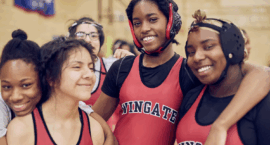
Women’s and girls’ wrestling has grown considerably in the U.S. since the late ’80s. After the sport’s debut at the 2004 Olympics in Athens, more and more girls began joining high school wrestling teams as more high schools began making teams for girls.
Although the sport carries a long history, women’s wrestling is now more popular than it’s ever been. The sport seeks to create community after being ignored for many years, and will be featured at the 2028 Olympic Games in Los Angeles. It will be in that moment in Los Angeles, under the Olympic flame, that women’s and girls’ wrestling will close the chapter of its trailblazing journey and launch into a modern era.
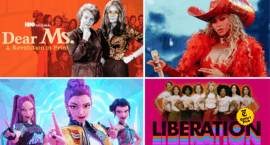
Another year of feminist struggles, another year of feminist triumphs. Our pop culture pushed back and provided many glimpses into feminist resistance throughout the culture.
This year’s top feminist moments reveal how artists, storytellers and creators confronted regressive politics with imagination, joy, righteous anger and expansive visions of humanity.
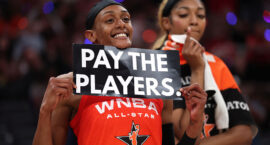
There’s a long history of women in sport fighting for equal pay, and what’s happening with the WNBA today is less of a mirror of the current gender pay gap and more of a throwback to a time when women’s efforts were even more deeply devalued. The WNBA is a visible legacy of Title IX, and an indication of how far there is left to go.
These are women at a pinnacle of professional achievement, who are still beholden to structural barriers. This is not a sports issue. It is a feminist issue.
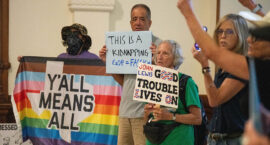
In every issue of Ms., we track research on our progress in the fight for equality, catalogue can’t-miss quotes from feminist voices and keep tabs on the feminist movement’s many milestones. We’re Keeping Score online, too—in this biweekly roundup.
This week:
—“I am deeply alarmed by news reports that Costco is refusing to sell safe, effective, and legal medication for no other reason than to appease the politics of antiabortion fanatics,” said Sen. Patty Murray (D-Wash.).
—The Democratic Legislative Campaign Committee called for Democrat-led state legislatures to pursue redistricting: “The DLCC refuses to allow Republicans to rig the maps to keep themselves in power.”
—“A troubling shift is underway: Women are leaving the U.S. workforce in unprecedented numbers. But this isn’t a choice; it’s a consequence,” warned Catalyst president and CEO Jennifer McCollum after a report showed 212,000 women have left the workforce since January.
—A third of college students have missed class because of their period.
—The Trump administration is planning to restrict coverage of abortion care for veterans in almost all circumstances.
—RFK Jr. takes aim at antidepressant use during pregnancy, despite American College of Obstetricians and Gynecologists’ approving of their usage.
—Texas’ abortion ban has made miscarriages more dangerous.
—A federal court blocked the Trump administration’s restrictions on grants from the Office on Violence Against Women. Seventeen states had challenged the restrictions, and the order is a temporary win for organizations supporting survivors of domestic and sexual violence.
… and more.
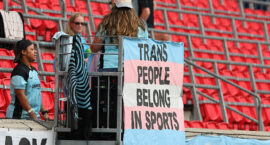
Laws, rules or regulations ban trans athletes from competing in sports consistent with their gender identity in 29 states, with 21 beginning the ban in kindergarten. The majority-conservative Supreme Court announced last month it’ll be taking on the question of the constitutionality of the bans. Meanwhile, the federal government is pressuring states without bans to change their policies in compliance with a Trump executive order that attempts to institute a nationwide ban.
These bans have been successful in part because of a toxic and ruthless ecosystem of far-right influencers, like Riley Gaines, who have formed entire careers around attacking trans athletes by prioritizing hate and misinformation.
“It can be really difficult when [trans athletes] feel like they’re doing everything right … and they still don’t belong.”

Members of the Democratic Women’s Caucus are pushing Congress for explicit Title IX protections for women student-athletes in a proposed national law related to name, image and likeness (NIL)—and long-time gender equity advocates hope they succeed.
Four years into student-athletes being able to capitalize on their NIL, 32 states have enacted their own laws. Now, there is a proposed bill before Congress, the Student Compensation and Opportunity Through Rights and Endorsements (SCORE) Act, which is designed to establish a national framework for collegiate athlete compensation, particularly as it pertains to NIL.
Something the SCORE Act doesn’t take into consideration is Title IX and gender equity. Earlier this year, the Department of Education Office of Civil Rights rescinded guidance put in place by the Biden administration, noting it was “overly burdensome” and effectively stating that Title IX, an educational statute that prohibits discrimination based on gender at any institution receiving federal funds, is inapplicable to NIL.
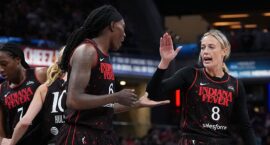
The latest headline to make me question reality: green dildos thrown on the court during WNBA games.
Yes, that happened. And no, it’s not harmless.
When they can’t match our talent, they reach for props. When they can’t silence us, they try to embarrass us.
In an era when women’s rights are being stripped away—when reproductive freedom, bodily autonomy and basic equality are under siege—this is not the moment to shrug off “pranks” aimed squarely at women. We are already fighting to keep our resilience and focus intact. We cannot pretend that degrading women in the public eye—particularly women who have achieved power, visibility and influence—is just part of the game. It isn’t. It’s misogyny with a juvenile laugh track.
In every issue of Ms., we track research on our progress in the fight for equality, catalogue can’t-miss quotes from feminist voices and keep tabs on the feminist movement’s many milestones. We’re Keeping Score online, too—in this biweekly roundup.
This week:
—States continue to develop strategies to pass antiabortion laws.
—Texas Attorney General Ken Paxton is still attempting to sue New York doctor Margaret Carpenter. New York Gov. Kathy Hochul responded, “Attorney General Paxton should focus more on his own private life instead of dictating the personal decisions of women across America.”
—Almost 300,000 Black women left the labor force in the past three months.
—Rep. Marc Veasey (D-Texas), co-chair of the Voting Rights Caucus, is leading a bill to prevent unnecessary redistricting in between censuses.
—Sens. Jeanne Shaheen (D-N.H.) and Brian Schatz (D-Hawaii) have introduced a bill preventing the unnecessary destruction of foreign aid food, medicine and medical devices.
—The Supreme Court enabled Trump to dismantle the Department of Education.
—Trans women were banned from U.S. women’s Olympic sports.
—Rep. Debbie Dingell (D-Mich.) is sharing her own history with domestic abuse as part of her advocacy to support survivors: “For me, it’s just about trying to keep other people from having to go through what we did and for mothers and fathers—there are men that are victims too—to know that there are resources.”
—Chef José Andrés details the policy changes needed to save millions in Gaza from starvation: “A starving human being needs food today, not tomorrow.”
—Under a quarter of Americans can name a female historical figure, and only 6 percent of monuments honor women.
—South African runner Caster Semenya won her case at the European Court of Human Rights.
—After bipartisan criticism in Congress, the Trump administration will release $1.3 billion for after-school programs that has been withheld from states.
—A Kentucky appeals court agreed that Jewish woman Jessica Kalb may continue her suit against the state’s strict abortion ban, which violates her religious beliefs.
… and more.
I’m tired. Maybe you are too.
I’ve been fighting for gender equality for over two decades—pushing against outdated norms, challenging industries that resist change and speaking up in rooms where I wasn’t always welcome. And while I’ve seen progress, the setbacks have a way of draining your spirit.
But last week, I felt a shift in my energy.
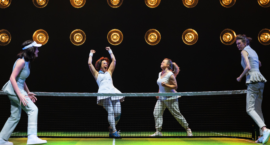
I saw Billie Jean, the new play about Billie Jean King, at the Chicago Shakespeare Theater. And just like that, something inside me reignited.
I’m writing thisn ot to share a story about a play, but to share a truth about persistence. The path to equality is long, winding and punishing. But it is also worth every step.