Two Mass Shootings, Two Countries—and Two Very Different Responses

On Dec. 14, 2025, two tragedies unfolded on opposite sides of the world—each marked by gun violence and grief, yet met with starkly different national responses.

On the first night of Hanukkah, a gathering on Bondi Beach in Sydney, turned into horror when a father and son opened fire during a “Hanukkah by the Sea” celebration, killing 15 people and wounding 40 in what Australian authorities called an antisemitic terrorist attack. 

The day before in Providence, R.I., a shooter opened fire at Brown University during finals, killing two students and wounding nine.

These shootings—one at a beloved public beach, the other on an Ivy League campus—expose not only shared grief but radically different understandings of responsibility.

She Was an Antiabortion Poster Child. Now She’s a Reproductive Freedom Activist.

At the age of 15, Charlotte Isenberg took to social media to process complicated feelings about a miscarriage after alleged sexual abuse. That was what first brought her to the attention of antiabortion groups.

“Almost immediately, anti-abortion actors threaded a narrative for me between my grief, my miscarriage and anti-abortion sentiment. I clung to it with desperation,” Isenberg wrote.

Feeling isolated from peers due to both her traumatic experiences and the COVID-19 pandemic, Isenberg found a sense of belonging in these online spaces.

But in May 2024, at age 20, Isenberg says her birth control failed, and she became pregnant for the second time. The timing was devastating: She was unemployed, without stable housing or transportation, and preparing to relocate for college—the first in her family to access higher education. 

When she couldn’t find adequate support for her unplanned pregnancy, Isenberg scheduled an appointment at her local Planned Parenthood for an abortion consultation, unsure of what she would ultimately decide. Another prominent antiabortion activist, one of Isenberg’s best friends in the movement, found out about her appointment; she and other members of the group intervened aggressively.

Despite this pressure, Isenberg was able to make the decision that was best for her and her body. Since her own abortion, she’s become a reproductive freedom activist, educating others about extremist antiabortion tactics and promoting systemic protections for people navigating reproductive healthcare. 

A Feminist Historian’s Year-End Reading and Viewing Guide

As the year winds down, I find myself returning—as I always do—to the stories, performances and ideas that have shaped my teaching and thinking. Feminism’s past is never really past; it’s a living archive we carry with us, full of unresolved questions, missteps, breakthroughs and beautiful, complicated people. This year’s reading and viewing list reflects that sensibility.

Liberation forces its contemporary narrator—and its audience—to reckon with the impossible expectations we’ve placed on small groups of women in church basements.

Molly Jong-Fast’s memoir presses on the tender, maddening ties between feminist foremothers and the daughters who grew up in their shadow.

Sarah Weinman’s study of spousal rape laws exposes just how recently the law stopped treating wives’ bodies as open territory—while showing how fiercely survivors and advocates have had to push for change that should never have been controversial.

Russia Was Once a Revolutionary Feminist Motherland

Russia’s hostility to feminism today stems not from its foreignness, but from memory. A century ago, it was Russian women who lit the first sparks of revolution. On International Women’s Day in 1917, factory workers filled the streets of Petrograd demanding bread, peace and equality—an uprising that toppled the Romanovs and pulled the world into modernity. Under the Bolsheviks, women won the right to vote, divorce became accessible and abortion was legalized. For a brief, radical moment, the Soviet experiment made women’s liberation a pillar of the state.

Julia Ioffe’s book, Motherland: A Feminist History of Modern Russia, from Revolution to Autocracy, reminds us that today’s Russia rejects feminism precisely because it once knew what it could do: ignite revolutions, upend hierarchies and reimagine power itself.

One Megabill for the Megarich

The Trump administration is calling its new budget “the most pro-family legislation ever crafted.” But for women like Bre’Jaynae Joiner, a single mother of two in Oakland, the cuts to Medicaid and SNAP threaten her family’s very survival.

Over the next decade, more than 11 million Americans—mostly women and children—are expected to lose health coverage, while deep food assistance cuts and work requirements will push even more families into crisis. Advocates call the bill a massive transfer of wealth to the rich at the expense of the poor, a policy that will shutter rural hospitals, deny essential care and worsen maternal mortality.

As Sen. Raphael Warnock puts it plainly: “If you cut $900 billion out of Medicaid, people are going to die.”

Community Is as Important to the Fight for Democracy as Everything Else

It has been a hell of a week for gridlock in my hometown, New York City, as global leaders convene for the 80th United Nations General Assembly—where on Monday, President Donald Trump delivered an hour-long rant calling climate change a hoax and claiming to have personally ended seven wars in his first seven months in office.

It wasn’t all grievance and gloom. Monday also marked the 30th anniversary of the historic United Nations Fourth World Conference on Women in Beijing, where 189 nations adopted an ambitious “Platform for Action” to acknowledge and advance women’s rights. It was there that future Secretary of State Hillary Rodham Clinton famously pronounced “women’s rights are human rights.” For more about the anniversary, read this extraordinary report, released this week and co-authored by Contrarian contributor Jennifer Klein, “Beijing+30: A Roadmap for Women’s Rights for the Next Thirty Years.” It details the myriad ways regression on women’s freedom is also an early sign of weakened democracy and outlines critical priorities to advance women’s rights in the immediate future.

Fast Facts About Bea Feitler, the Pioneering Graphic Designer You’ve Never Heard Of

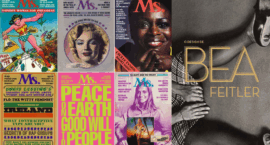
For our Summer 2025 issue, Ms. is going retro. The cover for the latest print issue is an homage to the October 1975 issue, which offered a “Special Issue on Men.” Both covers, 50 years apart, show a man in jeans and a T-shirt (the 1975 model was, no joke, Robert Redford) with a rolled-up issue of Ms. in his back pocket, honing in on the idea that women’s rights is a men’s issue too.

It’s the perfect time to remember Bea Feitler, the early Ms. art director who designed the 1975 men’s issue cover. Despite being a prominent designer (she art-directed Harper’s Bazaar and other magazines throughout the 1960s and ’70s), Feitler is largely unknown today.

In honor of her incredible legacy, which inspires Ms. staffers to this day, here are some of our favorite facts about Feitler and her remarkable life and work.

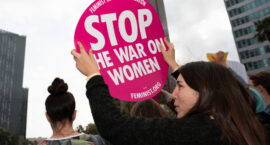
Historic Cuts to SNAP Deepen the War on Women

 Republicans in the House and Senate scrambled to pass legislation that will cut $184 billion from SNAP through 2034—by far the largest cut to SNAP in the program’s history—to finance tax cuts for the wealthy big businesses. They also hope to increase funding for pursuit of immigrants. 

This extremist budget will drive millions of people into poverty and hunger. It also represents a full-throated assault on women—particularly single mothers, for whom SNAP has been a lifeline.

Rest in Power: Étienne-Émile Baulieu, Abortion Pill Inventor and Women’s Rights Advocate 

Millions of women around the world gained safety, dignity and autonomy over their bodies thanks to Étienne-Émile Baulieu. The visionary biochemist, feminist and fearless innovator—best known for developing and championing “RU 486,” now known as mifepristone—died at his Paris home on May 30 at the age of 98.

Mifepristone has saved countless lives and offered millions of women a way to end unwanted pregnancies in the privacy and comfort of their homes. Baulieu and others championed the development of mifepristone for uses beyond abortion—including for treatment of fibroids, endometriosis, postpartum depression and cancer. He supported its use in managing miscarriages and as a way to help to dilate the cervix to reduce the need for Caesarean births. His vision for mifepristone wasn’t just to end pregnancies but to protect women’s health and reduce medical intervention that too often harmed them.

He predicted in 1991: “RU-486 will make its American entrance: science, good sense, and freedom will triumph.”

And here’s his view on why there has been tremendous opposition to abortion pills from the antiabortion movement: “A method that makes the termination of pregnancy less physically traumatic for women and less risky to their health has always been rejected by pro-lifers: What they really seek is to harm and punish women.”

Orwell’s ‘1984’ Is Now—Thanks to Trump’s Playbook of Reversal, Gaslighting and Control

Many have fallen for Trump’s lies—or don’t care about the truth. His cronies hope to acclimatize us, like a frog in warming water, to the atrocities of Trump’s authoritarian regime. If we continue down our current trajectory, I fear we are destined to become the controlled and manipulated society of Orwell’s 1984.

To think clearly, we must challenge their lies and relentlessly, loudly and clearly speak the truth. And we must invest in science, higher education, open debate and critical thinking without fear of penalty.