


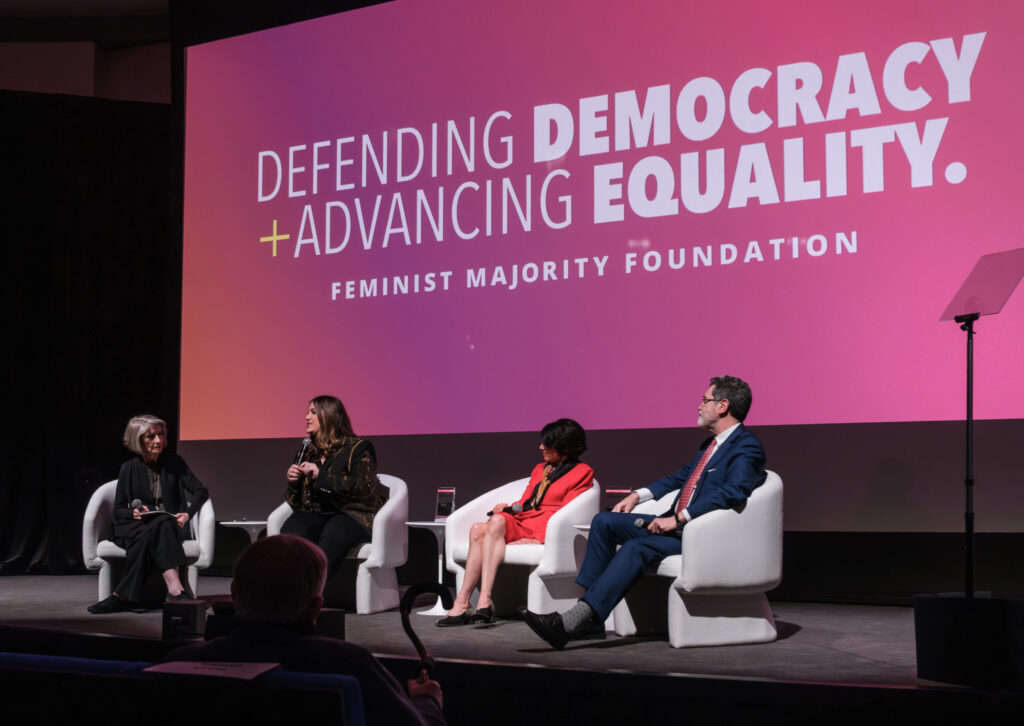
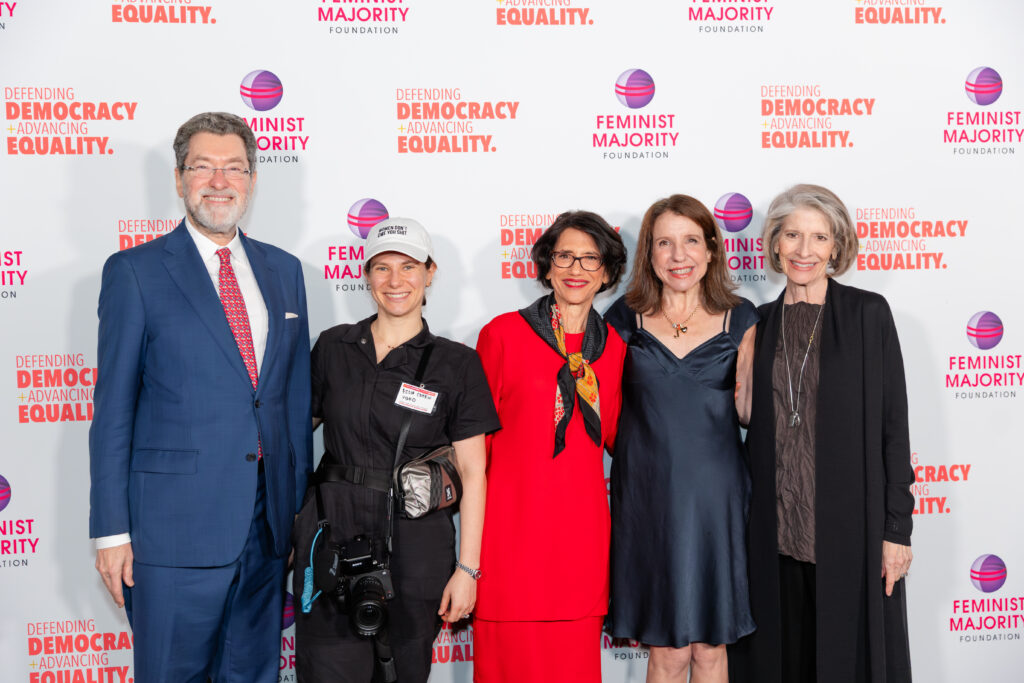
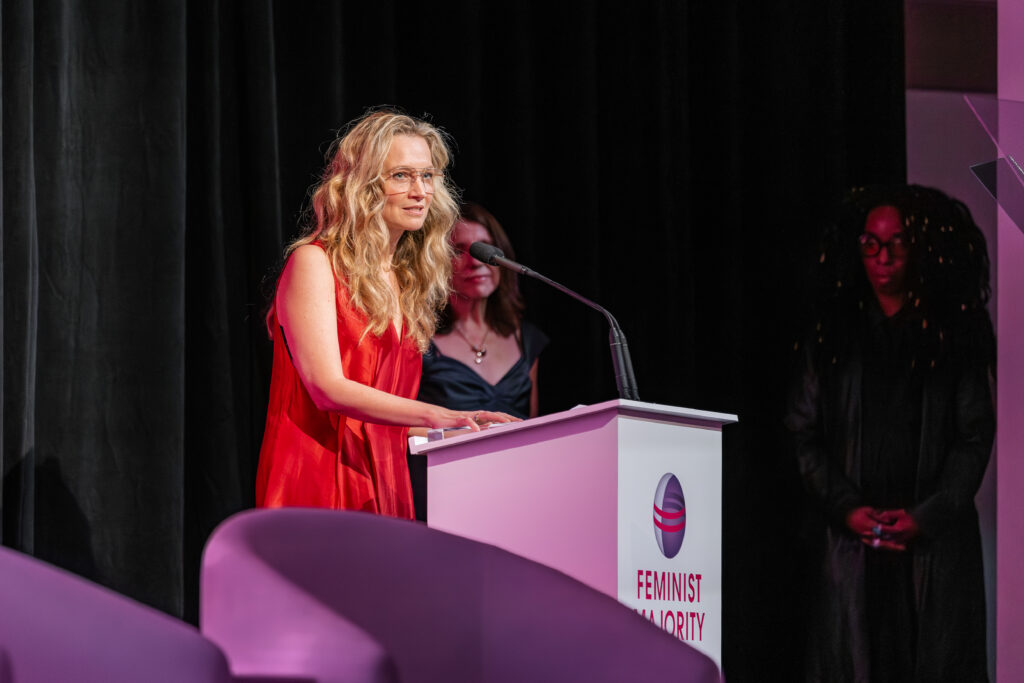
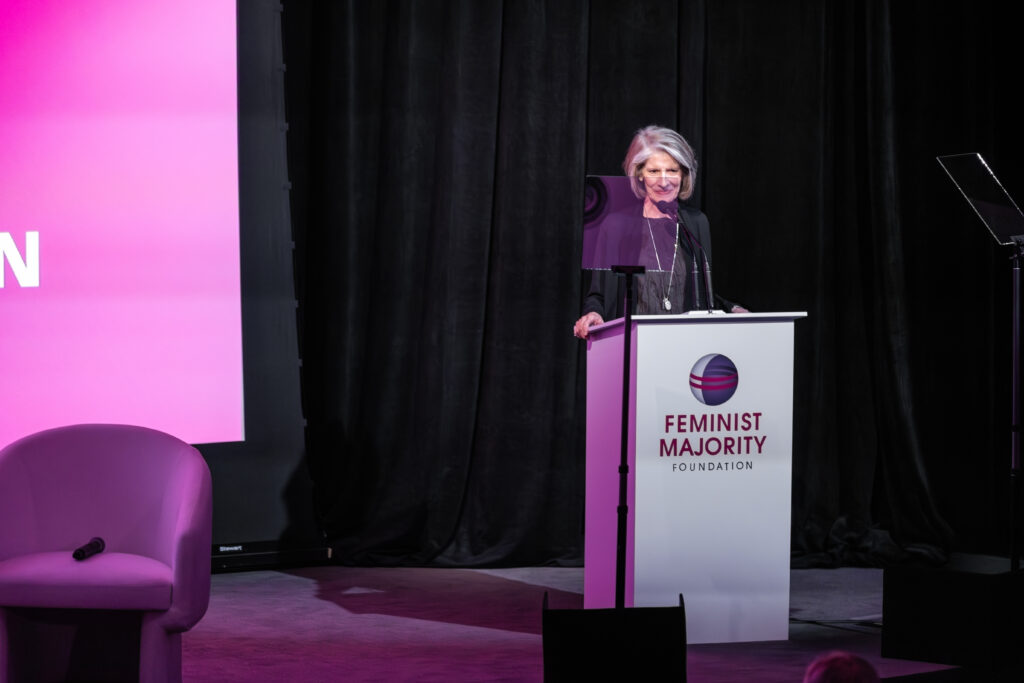
In the middle of an accelerating democratic crisis, and a year defined by sweeping attacks on women’s rights, the Feminist Majority Foundation (publisher of Ms. magazine) gathered in Los Angeles to honor some of the most formidable leaders on the front lines of resistance. At the Nov. 18 Global Women’s Rights Awards, Ms. community members, journalists, lawyers, artists, organizers, litigators, community activists and movement strategists came together to celebrate what I call the “essential trifecta” for defeating authoritarianism: the law, the press and culture.

We recognized The Contrarian’s Jennifer Rubin and Norm Eisen for building an independent media platform willing to call out authoritarianism plainly; Democracy Forward president and CEO Skye Perryman for her organization’s record-breaking wave of legal challenges against the Trump administration; and the creative team behind the Broadway hit Liberation—playwright Bess Wohl, director Whitney White, and former Ms. writer and editor Lisa Cronin Wohl—for reminding audiences that storytelling is itself a democratic act.
Against that backdrop, I sat down with Rubin, Eisen and Perryman for a candid conversation about the legal fights shaping this moment, the crisis of the American press and the magnitude of the threat facing the 2026 elections. What they told me was both sobering and galvanizing. Watch it here, or read a lightly edited version of it below.
Kathy Spillar: Congratulations to all of you, and thank you for everything you’re doing to save this democracy for women and for all people.
We’ve talked about the importance of the resistance in culture and how important that is, and in mass resistance, the mass numbers of people who are coming out and demonstrating against this administration. This conversation is going to focus more on the litigation strategy and the necessity of a truthful press operation.
Jen, the media is so severely compromised in this country by its owners capitulating, bending the knee, often to enrich themselves even further or to appease the Trump administration. That’s one of the reasons, of course, that you started The Contrarian, and it’s why you’re getting this award.
What needs to happen to correct the media’s fealty to Trump, and is it even possible to right this ship?
Jennifer Rubin: Well, first of all, I am so thrilled to be here and so honored to be amongst the company that I am. It is an honor every day to get up to fight the good fight, and evenings like this are important to celebrate the work of great warriors, like Skye and Norm, who I have the pleasure of working with every day.
The legacy media—and I don’t call them mainstream, because I don’t know what mainstream is when fascism is at one end and democracy is at the other. Are you fascistic every other day? Are you somewhat fascistic? So, I don’t call it the mainstream media. But they failed in a couple ways.
One is the way that you pointed out, which is ethically, financially, compromising themselves by changing their editorial policy, by giving him money, which is an abomination for an independent media outlet, and for pulling their punches. They are afraid of him. They have business interests that they want to succeed, and in some cases, for example, The Washington Post, those business interests far exceed, in terms of financial power, that of The Washington Post. So, The Washington Post becomes an adjunct, becomes almost like the public relations outlet for Amazon and for his space ventures and now for an AI company. They keep multiplying.
So, that is one problem, but the other problem is an intellectual problem. Prior to Trump, the press could look at the political landscape and say we have two pro-democracy policies and pro-democracy parties. They have differences of policy, but they operate, generally, within the same balanced effects, generally, with a love of country and a love of democracy, and therefore, they could play it down the middle. The Republicans say this is the solution to healthcare, the Democrats say this is the solution. The Republicans are in favor of this war, the Democrats are not in favor of this war.
But that does not work when you have a fascist, an authoritarian, a practiced liar and conspiratorialist on one side, and that requires something different, and they simply are not intellectually, emotionally equipped to take the side of truth and democracy.
And that’s why, in large part, Norm and I started The Contrarian, because you need that. You need people who are willing to say, as we often like quoting the great Christiane Amanpour, we need to be truthful, but not neutral, and that, we think, is an essential aspect of defeating autocracy.
Are they reformable? I don’t know, but they are replaceable, and I would like to think that independent media, not just The Contrarian, but other outlets, perhaps make them better, perhaps make them think why are we losing so many subscribers to that Jen Rubin? Why are all of our people canceling? And maybe that will improve them. In an ideal world, we would have new media, old media, all pursuing the vigorous truth, and ultimately, I think it is not just the success of The Contrarian, not just the success of independent media, and of course, their survival of democracy, but the survival of a free press, without which, there is no democracy.

Spillar: Norm and Skye, would you say the legal resistance is working as a front line of defending our democracy? The victories at the district courts have been significant, even at some of the appellate courts, even by some Trump-appointed judges, but then you’ve got to deal with the Supreme Court and an administration that defies the courts. So, your take on how it’s going in the courts?
Norm Eisen: I do have to use a small portion of my time to answer to tell you how profoundly moving it is for me to come back to my hometown of Los Angeles, where I represent the city of Los Angeles pushing back against ICE and the National Guard. I know I’m not supposed to talk about the specific cases yet. Also, here working on the lawsuit, where we’re defending Prop 50 on behalf of LULAC. How meaningful it is for me to come back and participate with the Feminist Majority, with my sisters, Jen and Skye.
It’s kind of both halves of my life are up here on stage, because court of law, court of public opinion, and the two of them are such inspirations to me, and I’m so proud to be a part of a woman-led litigation movement and a woman-led journalism movement.
Now, there is no question that the Supreme Court leaves something to be desired. There’s no doubt about that. We’ve been part of challenging moments at the court. There have been successes at the court. We were very proud, and The Contrarian supports our litigation, all profits from paid subscriptions. I’m not soliciting. Support the Feminist Majority and Ms. magazine tonight, but I will say all profits from paid subscriptions to The Contrarian do support the litigation.
Spillar: Well, you said you were going to start a Ms. Litigation Network.
Norm Eisen: Yes, we’re going to partner together on litigation.
We have been very outspoken at The Contrarian in talking about the failures of the Supreme Court, but we have had successes, as well. I was very proud to represent our wonderful Fed Governor, Lisa Cook. We had success at the Supreme Court in that case.
Sometimes, and Skye will say more, we’ve had challenges—like in the birthright citizenship case. I filed a birthright citizenship case, got a preliminary injunction with the Democracy Defenders Fund on day one of the administration. Supreme Court said no, no nationwide injunctions, but you can bring a class action. Two hours later, we filed that class action. We had the injunction 10 days later.
We’re back at the Supreme Court, and you know what? We’re going to win.
So, yes, they’re terrible, but we’re strong, and we’re better.
Spillar: Skye, it’s hard to miss the fact that a lot of your cases are going after some of the regulations of this administration, the actions of this administration that are disproportionately hurting women and girls, and I will also say that the majority of your litigation team are women, in a profession still dominated by men, and I think it’s probably no coincidence that you’re litigating for women’s rights as you are promoting women’s opportunities in the profession.
Why are you so focused on women’s rights?
Skye Perryman: We know there is a link between the ability of women and girls to thrive, and the ability of societies to thrive. You can see that link throughout history. You can see that link throughout the world, and we see it here today.
It is no mistake that, several years ago, the Supreme Court took away rights from women and girls. The people sitting here today, the volunteers that you have here today that ushered you through this auditorium, have less rights than I did and than my best friend did, who is here with me today, when we were in high school. They have less rights.
So, it’s no mistake that, then, several years later, you’re seeing this, what’s happening in our democracy, where all of us right now are facing less rights, but the question of, if it’s working, is a question I think that we all need to sit with today. The courts are not going to save this country or the American people, nor is the free press, even if it was as free as it could be. What is going to take us out of where we are is the people, and the ability of people in this country to initiate litigation against their government is an incredibly powerful thing.
Think about Myra Bradwell, who, in the 1800s, sought to become a member of the bar of the state of Illinois, and she was rejected.
So, she took her case to the Supreme Court, and the Supreme Court rejected her, and in a concurring opinion, Justice Bradley said to Miss Bradwell, ‘God created you to be a wife and mother.’ The Supreme Court. Not someone engaged in civic pursuits, right? That’s what our Supreme Court said.
And yet, the fight continued. People continued to show up to court, day in and day out, to demand an accounting of their government then—and that is what we are doing now. Since inauguration, there have been more cases filed in successful court orders, that remain in place, by the way, that have not been stopped by the Supreme Court, than any other time in United States history.
We are witnessing the largest and most successful affirmative litigation effort against a president in United States history, and we are doing it while powerful institutions have decided to sit on the sidelines, and so, my answer to is it working, is it is, but it’s not because of the lawyers.
It’s not because of the arguments that we’re making. It’s not because of the judges. It’s because of the people. The people are saying that we are still in charge, and we are going to show up in millions on the street. We’re going to show up and subscribe to new media that is accurate, and we are going to show up in court and demand an accounting.

Eisen: Oh, we’re also going to go to plays. Culture. Culture.
Spillar: Absolutely.
Eisen: The first full-time hire that we made at The Contrarian was a culture reporter from the LA Times. Meredith Blake, who is a fabulous, fabulous addition.
Spillar: Jen, what does the media get wrong about the coverage of the corruption of this administration and those surrounding him, including the Epstein files?
Rubin: Well, one thing they get very wrong, or they omit, is: It’s not a case that Trump is simply taking for himself. He is taking *from* everyone else, for himself.
In the big, ugly bill, we saw he was literally taking healthcare and SNAP and other benefits away from people in order to give billionaires tax cuts. It is a decision that he is serving himself and his cronies at the expense of all of us. Too often, the legacy media does not make that connection. They’re getting ahead. They’re exploiting the opportunities.
And what about you, your average American? When they are engaged in insider trading, when they are engaged in crypto scams, when they are suspending enforcement of white-collar crimes, the rest of us suffer.
When they shut down the Consumer Financial Protection Agency, the rest of us suffer. So, they don’t connect that to the average person. So, the average person simply says, well, all politicians are crooks, and he’s just getting rich. No, he’s stealing from you, the taxpayer, the American person. It is also the case that the worst corruption that we have seen, and we have seen it in the Epstein Files, is the corruption of our legal system. And when you bring spurious lawsuits against your enemies, when you pardon the January 6 insurrectionists, who murdered and maimed police officers, when you pardon the guy who made millions for you as a crypto scam artist…
I can go on and on. When you are doing those things, you are knocking down the pillars of democracy. Democracy cannot function without a rule of law in which everyone is expected to follow the law, and of course, our lovely Supreme Court seemed to believe that King George was right after all, and presidents should be above the law. That’s a different problem, but I think the effort to draw a through line…and in fact, spoiler alert, tomorrow, my piece for The Contrarian will be about that. The through line is corruption, and that whether it’s taking from one group to reward his oil and gas buddies with special breaks or it’s knocking down the East Wing of the White House to solicit millions from his pals, who, in turn, will then support him.
Or it is withholding vital information so that the thousand or so victims of Epstein and Maxwell will finally have some justice, and oh, by the way, expose why there has been a conspiracy of silence, why there has been, over multiple administrations, a failure to prosecute and to go after all of the people who victimized these girls and women. Then you understand the enormity of the problem, and it is a truism. Skye spoke about it. You see certain patterns. With autocracy, with fascism always comes corruption, and that is their Achilles’ heel, and by exposing it and by holding it up to the light of day, we weaken them, and ultimately, we will bring them down.
We are witnessing the largest and most successful affirmative litigation effort against a president in United States history, and we are doing it while powerful institutions have decided to sit on the sidelines …
Skye Perryman

Spillar: Speaking of elements of rising autocracy and what contributes to it, New York Times recently did a piece about the 12 markers of democratic erosion and the slide to autocracy. We’ve talked about several of them tonight already.
The last two markers, the Times listed, the threat to use military for domestic control and manipulating the law to stay in power, are on everyone’s mind as we head into the all-important 2026 elections, because we know that if Democrats can take control of the House and maybe even the Senate, it’ll stall Trump’s agenda and lead to oversight proceedings and investigations and possibly even another round of impeachments against him or some of his—
Eisen: I’m rested and ready.
The number one tool that autocratic actors use to try to consolidate power and take away power from the people, is to convince people that they have no power. Their toolbox is one of isolation. They want you to feel alone.
Skye Perryman
Spillar: This is a question that I’d like all of you to help us understand tonight. What is the magnitude of the threat to the 2026 elections, and how could it be stopped, and what can we do?
Eisen: The threat is significant.
It can be stopped by, as we’re doing now on Prop 50, by using the court of law. We also were very proud, at the Democracy Defenders Fund, to represent those brave Texas legislators who fled to Chicago, and they made that issue a national issue. So, you can fight in court. We were in court in 2025 in New Jersey, Pennsylvania, Virginia, California. We had a team in New York City just in case. So, I think if you fight in the court of law, meet Trump’s flood the zone with rule of law, shock and awe, you can do better.
That’s why you need our democracy coalition that’s litigating, but also talking to the people about it in the court of public opinion.
I wish the New York Times would run a story on all the signs of democratic pushback—the six Ps: protests, proceedings in court, progress in and at the polls, press awareness, political leadership and policies that work for the American people, because we are seeing progress in all six of those dimensions. That’s what I think.
Perryman: And I’ll just add that the number one tool that autocratic actors use is not actually election denialism. It’s not voter suppression. It’s not redistricting. Those are massive tools that they are seeking to use, and we’re going to defeat those tools in the courts and in the streets and at the ballot box—
But the number one tool that autocratic actors use to try to consolidate power and take away power from the people, is to convince people that they have no power. Their toolbox is one of isolation. They want you to feel alone. They want you to feel that there is nothing that you can do.
Don’t go file a case, because the Supreme Court’s going to overturn you anyway.
Don’t go vote, because you’re in a gerrymandered district.
Don’t go show up and write something for the paper because people don’t even subscribe to that anyway, or if they do, they’re going to question what you’re doing.
Those types of narratives, that we hear, by the way, from our friends, but that we also hear from autocratic actors. That is the seed of the destruction of democracy and of the chance to build a brighter future.
What we have to do tonight is recommit that we are going to defy isolation. We’re going to build some community with people that we know, and maybe with people that we don’t know. We’re going to silence the voices in our heads that say, maybe this case isn’t worth it, maybe this action isn’t worth it. I don’t know if people are going to care.
We have to silence those voices and listen to the voices of people who need us now, of people who need us in the future, and of people who have come before us, including some of the people we stand on the shoulders of here, who are in this room tonight, that said it doesn’t matter how big the obstacle is, how high the mountain is. We are going to climb it, and we we’re going to climb it together.
When they are engaged in insider trading, when they are engaged in crypto scams, when they are suspending enforcement of white-collar crimes, the rest of us suffer.
Jennifer Rubin
Spillar: I’ve been thinking and talking to people lately about how, even as we’re fighting back and bolstering the resistance in every way that we possibly can, we’ve got to start thinking about how we rebuild this democracy and what it’s going to take—not only to right the ship, but do it better this time, so that we’re all included.
I wanted to ask each of you, do you think we can rebuild, and what do you think is the most critical element we’ve got to be sure is in the rebuilding?
Rubin: I absolutely think we can rebuild, and I think the fundamental architecture has to be community.
When you see people in Chicago who are coming to the aid of their undocumented neighbors, when you see individuals supporting independent media, supporting litigation, then you realize that the community is, at the core, what democracy is built on. Unless we reach out to our fellow Americans, stop doom-scrolling, and get out and meet our neighbors and talk to people and engage—what does the great Nancy Pelosi say? ‘Don’t agonize. Organize.’ And that is really the key, and if we come through this period of time with simply the understanding that we the people, still does mean something.
That we can put 7 million people in the street, that we can sweep national elections just a year after a devastating defeat, then the fixtures and the repairs that are needed in the courts, in law, in state government, in federal government, we can address those, so long as we build back the fabric of America, and I think we have gone a long way, farther in that regard, I think, than we may have imagined a year ago, and it was just a year ago that we were all in a puddle watching those election returns, but we’ve had the experience of some great successes, and remembering that it is always better to win than to lose, we can, I think, rebuild a community and then rebuild our democracy.
Perryman: More than rebuilding, I have confidence that we will reimagine. This country, this society has been good, sometimes, but it was not a country that was built to hold most of the people in this room. Our institutions weren’t meant to hold most of the people in this room, and they have not been consistently delivering for people, and so, in this moment of great pain and terror and agony—we’ve got to have people’s backs every single day and do the work every single day to show up. There is also a piece of this work that is about looking where we are in the face and not blinking.
This isn’t just a rapidly accelerating autocracy or a backsliding democracy that started a few years ago or at inauguration. We live in a country and in a reality that was not meant to hold us all, and so, to recommit and to reimagine what true democracy can look like.
How do we build a country that can hold all of us, where we all can pursue happiness and our pursuits? I think that is the call for this moment. T
here is a lot of tremendously inspiring work that is happening in this moment to reimagine and to put the elbow grease behind the reimagining to actually implement it, and that’s what we’re going to have to be ready to do as we emerge from the place that we’re in.
Eisen: When I was serving as the U.S. ambassador in Prague, I was adopted by the great former dissident president of the Czech Republic, Václav Havel. He took me under his wing.
He had a saying that is apropos to answer your question, Kathy. I once asked him why he spent so much time mentoring me, and he said, I do it with every American ambassador. One of the wonderful lessons he imparted to me, he would say, ‘You Americans, you’re too optimistic,’ and I said to him, ‘You’re not optimistic?’
He says, ‘I’m not optimistic, but I’m hopeful. I’m not optimistic because I don’t know if we will rise to that challenge.’
I actually think Donald Trump has peaked. If you look at his plummeting poll numbers, at the abysmal performance on Nov. 4, he lost the Epstein battle today 431 to 1, and then it rolled through the Senate. They didn’t even bother to vote in the Senate. They passed the unanimous consent. He got steamrolled. So, I think he has passed the peak of his power. That terror has been exposed now, that he is a hollow man.
But whether we have the vision that Skye talks about to live up—the story of this country is the story of two Americas, of a dual state. My law school classmate and boss in the White House, Barack Obama, speaks so eloquently of whether America can live up to the idea of America, of whether we can truly become America. I don’t think we’ll ever achieve that perfection. Whether we have the vision, and the determination and the energy to rebuild what so many things are broken, we’ll see. I am hopeful because of the extraordinary efforts, including the two women beside me, our wonderful playwright Bess, all of you, the Feminist Majority, everyone here, our hero, Dolores Huerta.
Every time I get an award in Los Angeles, Dolores is there. That inspires me to be hopeful—and how can I not be hopeful? I grew up miles from here, family hamburger stand—and now to be here, to have this opportunity with my colleagues to fight for this democracy that took my country, and my parents, as you heard, were Holocaust survivors, and when my mother was living, she loved to say the Nazis took us out of Czechoslovakia on cattle cars, and my son flew back on Air Force One. So, how can I not be hopeful, Kathy?
Spillar: Well, as imperfect and incomplete as it is, you’ve all shown extraordinary courage in defending our democracy.