Letter From the Editor: Welcome to 2026! Women Are Shaping What Comes Next.

Welcome to 2026!

Here at Ms., we’re looking forward to the new year, and are prepared for the battles that are in store for us, from Capitol Hill and the Supreme Court to statehouses and ballot boxes, workplaces and classrooms and in our day-to-day lives.

And if 2025 taught us anything, it’s that women will play a decisive role in the outcomes of these decisions—whether in their roles as lawmakers on Capitol Hill, in statehouses and mayors’ offices across the country; in media and in newsrooms; or as a powerful voting block.

As we enter this new year, with so much at stake, know that you can depend on Ms. to keep providing the thoughtful feminist reporting and analysis you count on to stay informed—and ready to fight back.

Here’s to another year of reporting, rebelling and truth-telling. We’re so glad you’re with us!

It’s Been a Hell of a Year for Feminists

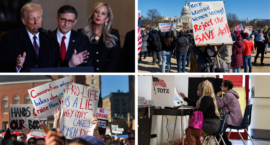
Since Trump’s inauguration in January, we’ve seen a barrage of attacks on the rights of women, immigrants and undocumented people, people of color and LGBTQ+ people. The cruelty that the administration has shown has been astounding to witness.

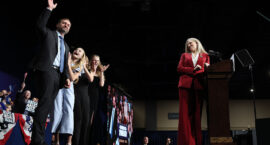
But the resistance to this cruelty has been just as astounding. Millions taking to the streets, again and again. Neighbors stepping in and preventing ICE from kidnapping neighbors they may not even know. Democracy defenders taking to the courts, fighting the onslaught of unconstitutional executive actions. Courageous networks of doctors, nurses, midwives and regular people distributing abortion pills into red states and ensuring women have access to safe abortion no matter where they live. And of course, the major feminist victories in November’s elections—in which women made a decisive difference for our democracy. 

The Best and Worst Quotes of 2025, By and About Women

A collection of this year’s most inspiring and infuriating things said by and about women. Some quotes hit like a shot, others a palate cleanser. Here they are in alternating fashion. 

“Let me just tell you, you are an obnoxious—a terrible, actually a terrible reporter.”

“Yes, this work will break your heart. Some days, it will exhaust you, and still, you must continue, because here’s what the research ultimately shows: When younger people lead, democracy doesn’t just survive, it thrives.”

“We are initiated into a sisterhood. We’re in a sorority that none of us asked to join, but we all stand here today, stronger together, because our collective voice is powerful.” 

What 200 Gen Z Women Told Me About Birth Control Should Alarm Every Woman in America

Birth control is the single most powerful tool for women’s economic mobility and autonomy in modern history. It changed everything: When women could plan if, when and with whom they wanted to have children, college enrollment soared, dropout rates fell and poverty rates declined. The ability to access contraception has been directly tied to women’s ability to stay in school, build careers and make decisions about their own futures.

So why, in 2025, are we finding ourselves in a messaging war on birth control?

Trump’s Anti-Diversity Crusade Claims Two Campus Magazines

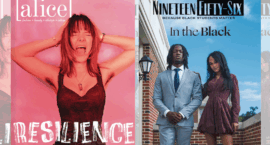
I recently discovered two glossy magazines published by and for young people: Alice, which focuses on fashion, beauty, personal health, wellness and lifestyle; and Nineteen Fifty-Six, which brings a Black cultural lens to coverage of news, style and the arts.

Both are student-run publications housed at the University of Alabama. And on any other day, they would make one think the future of journalism look very bright indeed. Except that the sole reason I found these magazines at all is because they are now officially suspended. Last week, campus officials announced their permanent shuttering. Yet another casualty of the Trump administration’s attacks on free speech and public higher education—all in the name of stamping out supposed diversity, equity and inclusion.

‘Ms. Does Not Flinch’: Why Independent Feminist Journalism Matters

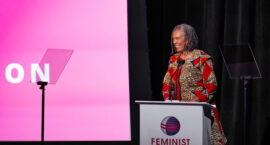
Bonnie Thornton Dill on the enduring power of Ms. magazine:

“Opening minds and eyes is what Ms. is about, and there has been no time when Ms. is more needed than it is today. …

“While major media outlets rarely, if ever, report on violence to abortion clinics and abortion providers … Ms. keeps a constant tab and a laser focus on that sort of violence, including how the deadly violence that targeted lawmakers in Minnesota was the result of antiabortion extremism. …

And what national media outlet is tracking the administration’s attacks on women and gender studies programs?”

A Feminist Historian’s Year-End Reading and Viewing Guide

As the year winds down, I find myself returning—as I always do—to the stories, performances and ideas that have shaped my teaching and thinking. Feminism’s past is never really past; it’s a living archive we carry with us, full of unresolved questions, missteps, breakthroughs and beautiful, complicated people. This year’s reading and viewing list reflects that sensibility.

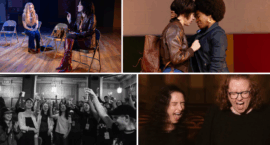
Liberation forces its contemporary narrator—and its audience—to reckon with the impossible expectations we’ve placed on small groups of women in church basements.

Molly Jong-Fast’s memoir presses on the tender, maddening ties between feminist foremothers and the daughters who grew up in their shadow.

Sarah Weinman’s study of spousal rape laws exposes just how recently the law stopped treating wives’ bodies as open territory—while showing how fiercely survivors and advocates have had to push for change that should never have been controversial.

The Ms. Q&A With Democracy Defenders Norm Eisen, Skye Perryman and Jennifer Rubin

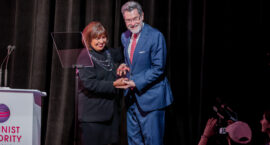
In the middle of an accelerating democratic crisis, and a year defined by sweeping attacks on women’s rights, the Feminist Majority Foundation, publisher of Ms. magazine, gathered in Los Angeles to honor some of the most formidable leaders on the front lines of resistance. At the Nov. 18 Global Women’s Rights Awards, journalists, lawyers, artists, organizers, litigators, community activists and movement strategists came together to celebrate what I call the “essential trifecta” for defeating authoritarianism: the law, the press and culture.

We recognized The Contrarian’s Jennifer Rubin and Norm Eisen for building an independent media platform willing to call out authoritarianism plainly; Democracy Forward president and CEO Skye Perryman for her organization’s record-breaking wave of legal challenges against the Trump administration; and the creative team behind the Broadway hit Liberation—playwright Bess Wohl, director Whitney White, and former Ms. writer and editor Lisa Cronin Wohl—for reminding audiences that storytelling is itself a democratic act.

“The number one tool that autocratic actors use to try to consolidate power and take away power from the people, is to convince people that they have no power,” said Perryman. “Their toolbox is one of isolation. They want you to feel alone.”

“I grew up miles from here, family hamburger stand,” said Eisen, “and now to be here, to have this opportunity with my colleagues to fight for this democracy that took my country, and my parents. … When my mother was living, she loved to say the Nazis took us out of Czechoslovakia on cattle cars, and my son flew back on Air Force One. So, how can I not be hopeful?”