Complying With Trump Administration’s Attack on DEI Could Get Employers Into Legal Trouble

Since the Trump administration made diversity, equality and inclusion “immoral” and “illegal,” a large part of workplace discrimination in the country still remains to be experienced by women and members of racial minority groups. Now, these groups have less of a platform to make complaints about such discrimination.

Tools of the Patriarchy: How Communication Double Standards Silence Women

“Sorry, but—”

I paused as the words flew from my mouth, forming an apology before I could even consider why I felt the need to begin my confrontation with one. A moment earlier, my friend had interrupted me during a heated debate, and I wanted to finish making the point I had been in the middle of.

“No worries, it’s all good,” he said with a smile, continuing with his argument. I sat stunned by how in a matter of seconds, I had been interrupted, then enabled to apologize for trying to address the interruption—all with the end result of my friend getting to speak over me.

These types of interactions happen to women all the time. Compulsive apologies, interruptions, mansplaining and emotional weaponization are all barriers that get in the way of women getting their point across, and being heard.

Communicating is already complicated enough, but it is even more difficult as a woman—so let’s talk about it.

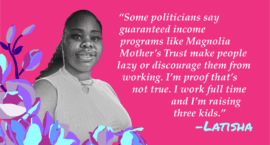
My Paycheck Covers Rent, Lights and Food. Guaranteed Income Helps Me Dream Bigger.

Front & Center amplifies the voices of Black women navigating poverty—highlighting their struggles, resilience and dreams as they care for their families, build careers and challenge systems not built for their success. Now in its fourth year, Front & Center is a collaboration between Ms. and Springboard to Opportunities, a nonprofit based in Jackson, Miss., working alongside residents of federally subsidized housing as they pursue their goals.

In Jackson, Miss., Latisha juggles full-time work, parenting and rising costs—while a guaranteed income program gives her the breathing room to plan for the future.

“Affordable childcare is [a] big barrier. Right now there aren’t even openings for state childcare vouchers, and when there are, the hoops to qualify … keep a lot of working parents from getting help they really need. …

“If I could tell Congress one thing, it would be this: Don’t cut benefits like SNAP or childcare. Make them stronger, because they fill the gap for working families. In jobs like mine—essential jobs serving food and keeping businesses going—the paychecks often aren’t enough to cover the most basic needs of childcare, food and rent. These programs are a safety net when hours get cut or expenses spike.

“These days, I’m finding joy at home. The money from the Trust has allowed me to scale back my hours a little, which means I can rest and be more present with my kids. Having that time and energy back makes a difference in how I show up for them—and for myself.”

Trump’s Pronatalist Agenda Weaponizes Motherhood to Push Women Out of Public Life

The Trump administration is using one of the oldest tools of patriarchy—promising rewards for compliance—through a wave of proposed pronatalist policies designed to push women into motherhood and encourage them to give birth to more children.

A recent report by the National Women’s Law Center warns that these proposals are not random: They stem from an “obscure, dangerous, and increasingly influential movement of ‘pronatalists’” that are now dictating the Trump administration’s family policy. 

According to NWLC, there are two major groups of pronatalists: Silicon Valley tech elites, such as Elon Musk, who claim that “high-IQ” people like themselves should be having more children; and traditional conservatives, who advocate for pushing women back into stay-at-home motherhood.

Keeping Score: Democrats Fight Republican Redistricting; Periods Make College Students Miss Class; Costco Refuses to Sell (Safe, Legal) Abortion Pills to Appease Antiabortion Politics

In every issue of Ms., we track research on our progress in the fight for equality, catalogue can’t-miss quotes from feminist voices and keep tabs on the feminist movement’s many milestones. We’re Keeping Score online, too—in this biweekly roundup.

This week:
—“I am deeply alarmed by news reports that Costco is refusing to sell safe, effective, and legal medication for no other reason than to appease the politics of antiabortion fanatics,” said Sen. Patty Murray (D-Wash.).
—The Democratic Legislative Campaign Committee called for Democrat-led state legislatures to pursue redistricting: “The DLCC refuses to allow Republicans to rig the maps to keep themselves in power.”
—“A troubling shift is underway: Women are leaving the U.S. workforce in unprecedented numbers. But this isn’t a choice; it’s a consequence,” warned Catalyst president and CEO Jennifer McCollum after a report showed 212,000 women have left the workforce since January.
—A third of college students have missed class because of their period.
—The Trump administration is planning to restrict coverage of abortion care for veterans in almost all circumstances.
—RFK Jr. takes aim at antidepressant use during pregnancy, despite American College of Obstetricians and Gynecologists’ approving of their usage.
—Texas’ abortion ban has made miscarriages more dangerous.
—A federal court blocked the Trump administration’s restrictions on grants from the Office on Violence Against Women. Seventeen states had challenged the restrictions, and the order is a temporary win for organizations supporting survivors of domestic and sexual violence. 

… and more.

Over a Million Women Are at Risk of a Pay Cut Under a New Trump Rule

The Trump administration’s Department of Labor recently proposed a new rule that would directly take earnings away from the more than 1.5 million home care workers in the United States, more than 80 percent women, and their families.

Between 2019 and 2040, the population of adults ages 65 and older is expected to balloon from 54 million people to nearly 81 million people, comprising an estimated 22 percent of the U.S. population. That means that the direct care workforce is projected to grow at a faster rate than any other occupation over the next decade.

‘Care Is Baked Into a Healthy, Functioning Economy’: Economists Lenore Palladino and Rakeen Mabud on How to Advance Economic Justice

The experts and Ms. contributors assessed the state of the U.S. care crisis and women’s economic inequality in the latest episode of the Ms. podcast Looking Back, Moving Forward—and broke down why investing in women and care workers is good policy. 

Rakeen Mabud: “We’re at a really pivotal moment and a really complicated moment. We have conservative, pronatalist voices, with more institutional power than they have ever had, at least in modern times. They are advancing an agenda of deep progressive patriarchy, whiteness—and wealth, frankly, is the third prong of that. And they are co-opting progressive policy ideas to do it.”

Lenore Palladino: “There are schools, and there are childcare centers, and there are hospitals being shut down right now. Investing in those would be a really important way to move this whole conversation forward. … Within economic policy, there’s such bifurcation. There’s tax policy over here. There’s care over here. It’s still a women’s issue.”

“Economics is still seen as a man’s game. Women actually make most financial decisions in households, but men are the ones who are seen as the experts, and our financial system is shaped around their life cycles.”

Listen to the latest episode of Looking Back, Moving Forward, “Women Can’t Afford to Wait for a Feminist Economic Future (with Premilla Nadasen, Rakeen Mabud and Lenore Palladino, Aisha Nyandoro, Gaylynn Burroughs, and Dolores Huerta)” on Spotify, Apple Podcasts or wherever you get your podcasts.


FX’s ‘The Bear’ Season 4 Embraces Feminist Leadership, Challenging Aggressive Masculinity and Reimagining the Workplace

The renowned show’s newest season is carving a new, feminist path for recognition of women-led workplaces, in spite of a history of white, male dominance.

Cultural depictions of feminist leadership, even when fictional, can help us both imagine and demand better. We need not settle for egotistical, unpredictable, manipulative leaders who focus on personal gains and grievances.

‘In Whose Interests Are We Fighting?’ What Historian Premilla Nadasen Learned About Economic Justice from the Domestic Workers’ Rights Movement

Nadasen, who teaches history at Barnard College, offered lessons from the domestic workers’ movement for the current moment in the latest episode of Looking Back, Moving Forward. “We, as feminists today, like domestic workers in the 1970s and in the early 2000s,” she told me, “need to think outside the box.”

Listen to the latest episode of Looking Back, Moving Forward, “Women Can’t Afford to Wait for a Feminist Economic Future (with Premilla Nadasen, Rakeen Mabud and Lenore Palladino, Aisha Nyandoro, Gaylynn Burroughs, and Dolores Huerta)” on Spotify, Apple Podcasts or wherever you get your podcasts.

‘If You’re Not Centering the People Who Are Most Impacted, Your Policy Solution Will Fall Apart’: Gaylynn Burroughs Is Fighting for Economic Justice at the Intersections

Burroughs, the vice president of education and workplace justice at the National Women’s Law Center, connected the dots between poverty, policy and culture change in the latest episode of the Ms. Studios podcast Looking Back, Moving Forward. “Once you start seeing these problems as being problems that policy can solve,” she told me, “a whole world opens up.”

Listen to the latest episode of Looking Back, Moving Forward, “Women Can’t Afford to Wait for a Feminist Economic Future (with Premilla Nadasen, Rakeen Mabud and Lenore Palladino, Aisha Nyandoro, Gaylynn Burroughs, and Dolores Huerta)” on Spotify, Apple Podcasts or wherever you get your podcasts.